


Compliance process optimization is the systematic improvement of how your business manages regulatory and internal processes. The goal is to reduce costs, minimize risks, and boost operational efficiency. Here’s what you need to know:
Key Benefits:
- Cost Reduction: Save 30-44% per process through automation.
- Risk Mitigation: Avoid penalties that average $14.82 million for non-compliance.
- Efficiency Gains: Free up 30% of your compliance team’s capacity for strategic work.
- Quality Improvement: Reduce human error with standardized processes.
Essential Steps:
- Assess Current State: Identify gaps and inefficiencies.
- Standardize Processes: Document and streamline workflows.
- Implement Automation: Use technology for routine tasks.
- Monitor Continuously: Track KPIs and adjust as needed.
- Foster Culture: Train staff and promote a compliance mindset.
Simple mistakes—a wrong click on a spreadsheet, a lost report, a missed policy update—happen daily and can lead to disaster. The stakes are high, with compliance costs for banks having increased by 60% since 2008.
But compliance doesn’t have to drain your resources. Smart companies are turning it from a cost center into a competitive advantage through process optimization.
Whether you’re dealing with GDPR, HIPAA, SOX, or other regulations, this guide will show you how to streamline your compliance processes, cut costs, and build a more resilient business.

Related content about compliance process optimization:
Understanding the Stakes: Why Business Process Compliance Matters
Imagine a regulatory audit reveals gaps in your compliance processes, leading to millions in fines, legal battles, and damaged customer trust. This isn’t a hypothetical scenario. Business process compliance—ensuring your operations align with external regulations and internal standards—is a make-or-break factor for modern businesses.
Think of compliance as your business’s insurance policy and competitive edge. It doesn’t just protect you from disaster; it makes your entire operation run smoother.
Risk management is at the heart of compliance. Operating outside of guidelines is a high-stakes gamble, with the average cost of non-compliance reaching a staggering $14.82 million per incident. The steep cost of non-compliance is demonstrated by Amazon’s €746 million GDPR fine in 2021, a stark reminder of the consequences.
Beyond avoiding penalties, effective compliance builds trust with customers and partners. In today’s transparent market, a strong compliance record is a key differentiator. It also drives operational excellence. Standardizing processes to meet regulatory requirements often uncovers hidden inefficiencies and improves workflow quality.
The Core Challenges in Compliance Management
Managing compliance process optimization is challenging for several reasons:
- Regulatory complexity: Regulations constantly multiply, evolve, and overlap. A large majority of chief compliance officers expect greater regulatory expectations in the coming years.
- Manual processes and human error: Relying on manual data entry and spreadsheets is like building your compliance program on quicksand. A single mistake can lead to serious violations.
- Data silos: When customer, financial, and operational data are stored in separate systems, creating a complete compliance picture for an audit becomes a massive headache.
- Resource constraints: Smaller businesses often lack dedicated compliance staff, stretching teams thin as they try to manage complex requirements.
- Evolving standards and technology: What was compliant last year might not be this year, especially with new cybersecurity threats and data privacy laws.
- Organizational resistance: Employees may resist new compliance processes, fearing they will slow down work or make their roles obsolete.
Compliance vs. Adherence: A Crucial Distinction
Many leaders confuse compliance and adherence, but both are vital for effective compliance process optimization.
| Feature | Process Compliance | Process Adherence |
|---|---|---|
| Focus | External laws, regulations, industry standards | Internal policies, procedures, best practices |
| Driver | Regulatory bodies, legal requirements | Organizational procedures, operational efficiency |
| Consequences | Legal penalties, fines, reputational damage | Inefficiencies, errors, quality issues, operational friction |
| Scope | Ensuring legal and ethical operation within external frameworks | Ensuring consistency and quality within internal operations |
| Examples | GDPR, HIPAA, SOX, environmental regulations, labor laws | Following a specific customer service script, adhering to a defined software development lifecycle, proper use of company assets |
In short, process compliance is about following external rules (like GDPR), while process adherence is about following your own internal procedures. You need both. Compliance without adherence means your policies are just for show. Adherence without compliance means you might be very efficient at doing the wrong thing.
The goal is to align internal adherence with external compliance, creating a robust system that drives efficiency and protects your business.
The Tangible Benefits of Optimized Compliance


Committing to compliance process optimization builds a stronger, more competitive business. The benefits are significant:
- Reduced costs: Automation alone can cut process costs by 30-44%. These savings can be redirected toward growth initiatives.
- Improved quality and accuracy: Standardized and automated processes dramatically reduce human error, leading to more reliable data and consistent outputs.
- Improved efficiency and productivity: Teams spend less time on tedious compliance tasks and more on strategic work that drives value.
- Protected business continuity: Robust compliance systems identify and mitigate risks before they escalate into crises, ensuring your operations can withstand challenges.
- Increased trust and reputation: Customers, investors, and partners are drawn to companies with strong ethical governance and transparent processes.
- Competitive advantage: In a tightening regulatory environment, efficient compliance processes can be a key factor in winning new business.
Compliance process optimization transforms compliance from a defensive chore into a proactive strategy that drives growth and long-term success.
A Strategic Blueprint for Compliance Process Optimization
Waiting for an audit to reveal problems is a recipe for disaster. Compliance process optimization requires a shift from reactive firefighting to proactive planning. It’s like performing regular maintenance on a car instead of waiting for a breakdown. This strategic approach transforms compliance from a burden into a competitive advantage.
This requires moving from reactive to proactive by anticipating regulatory changes and building systems that catch problems early. A clear roadmap is essential to outline objectives, set timelines, and assign ownership. The goal is to integrate compliance into daily operations, making it a natural part of every workflow, not a separate checklist.
Most importantly, this requires fostering a culture of compliance. When leadership champions this mindset, everyone in the organization understands their role in keeping the company safe and feels empowered to raise concerns. Compliance becomes something employees actively participate in.
At 1-800 Office Solutions, we understand that effective compliance requires both robust systems and engaged people. Our expertise in cybersecurity and IT services helps ensure your technology infrastructure supports your compliance goals. More info about our compliance management systems.
Key Strategies for Compliance Process Optimization
An effective compliance program combines several key strategies:
- Conduct regular risk assessments: This is the foundation. Map out all applicable regulations (GDPR, HIPAA, SOX), analyze current processes to find gaps, and prioritize risks based on their potential impact. This is an ongoing process, not a one-time check.
- Standardize and document processes: Eliminate guesswork by establishing clear, standardized procedures. This creates a single source of truth, reduces training time, and simplifies audits.
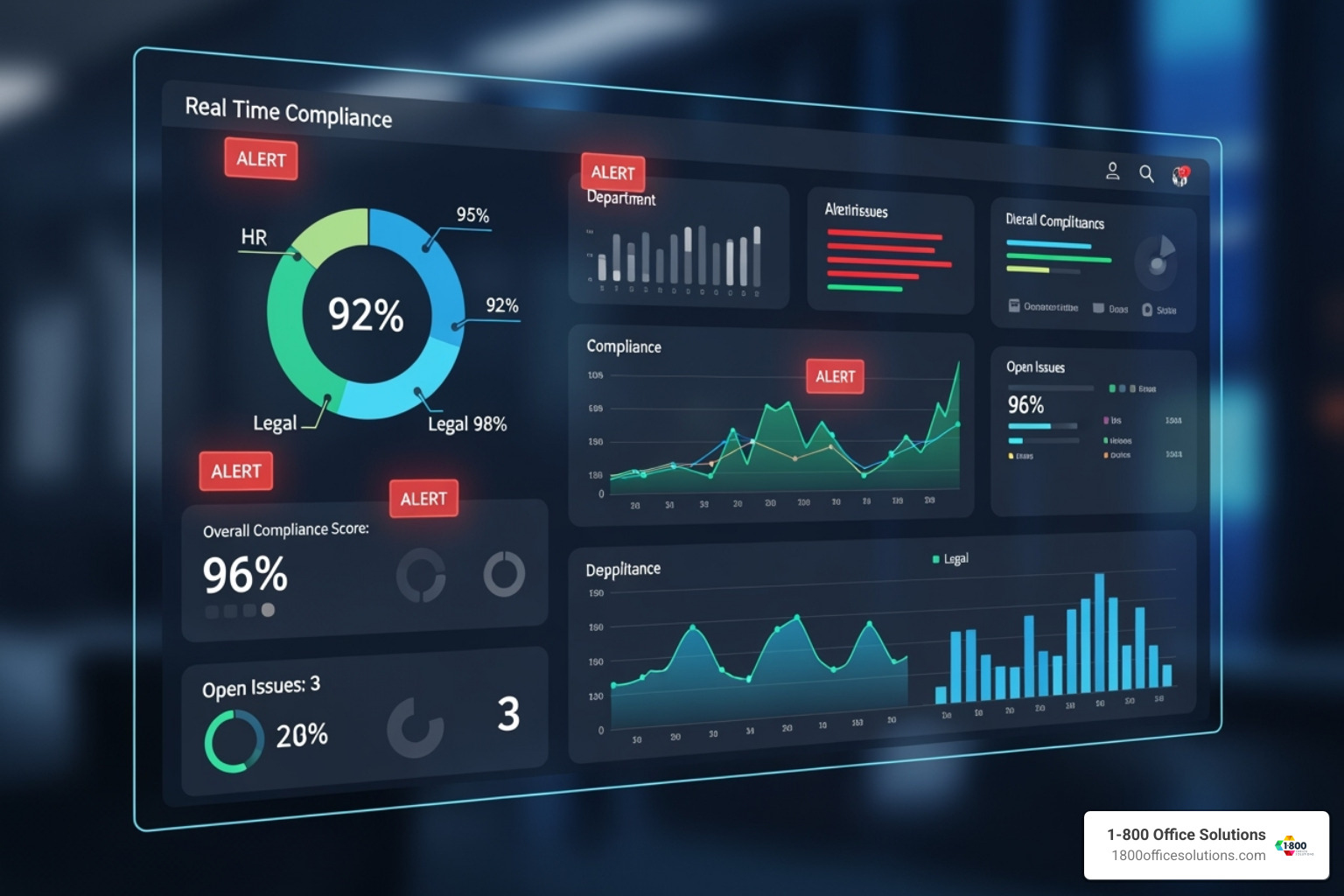
- Implement continuous monitoring: Gain real-time visibility into your compliance status with automated alerts and performance dashboards. This allows you to catch and correct small issues before they become major problems.
- Invest in comprehensive employee training: People are a critical element. Effective training explains the why behind the rules and uses modern Learning Management Systems to deliver consistent, trackable education.
- Foster a culture of compliance: This ties everything together. It means making compliance everyone’s responsibility, from leadership down. It involves modeling ethical behavior and creating safe channels for reporting concerns.
Implementing Continuous Improvement for Lasting Success
Compliance process optimization is a continuous journey, not a destination. The Plan-Do-Check-Act (PDCA) cycle is an invaluable framework for sustainable improvement.
- Plan: Identify improvement opportunities from risk assessments, audits, or feedback. Set clear, measurable objectives (e.g., reduce audit findings by 50%).
- Do: Implement the planned changes. Start with pilot programs to test new systems or policies before a full-scale rollout.
- Check: Evaluate results against your KPIs. Use internal audits and performance metrics to see what’s working.
- Act: If a change is successful, standardize and scale it. If not, analyze why, learn from the experience, and adjust your approach.
This iterative process requires establishing meaningful metrics (like incident response times or training completion rates) and fostering open communication to encourage feedback. As you learn, you can update training programs to address common mistakes and emerging risks. This systematic approach, supported by frameworks like those from McKinsey, ensures your compliance efforts become more effective over time. McKinsey outlines seven steps toward sustainable compliance that align with these principles.
Leveraging Technology and Automation to Streamline Compliance
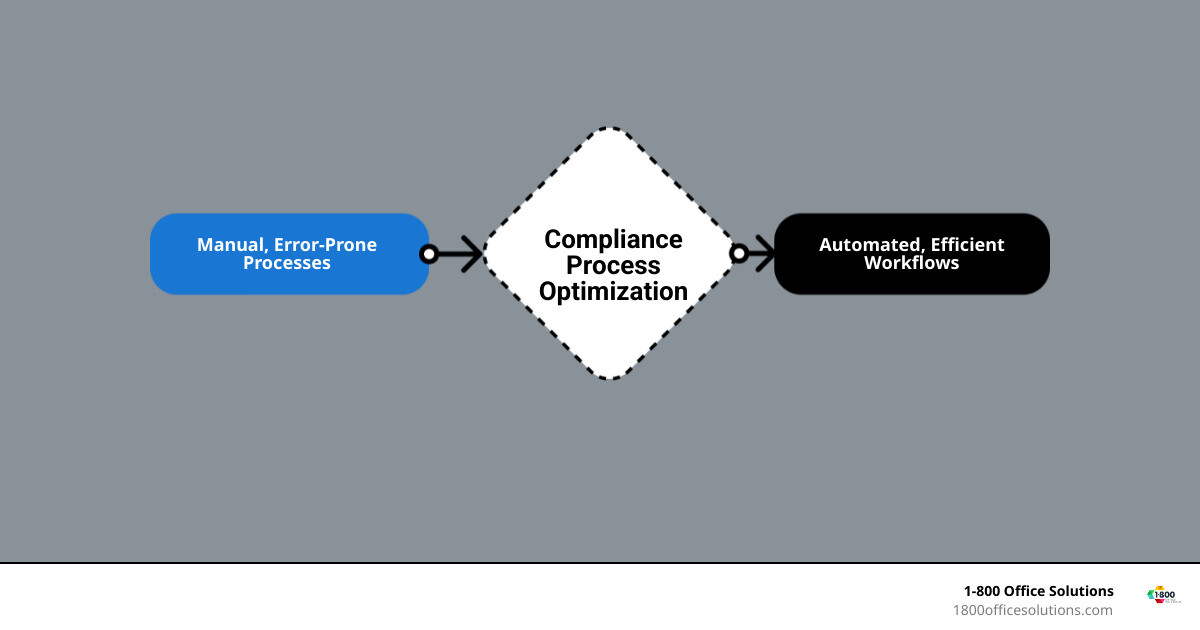
Imagine your compliance officer drowning in spreadsheets while a competitor’s team uses automation to focus on strategic risk analysis. In today’s complex environment, manual compliance processes are unsustainable—they are slow, error-prone, and costly. Technology is the game-changer for compliance process optimization.

Technology shifts compliance from a reactive burden to a proactive, strategic advantage. The evolution is from scattered spreadsheets to integrated, intelligent systems.
- Moving from spreadsheets to specialized software is a critical first step. Compliance management software offers dedicated tools for risk assessment, policy management, and incident tracking with built-in audit trails that Excel can’t match.
- Centralized platforms consolidate all compliance activities, creating a single, holistic view of your organization’s posture. This eliminates data silos and ensures consistency across all locations, from Miami to Detroit.
- Improved data management tools enable better collection, storage, and analysis of compliance information. This leads to more accurate reporting and easier audits.
Our IT services are designed to help businesses implement these solutions, ensuring your infrastructure supports your compliance goals. More info about our IT services.
The Role of Automation in Compliance Process Optimization
Automation through Robotic Process Automation (RPA), Artificial Intelligence (AI), and Machine Learning is where the real magic happens. It shifts compliance work from manual drudgery to intelligent oversight.
RPA acts as a digital assistant, automating repetitive tasks like data entry and report generation with perfect accuracy. This can lead to cost savings of 30-44% per process.
AI and Machine Learning add intelligence to automation, enabling systems to learn and make informed decisions. Key applications include:
- Automating KYC (Know Your Customer) processes: AI can rapidly verify customer information and flag suspicious activity, which is crucial for anti-money laundering (AML) efforts.
- Transaction monitoring: AI uses sophisticated pattern recognition to analyze transactions, dramatically reducing the false positives that plague manual reviews.
- Regulatory reporting: AI and Natural Language Processing (NLP) can parse complex regulations and automate the creation of compliance reports, saving countless hours.
How automation can help compliance processes provides excellent insights into these capabilities. Our managed print and document security solutions also integrate with these efforts, automatically categorizing sensitive information and tracking access to maintain an audit trail. More info about managed print and document security.
Overcoming Roadblocks to Successful Automation
Implementing automation has its challenges, but they are manageable with the right approach.
- Budget constraints: The upfront cost can seem daunting, but it’s small compared to the average non-compliance penalty of $14.82 million. Start by automating high-risk, repetitive tasks to demonstrate ROI and fund future initiatives.
- Cultural resistance and fear of job displacement: Communicate clearly that automation augments human skills, not replaces them. It frees employees from tedious tasks to focus on strategic work that requires human judgment. As McKinsey notes, Focus on people as much as technology.
- Data quality issues: Automation is only as good as the data it uses. It’s crucial to balance automation with human oversight, especially in high-risk areas. Human professionals are still needed for strategic decisions, interpreting complex rules, and handling exceptions. Regular audits of automated processes ensure accuracy and build trust in the system.
Conclusión

Stop worrying about compliance audits and the high cost of manual errors. Compliance process optimization is about more than just avoiding the $14.82 million average cost of non-compliance—it’s about building a more resilient, efficient, and trustworthy organization.
By conducting risk assessments, embracing automation, and fostering a culture of compliance, you create a ripple effect of positive change. Employees focus on strategic work, customers trust you more, and your leadership can rest easier knowing the business is protected.
The future of compliance is efficient and integrated. Smart businesses are already seeing 30-44% cost savings per process through automation, turning a traditional cost center into a competitive advantage.
At 1-800 Office Solutions, we’ve seen how the right technology foundation makes all the difference. From our secure managed print services to our comprehensive IT services, we help businesses across Florida, Michigan, Georgia, and beyond transform compliance challenges into strategic opportunities.
Your compliance journey doesn’t have to be overwhelming. Start with one process, build momentum, and create a system that supports your business goals.
Ready to take the first step? Transform your compliance strategy with a robust compliance management system and find how much easier—and more profitable—compliance can be.
What is the first step in optimizing compliance processes?
The first and most critical step is a comprehensive risk assessment. You can't fix what you don't understand. This involves identifying all applicable regulations (like GDPR, HIPAA, or SOX), analyzing your current processes to find gaps, and prioritizing risks based on their potential impact. This assessment creates a roadmap that shows where your biggest vulnerabilities are and where optimization efforts will provide the most benefit.
How can a small business afford to automate compliance?
You don't need to automate everything at once. Start with scalable, cloud-based solutions that offer subscription models instead of large upfront investments. Focus on automating the most repetitive, high-risk, and time-consuming tasks first to get the highest return. The cost savings from avoiding even a single penalty can often justify the investment, especially when the average cost of non-compliance is $14.82 million.
Does automation replace the need for compliance professionals?
No, absolutely not. Automation improves the role of compliance professionals; it doesn't replace them. Like a calculator for an accountant, automation frees compliance experts from tedious manual tasks like data entry and routine reporting. This allows them to focus on high-value strategic work, such as risk analysis, policy development, interpreting complex regulations, and handling exceptions that require human judgment. Automation amplifies their capabilities, making them more efficient and proactive.