


In the modern world, business productivity and customer satisfaction are intertwined. Efficient operational Customer Relationship Management (CRM) Systems and Enterprise Resource Planning (ERP) play an essential role in resolving this issue. While CRM systems focus on leads and clients, ERP systems take care of the backend processes, such as inventory, finance, supply chain, and HR.
These aspects are at the heart of many businesses, however, when they work in silos, companies struggle with data silos, fragmentation, lower operational efficiency, and missed opportunities. This is where CRM and ERP integration are important. Binding these two provides businesses with coherent data, smoother processes, and a better understanding of their clients. Creating real value starts when this integration is done in a bespoke way. Custom integration supports business logic by honoring your methods, helps you grow in the long term, and allows you to customize your processes.
Especially when dealing with complex environments or systems like SAP, the right partner is essential. Businesses can greatly benefit from SAP Hubris development for tailored development that requires no additional customization later on to ensure readily usable integrated systems.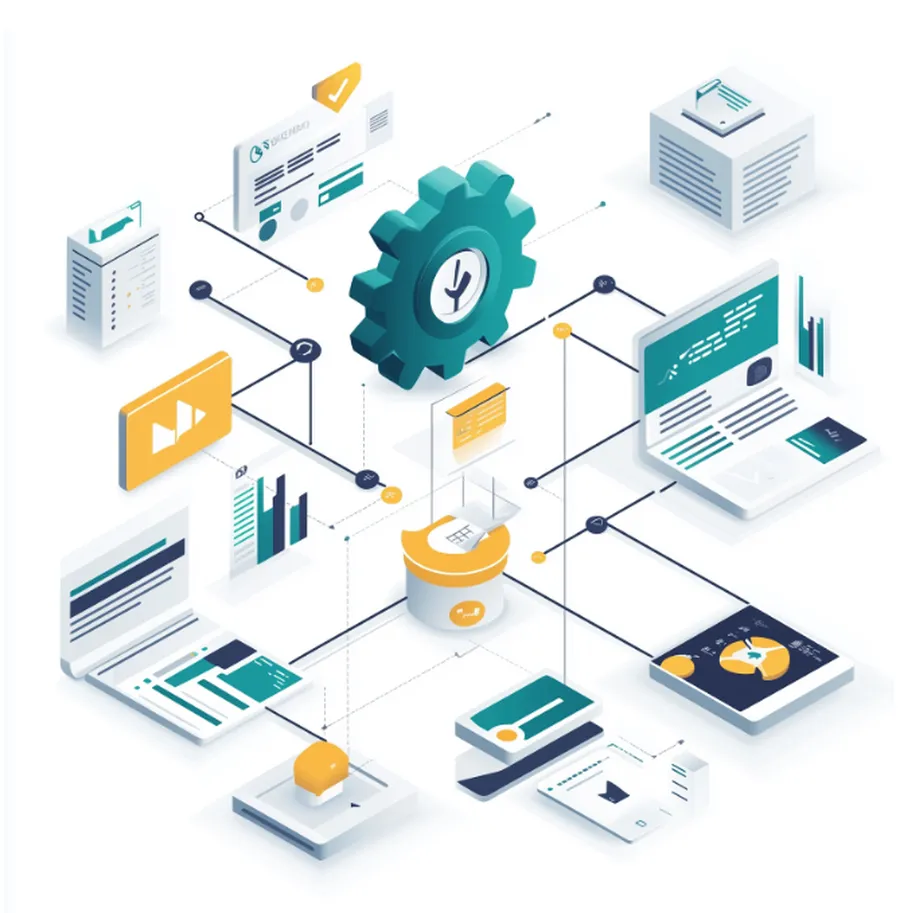

Understanding CRM and ERP Integration
In a nutshell, CRM and ERP integration is all about aligning customer management applications to the backend operational systems of an organization. This guarantees that different teams for sales, finance, marketing, and support are working on the same dataset and in real-time.The two main types of CRM ERP integration architecture are the following:
- Point-to-point integration: This represents a direct link between the CRM and ERP systems. It can be appropriate for small setups, but becomes hard to manage as complexity increases.
- Middleware-based integration: This employs a third-party service as a mediator between the systems. It is more flexible and advanced, supports sophisticated logic, and is equipped with error management and monitoring features.
When done right, the pros associated with ERP CRM integration include:
- Better data integrity: Decreasing double entries leads to fewer chances of errors.
- Improved responsiveness: Management can act more confidently knowing that they have real-time access to synchronized data.
- Better service delivery: Customer information such as orders, preferences, and history can be tracked in one place, enabling better customer service.
Challenges of Standard CRM ERP Integration
The prospect of integrating CRM and ERP systems is appealing, but using off-the-shelf solutions comes with its own set of challenges:
- Information silos: Most standard integrations only sync the most basic fields and leave most important areas untouched causing inconsistency between departments.
- Legacy system integration issues: Older versions of ERP or CRM systems are likely to have rigid integration approaches, which make direct connections either unreliable or impossible.
- Rigid frameworks: Prebuilt connectors have a scant range of motion. Companies have to adopt the prebuilt tool instead of adapting it to fit the company workflows.
So, can CRM be integrated with ERP without causing too much friction to either side? The answer is yes, but not using one-size-fits-all methods. That is where personalization comes in.
Why Customization Matters
When integrating software, one might think that grouping companies will make their work easier. Unfortunately, no organization contains the same set of workflows, the same sales funnel, or the same reporting map. This is exactly why customization isn’t simply an opportunity; it’s a necessity when integrating ERP and CRM.Here’s why bespoke integration triumphs:
- Tailored workflows: Custom configurations allow the technology to accurately represent the reality of your teams, whether they are unique approval matrices, workflows tied regionally, or other industry-specific processes. Customization guarantees technology accommodates business processes instead of the other way around.
- Scalability: Nothing in your business just stays the same. The addition of new departments, new services, or new regions requires a pre-planned advanced integration that can scale. It’s future-ready.
- Advanced automation: You can create unique trigger logic using tailored integrations, like automating invoice dispatching after a deal closure in CRM or real-time updating of product availability from ERP to CRM.
- Security and compliance: Custom integrations tend to be more compliant than off-the-shelf systems due to role-level access control, data encryption, and audit trail capabilities that fulfill compliance requirements.
The compliance and security features a custom integration offers ensure functionality is achieved without hindering efficiency.
Guidance for Effective Customized ERP CRM Integration
In order to achieve optimum performance with a customized CRM ERP integration, consider these additional guidelines:
- Choose your preferred architecture: Select between middleware, API based, or hybrid integrations depending on the complexity of your systems and future aspirations. Unless your business is guaranteed to stagnate, don’t get locked into point-to-point.
- Sustaining data consistency is essential: Maintain uniformity between customer records, order statuses, pricing, and inventory. Carefully mapped data fields are important in preventing duplication and data mismatches.
- Implement instantaneous updates: In fast-paced sectors like eCommerce and logistics, uploading in batches creates latency. All users who have the most recent information rely on instantaneous updates.
- Ease of use and user adoption training needs to be planned for: Even the best systems fail without proper user onboarding. Employees need to know how to identify problems, where to report them, and how to navigate the integration.
- Test and optimize continuously: Prior to deploying, execute integration testing. After the system is live, evaluate performance, system metrics, and user responses. Employ this feedback to continuously improve integration over time.
- Collaborate with experts: Whether in-house or outsourced, working with seasoned integration specialists—particularly for services like SAP Hubris development—can make or break your project.
Conclusión
Businesses seeking to improve operational efficiency and increase customer interaction strategically invest in integrating CRM and ERP systems. However, the change is most significant when the integration is tailored to the company’s structure and processes alongside its growth trajectory.Instead of constraining your operations to fit standard industry tools, let the tools be designed around your operations, as custom integration is designed to facilitate data, not just movement, but real-time data movement and communication across units without manual intervention.The integration between ERP and CRM systems goes well beyond the idea of connection; it is one that revolves around transformation. Done right, it becomes the solid foundation for a smarter, more responsive organization.Are you ready to advance further? Consult seasoned professionals focusing on tailored ERP CRM integration to ensure your systems are future-ready.