
Photocopier or Printer: What’s the Difference?
Copier vs printer vs multifunction printer, compared on cost, speed, security, and fit
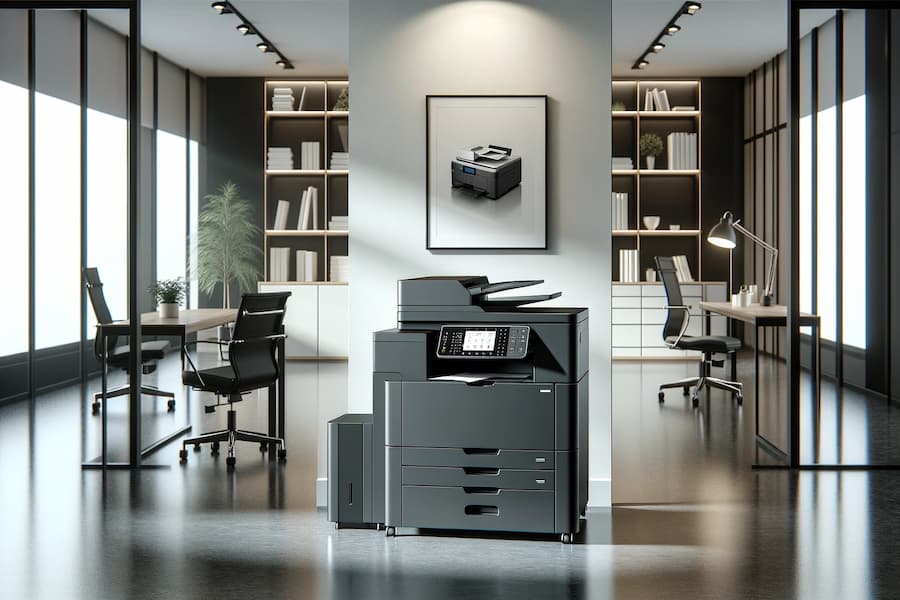
Choosing a photocopier or printer comes down to one thing: the input. A photocopier duplicates a physical page you lay on the glass, using a dry electrostatic process called xerography. A printer renders a digital file sent from a computer or phone. Almost every office machine sold in 2026 does both, and the industry calls it a multifunction printer (MFP).
The Short Version
Photocopier or Printer: Start With the Input
Ask ten office managers to define the difference. You will get ten answers. Some are right. Most blur the line, because the machines blurred it first.
A photocopier is a duplication device. Paper goes on the glass. You press a button. Paper comes back. No computer needs to be involved at any point. Internally, the machine scans the original, charges a photoreceptor drum, attracts toner to the charged areas, then fuses the toner to the sheet with heat and pressure. Chester Carlson patented the process in 1938. It still works the same way.
A printer begins somewhere else entirely: a file. Your laptop, phone, or server pushes data across a cable or a network. The printer turns bits into marks. Nothing physical existed before you clicked print.
So one machine copies atoms, and the other renders bits. Simple enough.
But here is where offices get confused. Nearly every device on a dealer floor in 2026 accepts both inputs. Buy a copier today and it will almost certainly print from your network. Buy an office printer above a certain price point and it will almost certainly have a scanner lid and a copy button. The categories converged. What survives is a difference of emphasis, of engineering priorities, and of price.
Our team at 1800 Office Solutions has walked South Florida businesses through this decision. The question we hear is rarely academic. It is budgetary.
Side By Side
Copier vs Printer vs MFP: The Core Differences
Below is the honest comparison, stripped of dealer marketing. Note the middle column describes a true standalone copier, which is now genuinely hard to buy new.
| Attribute | Standalone Copier | Office Printer | Multifunction Printer (MFP) |
|---|---|---|---|
| Primary input | Physical original on glass or feeder | Digital file over network or USB | Both |
| Needs a computer? | No | Yes | Optional |
| Core technology | Xerography (toner, drum, fuser) | Laser or inkjet | Usually laser or business inkjet |
| Scan to email or cloud | Rarely | Only if scanner equipped | Standard |
| Fax | Sometimes | Rarely | Common option |
| Finishing (staple, punch, booklet) | Common on floor units | Rare | Available on floor units |
| Typical duty cycle | High | Low to moderate | Moderate to very high |
| Footprint | Large, floor standing | Desktop to small floor | Desktop to large floor |
| Availability in 2026 | Niche, mostly refurbished | Wide | Wide, the default |
Look at the last row. It matters more than the others. The standalone copier is effectively a legacy product; you can still find one refurbished, and a handful of high volume duplicators remain in production, but the mainstream market moved on. When a vendor quotes you a “copier” in 2026, they are almost always quoting an MFP.
Under The Hood
How Each Machine Actually Works
Xerography, the copier heart
Light bounces off your original. A photoreceptor drum holds an electrostatic charge. Where light strikes, the charge drains away; where the page is dark, charge remains. Toner (a fine plastic and pigment powder) clings to the charged regions. Paper rolls through. A fuser unit melts the plastic into the fibers. The page comes out warm. That warmth is the plastic setting.
And because the process is dry, nothing smears, and nothing dries out during a long weekend.
Laser printing, the same trick with a laser
A laser printer uses identical physics. The only change is the light source: instead of reflecting light off a physical page, a laser beam draws the image directly onto the drum from digital data. Everything downstream (toner, drum, fuser) is the same. This is why laser printers and copiers feel so similar to service, and why the same toner cartridge families often span both.
Inkjet, a different animal
Inkjets spray microscopic droplets of liquid ink through nozzles. There is no drum, no fuser, and no warm page. Modern business inkjets from HP and Epson print quickly and quietly, and they draw far less power because there is no heating element. But the nozzles clog if the machine sits idle. We wrote about whether printer ink dries out in dormant fleets, and the short answer is yes, it does.
- Laser or toner: lower cost per page, better for text volume, tolerates idle time
- Inkjet: lower hardware cost, better photo gradients, higher supply cost per page in most cases
- Solid ink and dye sublimation: specialty use only, rare in general offices
Money
Cost Reality: Lease Rates and Cost Per Page
Hardware price is the number people fixate on. It is also the number matters least over a five year horizon. Supplies, service, and click charges dominate.
Below are 2026 lease ranges we see across the South Florida market. Treat them as ranges, not quotes. Your speed requirement, color mix, finishing needs, and credit profile move these numbers considerably. Verify any figure against a written proposal before you sign.
| Device class | Typical monthly lease | Best fit | Click rate (B&W / color) |
|---|---|---|---|
| Entry monochrome desktop | $50 to $90 | Under 1,000 pages a month | $0.010 to $0.015 / n/a |
| Monochrome floor unit | $89 to $150 | 5 to 15 people, text heavy | $0.010 to $0.015 / n/a |
| Mid range color MFP | $150 to $300 | 15 to 50 people, mixed color | $0.010 to $0.015 / $0.06 to $0.12 |
| Color MFP with finishing | $300 to $450 | Legal, marketing, booklet work | $0.010 to $0.015 / $0.06 to $0.12 |
| Production print | $475 to $1,100+ | In house print shops | Negotiated |
Two observations. First, a color MFP typically costs 60% to 100% more per month than an equivalent speed monochrome machine. Second, the color click rate is roughly six to ten times the black and white rate. So a department printing 3,000 color pages a month is spending $180 to $360 on clicks alone, before the lease payment. That is the line item nobody reads.
We break the math down further in our post on what it actually costs to lease a copier and in our 2026 copier lease rates breakdown. Both are worth ten minutes before your next renewal.
Average reduction in total print spend during the first year of a structured managed print program
Reported by Quocirca Global Print research and echoed by IDC. We have not independently audited these figures; treat them as directional, and ask any vendor to model your own volumes.
Throughput
Speed, Volume, and the Duty Cycle Trap
Copiers earned a reputation for speed. It was earned honestly, in the era when a copier scanned once and spat out a hundred collated sets while a printer waited on a slow parallel cable. Both halves of that story have changed.
Today a fast MFP and a fast copier are frequently the same chassis with different software. Rated speed (pages per minute, or ppm) is the headline. Duty cycle is the number to actually check.
Duty cycle is the maximum monthly page volume a manufacturer will stand behind. A 40 ppm device might carry a 150,000 page monthly duty cycle. Sounds enormous. But the recommended monthly volume, buried further down the spec sheet, might be 12,000 pages. Run it at 40,000 and you will meet your service technician often.
Here is the rule we give clients. Take your true monthly page count. Multiply by three. Buy a device whose recommended (not maximum) volume clears that number. You will pay slightly more up front and spend dramatically less on downtime.
- First page out time matters more than ppm for small jobs
- Warm up time separates good laser devices from cheap ones
- Automatic document feeder speed governs how fast you scan, not how fast you print
- Duplex scanning in a single pass roughly halves batch scan time
Yet speed is rarely why a fleet fails. Reliability is. And reliability tracks duty cycle headroom more than any other spec.
Convergence
Why the Multifunction Printer Won
Four machines used to sit in a copy room: copier, printer, scanner, fax. Each had its own service contract, its own supplies, and its own square footage. The MFP collapsed all four into one footprint. Offices noticed.
Digitization pushed the same direction. Scan to email, scan to folder, and scan to cloud turned the copy room device into the on ramp for every paper document entering the business. Copying became a side feature of a scanner. A machine whose only skill is duplication now looks strange.
What did offices give up? A few things, honestly:
- Simplicity. An MFP touchscreen buries the copy button under menus on some models
- Single point of failure. When the MFP goes down, you lose print, scan, copy, and fax at once
- Sustained duplication speed. Dedicated high volume duplicators still beat MFPs on thousand copy runs
- Attack surface. A networked device with a hard drive is a computer, and computers get attacked
The last point deserves its own section.
Risk
The Security Difference Nobody Mentions
A 1985 photocopier could not be hacked. It had no network stack, no storage, and no firmware to compromise. It sat in a room and made copies.
A 2026 MFP has an operating system, an internal drive or SSD, a web administration panel, address books full of employee email addresses, and a network connection to your file server. It is, functionally, a Linux server with a paper tray. Most organizations do not patch it. Many never change the default administrator password.
of surveyed organizations reported at least one print related data loss in the prior year
Quocirca Global Print Security Landscape 2025, based on 400 IT decision makers surveyed in May and June 2025. We are citing Quocirca’s summary; verify against the primary report before quoting it externally.
Quocirca also reported print related breach costs averaging around £630,000 for standardized single vendor fleets and roughly £937,000 for multi vendor fleets. We cannot independently confirm those figures, and the sample is limited to 400 respondents, so read them as a signal rather than a settled fact. The directional finding (mixed fleets are harder to secure) matches what we see in the field.
Practical hardening steps, none of which require a new machine:
- Change the default admin password on every device today
- Enable secure or pull printing so jobs release only at the panel
- Turn on drive encryption and end of lease drive wipe
- Disable unused protocols: Telnet, FTP, and legacy SNMP
- Patch firmware on a schedule, the same as you patch laptops
- Segment the print VLAN away from finance and clinical systems
The NIST Cybersecurity Framework treats networked printers as ordinary assets requiring inventory and control, and CISA publishes free baseline guidance any small business can follow. Neither carries a license fee. Both are ignored by most offices we walk into.
Decision
Choosing for Your South Florida Office
Regional detail matters more than dealers admit. Miami-Dade humidity averages well above the national norm for most of the year, and paper is hygroscopic. It absorbs moisture. Damp paper curls, jams, and misfeeds. Offices in Doral or Homestead running open storage rooms see jam rates that offices in Denver never encounter. Store reams sealed, and keep the device room conditioned.
Hurricane season adds a second wrinkle. A fused toner image survives a wet box better than an inkjet page does; if your disaster binder lives in a filing cabinet, that is worth knowing. Surge protection on the MFP circuit is not optional here. We have replaced enough fusers after June storms to feel strongly about it.
Then there is compliance. South Florida is dense with medical practices, law firms, title companies, and logistics brokers. HIPAA, and Florida’s own breach notification statute, do not exempt the copier. That scanned patient chart sits on the device drive until something wipes it.
A short decision path
- Under 500 pages a month, one or two people: a desktop laser MFP, purchased outright
- 500 to 5,000 pages, mostly text: a monochrome floor MFP on a 36 or 48 month lease
- Color proposals, brochures, or client facing print: a mid range color MFP, and negotiate the color click rate hard
- Thousands of identical copies weekly: keep a dedicated duplicator alongside a modest MFP
- Regulated data: require drive encryption, pull printing, and a written end of lease wipe certificate
Is a dedicated copier ever right anymore? Occasionally, yes. Schools, election offices, and churches running enormous single document runs still benefit. Everyone else should buy an MFP and stop worrying about the vocabulary.
Our Role
How 1800 Office Solutions Helps
We are an independent dealer, not a manufacturer, so we have no reason to push one badge over another. We have built fleets for South Florida offices of two people and of two hundred.
Print Assessment
We meter your actual volumes for 30 days before recommending anything. Guesswork costs money.
Fleet Right Sizing
Most offices own too many devices and too little capacity in the right places. We rebalance.
Lease Negotiation
We read the click rate, the escalator clause, and the end of term language so you do not have to.
Device Hardening
Encryption, pull printing, firmware discipline, and a documented wipe at lease end.
Managed Print
Automated toner, proactive service, and one predictable invoice. See our managed print analysis.
Curious what a structured program saves? Our managed print cost savings guide walks through the arithmetic without the sales gloss. And if your current fleet is a mix of four brands, expect the security conversation to come up early.
Questions
Frequently Asked Questions
Is a photocopier the same as a printer?
No, though the distinction has narrowed. A photocopier duplicates a physical original placed on its glass. A printer produces a page from a digital file. Modern multifunction printers perform both jobs, which is why the terms get used interchangeably in everyday office conversation.
Can a printer make copies?
Only if it has a scanner. A basic printer with no scanner lid cannot copy anything. Any printer marketed as an all in one or multifunction device includes a scanner and a copy function, so it can duplicate a page without a computer attached.
Do copiers need to be connected to a computer?
A true standalone copier does not. It scans and reproduces on its own. Most machines sold as copiers in 2026 are actually multifunction printers, and those connect to your network so people can print, scan to email, and manage jobs remotely.
Which is cheaper to run, a copier or a printer?
Per page, a toner based copier or laser MFP usually wins for text volume. Black and white click rates commonly run about $0.01 to $0.015 per page in 2026, while color sits closer to $0.06 to $0.12. Inkjet hardware costs less up front but supplies often cost more per page. Ask any vendor for a written cost per page, not a hardware price.
What is a multifunction printer?
An MFP combines printing, copying, scanning, and often faxing into one device. It replaced the four machine copy room. Business grade models add finishing options like stapling, hole punching, and booklet making, plus security features such as encrypted drives and pull printing.
Are standalone photocopiers still sold in 2026?
Rarely, and mostly refurbished. High volume duplicators remain in production for schools and print rooms with enormous single document runs. For general office use the multifunction printer is the default, and dealers quoting a “copier” are usually quoting an MFP.
Is inkjet or laser better for an office?
Laser suits most offices. It handles idle periods, delivers a lower cost per text page, and tolerates high volume. Business inkjet makes sense for lower volumes, tighter budgets, or workflows needing rich color gradients. Inkjet nozzles can clog when a machine sits unused for weeks, which is a real risk in seasonal South Florida offices.
How much does it cost to lease a copier in 2026?
Ranges we see run roughly $50 to $90 monthly for an entry monochrome desktop, $89 to $150 for a monochrome floor unit, $150 to $300 for a mid range color MFP, and $300 to $450 for a color MFP with finishing. Production devices start near $475. These are market ranges, not quotes; click charges and service terms sit on top.
Do office copiers store the documents they scan?
Many do. Business MFPs contain a hard drive or SSD holding job images, address books, and sometimes cached credentials. Enable drive encryption, and require a documented wipe or drive return when the lease ends. Regulated offices in healthcare and law should treat this as a compliance requirement rather than an option.
Should a small Miami office buy or lease?
Buy if volume is low and the device is inexpensive. Lease if you need a floor standing MFP, want service bundled, and prefer predictable monthly cost. Leasing shifts obsolescence risk to the dealer. But read the escalator clause and the end of term buyout language carefully, because those two lines cause most disputes we are asked to untangle.
What speed rating does my office need?
Count your true monthly pages, then multiply by three, and select a device whose recommended monthly volume clears that figure. Rated pages per minute matters less than duty cycle headroom. A machine run near its maximum will jam, wear, and cost you more in downtime than the faster model would have cost up front.
Does humidity affect copiers and printers in South Florida?
Yes. Paper absorbs moisture, and damp sheets curl, misfeed, and jam. Store reams sealed until use, and keep the device room conditioned. Surge protection matters during hurricane season, since fuser assemblies and control boards are the components most often lost to power events.
Not Sure Which Machine Your Office Needs?
We will meter your real print volume, audit your device security, and show you the numbers before you sign anything. No obligation, no pressure, and no manufacturer quota driving the recommendation.
GET A FREE CONSULTATION
(888) 574-5120
1800 Office Solutions · Your One Source For Everything Office