
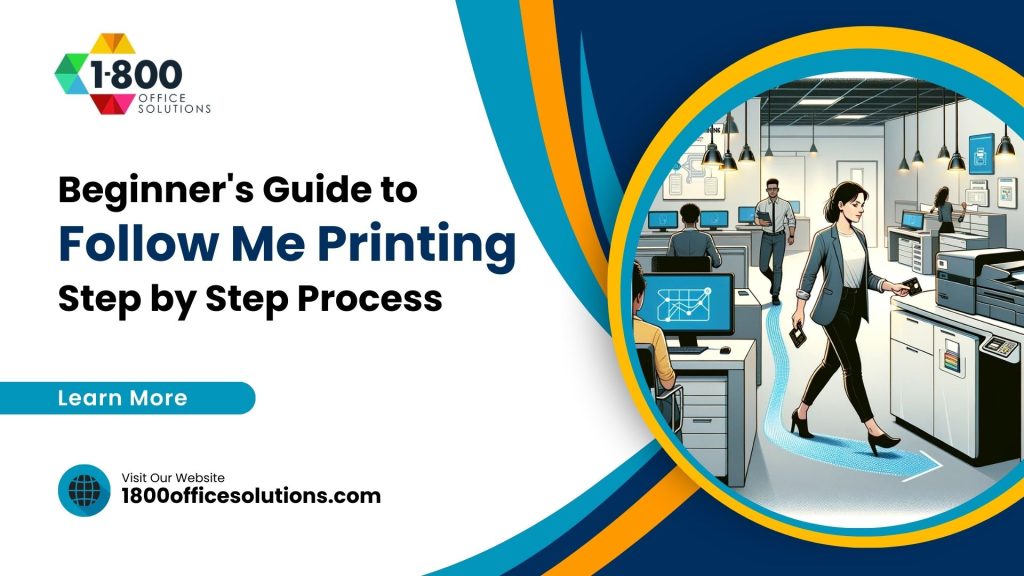
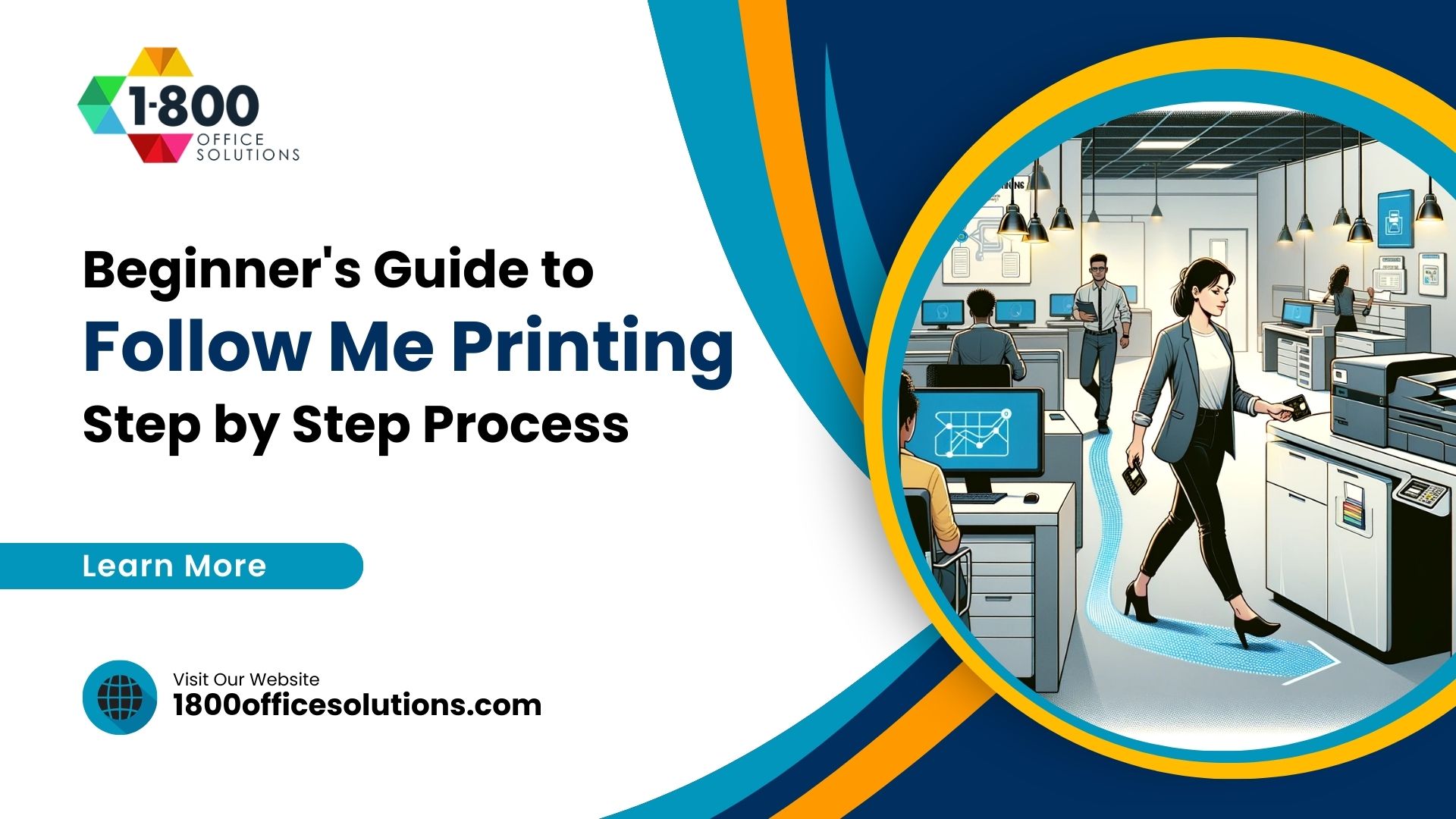
What Is Follow Me Printing, Really?
Follow Me printing is a print workflow. Your job does not rush to one fixed printer. Instead it waits in a shared, secure queue until you release it at a device of your choice. Then it prints. Simple as that.
The name fits the behavior. Your document follows you around the building. Print from your desk, get pulled into a meeting, and release the pages at the printer near the conference room. Nothing is stranded on a tray two floors away.
People use a few names for this: pull printing, secure release, or secure pull printing. And they all point to one core idea. Hold the job, verify the person, then print. 1800 Office Solutions sets this up every week for offices across South Florida, so the pattern is familiar.
Why does the small shift matter so much? Because most print waste and most print security gaps come from a single habit. Sending pages to a tray before anyone is there to grab them.
How Follow Me Printing Works, Step by Step
The flow is short. Here is the whole thing.
- You send a job. It routes to a single virtual queue on a print server or a cloud service, not to one device.
- The job waits, encrypted. It sits safely until you show up. Nobody sees your pages in the meantime.
- You authenticate. Tap a badge, punch a PIN, or use a phone app at any enabled printer.
- The job releases. Your pages print in seconds, right where you are standing.
- Unclaimed jobs expire. If you never show, the system deletes the job after a set window.
Notice what is missing. No dedicated printer per person. No stack of forgotten pages. And no driver install on every laptop, since submission can happen by web or email. That last point helps hybrid teams a lot.
Curious how release speed feels day to day? It is quick. A badge tap and a short pause, then paper. Most staff stop thinking about it within a week.
One more detail worth calling out. The queue itself lives on hardware you control, either a small server in your closet or a hosted cloud service. So you decide where jobs rest and for how long. And you decide who can release what. That control is the quiet power of the whole setup.
Ways to Authenticate at the Printer
Release always needs proof of who you are. But the proof can take several forms, and the right one depends on your office. Here are the common options, with honest trade-offs.
- Proximity badge. Tap the card you already carry. Fast and popular, though you must plan for lost cards.
- PIN code. No extra hardware needed. Cheap and simple, yet PINs can be shared or shoulder-surfed.
- Mobile app. Release from your phone. Great for roaming staff, and it leans on a device people rarely lose.
- Biometric. A fingerprint at the panel. Strong security, but not every device supports it.
Which one wins? There is no single answer. Quocirca’s 2025 research found offices scatter across methods, with roughly 47 percent using Windows or device passwords, 38 percent using biometrics, and only 34 percent using proximity cards. So blending methods is normal, not a failure. A law firm might badge in, while a warehouse team taps a PIN. And a hybrid sales crew may lean on the phone. We help match the method to the room.
Is one option clearly safest? Biometrics scores high, yet cost and hardware limits hold it back for many. So most offices land on a mix of badges and PINs, with mobile for the people who move around.
The Hidden Cost of Uncollected Prints
Walk past any shared printer at 5 p.m. You will often find orphaned pages. Reports nobody grabbed. Drafts printed twice. It looks small, yet it adds up fast.
Think about what a rogue third of your print budget really means. Paper, toner, wear on the device, and energy, all spent on pages heading straight to recycling. So the waste is not just paper. It is money and staff time too.
Secure release fixes the root cause. A page prints only when a human is there to take it. And if a job is never claimed, it quietly disappears. Our team at 1800 Office Solutions often finds this one change pays for a project on its own.
Follow Me Printing and Document Security
Here is a scenario. Someone prints a payroll sheet, gets a call, and forgets. The sheet sits in the tray for an hour. Anyone walking by can read it. So a real breach risk appears, and it happens constantly.
Follow Me printing removes the exposed tray entirely. Sensitive pages release only at the moment you authenticate. So payroll, medical charts, and legal filings stay private. This maps well to HIPAA, and to guidance from the National Institute of Standards and Technology on protecting sensitive data. The Cybersecurity and Infrastructure Security Agency also flags printers and multifunction devices as real network endpoints worth hardening.
Breaches are not cheap either. Organizations without strong print controls reported far higher breach-related costs in the same study. And a printer is a computer with storage, a hard drive, and network access. So it deserves the same care as any server. Want the deeper version? Our post on ways to secure a computer network covers the wider picture.
How Much Can Follow Me Printing Save You?
Savings come from three places at once. Fewer wasted pages. A smaller, better-used fleet. And a lighter support load. Stack them and the numbers get real.
Pull printing also spreads work across devices. Users go to the nearest free printer, so you can often shrink the fleet by 20 to 30 percent. Fewer machines means fewer leases, fewer service calls, and less toner on the shelf. Pair it with default duplex and the paper savings climb again. Our guide to duplex printing shows how that stacks.
Wondering where the real dollars land? Most of it hides in per-page and device costs. Here is a rough 2026 picture of managed print pricing, so you can sanity-check a quote.
| Cost element | What drives it | Typical 2026 range |
|---|---|---|
| Black & white per page | Volume and device class | $0.009 to $0.025 |
| Color per page | Coverage and volume | $0.055 to $0.140 |
| Base monthly service | Fleet size and SLA | $150 to $1,000+ |
| Secure release setup | Readers, server, or cloud queue | Scoped per site |
These are ballpark figures, not a promise. Your real number depends on volume, color mix, and service level. So treat any flat quote with a little caution and ask what is bundled.
Here is a simple way to picture the payback. Say a 60 person office prints a million pages a year. Trim a quarter of it and you erase 250,000 pointless pages. Add fewer devices and lighter service calls, and the annual saving often covers the release setup within the first year. So the project tends to fund itself, then keep paying after. We build that estimate with you before anyone signs a thing.
Follow Me Printing vs Traditional Direct Printing
A quick comparison makes the difference obvious. Direct printing is the old default. Secure release is the modern one. Both still have a place, so let us be fair about it.
| Factor | Direct printing | Follow Me printing |
|---|---|---|
| Where the job waits | In the printer tray | In a secure central queue |
| Release method | Prints immediately | Badge, PIN, or phone at the device |
| Confidential documents | Exposed on the tray | Private until you release them |
| Uncollected waste | Common and costly | Auto-deleted, near zero |
| Device flexibility | Locked to one printer | Any enabled printer works |
| Reporting and audit | Limited | Full, per user and job |
| Best fit | Tiny office, one printer | Teams sharing devices |
So is direct printing always wrong? No. A one person studio with a single desktop printer gains little from a queue. But the moment you share devices, secure release starts to pull ahead on both cost and privacy.
Who Gets the Most Value?
Every office can use secure release. But some feel the payoff faster than others. Here is a quick read on where it lands hardest.
- Healthcare clinics. Patient records demand privacy, and audit trails ease HIPAA reviews. So the security case is immediate.
- Law firms. Filings, contracts, and discovery move constantly. Confidential release keeps them off open trays.
- Financial and accounting teams. Statements and tax forms carry real risk if left exposed. Release-at-the-device closes the gap.
- Schools and campuses. Shared devices and roaming staff fit pull printing well, and quotas curb runaway printing.
- Multi-floor offices. Anyone tired of walking to a distant printer gains from routing to the nearest one.
Notice a theme. Shared devices plus sensitive documents equals a strong fit. And most South Florida businesses check both boxes. So the question is rarely whether it helps, but how much.
What You Need to Roll It Out
Good news first. Most current multifunction printers already support secure release. So you may not need new hardware at all. Here is a short checklist of the moving parts.
- A release method. Card readers, PIN pads, or a mobile app. Many offices mix them.
- A queue. A print server on site or a cloud-hosted queue, sized to your volume.
- Directory integration. Tie release to your existing user accounts, so badges match people.
- Firmware and policy. Update older devices and set your job expiry window.
- A short pilot. Test with one team, gather feedback, then expand.
One honest caveat. A print server sized too small can add lag at busy times. So plan capacity around your peak, not your average. Our team scopes this before rollout to avoid the trap. And if a device keeps jamming, the fix may be maintenance, not the queue; our notes on common printer problems can help you spot the difference.
Common Mistakes to Avoid
Secure release is not hard to run. But a few missteps trip up new deployments. Here are the ones we see most, so you can skip them.
- Skipping the pilot. Flipping the whole office at once invites chaos. Start small, learn, then scale.
- Ignoring the queue window. Hold jobs too long and you store sensitive data needlessly. Too short and people lose work. Tune it.
- Forgetting firmware. Old firmware is a soft spot for attackers. Patch devices before you trust them with private jobs.
- No fallback plan. Servers and networks hiccup. Set a clear plan for release when the queue is down.
- Leaving old habits in place. Personal desktop printers quietly undo your savings. Retire them as the shared fleet proves itself.
None of these are dramatic. Yet each one chips away at the security and savings you set out to gain. So a short planning pass up front pays for itself many times over. This is exactly the kind of detail 1800 Office Solutions handles so your team does not have to.
What is the single most common slip? Rushing. Give the rollout a few weeks, gather feedback, and adjust. Then the change sticks.
Secure Printing for South Florida Offices
Miami runs on regulated industries. Healthcare, law, real estate, finance, and logistics all move sensitive paper every day. And every one of them faces privacy rules with teeth. So an open print tray is a quiet liability.
Humidity and heavy print seasons add a local twist. Devices work hard here, and downtime hurts. A right-sized, well-monitored fleet handles it better than a room full of aging personal printers. 1800 Office Solutions has served Miami, so we scope for the climate and the compliance both.
There is a regional cost angle too. Fewer devices means fewer service trips across a spread-out metro. So a leaner fleet saves more here than in a single tower downtown. Want a second look at your setup? Even a small audit often surfaces easy wins.
Local support matters more than people expect. When a device goes down in Doral or Brickell, a technician nearby beats a ticket queue in another time zone. So we keep service close to the offices we serve. And that speed keeps your print flowing when a deadline is on the line.
How 1800 Office Solutions Helps
We handle the whole path, from assessment to support. Here is what it looks like in practice.
Print Assessment
We map your fleet, volumes, and security gaps before recommending anything.
Secure Release Setup
Badge, PIN, or mobile release, tuned to how your teams actually work.
Fleet Right-Sizing
Fewer, better-placed devices, so you stop paying for idle machines.
Compliance Support
Audit trails and access controls to back HIPAA and privacy needs.
Ongoing Monitoring
Proactive toner, uptime, and security checks across your fleet.
Every office is a little different. So we start with a conversation, not a contract. Then we build the plan around your real workflow.
Follow Me Printing: Frequently Asked Questions
What is Follow Me printing in simple terms?
Follow Me printing holds your print job in one secure queue instead of firing it to a single machine. You walk up to any enabled printer, prove who you are with a badge, PIN, or phone, and the pages release right then. So nothing sits waiting in an open tray.
Is Follow Me printing the same as pull printing or secure print release?
Yes. Follow Me printing, pull printing, and secure print release all describe the same idea. Jobs wait in a central queue and print only after you authenticate at the device. Vendors pick different names, but the workflow is nearly identical.
How does Follow Me printing improve document security?
Confidential pages never print until you are standing at the machine. So the gap where payroll, medical, or legal documents get grabbed by the wrong person simply closes. It also creates an audit trail of who printed what and when, which helps with HIPAA and other compliance needs.
Does Follow Me printing actually save money?
It usually does. Offices commonly cut total print volume by 15 to 30 percent because forgotten jobs never reprint and never waste paper. Fewer devices, less toner, and a lighter support load add up quickly across a year.
What hardware do I need to use secure pull printing?
Most current multifunction printers already support it. You add a small card reader, or use a PIN pad or mobile app for release. Your print jobs route through a print server or a cloud queue. Older devices may need a firmware update or a release terminal.
Can employees print from phones and laptops?
They can. Mobile and web submission is a core part of secure release. A user emails or uploads a job, then releases it at any enabled printer. So remote and hybrid staff keep printing without loading drivers on every device.
How long do jobs stay in the queue before deleting?
Most setups hold a job for a set window, often somewhere between a few hours and 72 hours. If nobody releases it, the system deletes it automatically. You control the timing to match your security and storage rules.
Will Follow Me printing slow my team down?
Not in normal use. Release takes a badge tap or PIN and a second or two. Many staff find it faster because they route to the nearest free printer instead of waiting behind a stuck job. But a poorly sized print server can add lag, so scoping matters.
Is Follow Me printing worth it for a small office?
It can be, though the math is tighter. A five person office sees less raw savings than a 200 person firm. Still, the security and privacy gains matter at any size, especially for medical, legal, or financial teams in South Florida.
How do I get started with Follow Me printing in Miami?
Start with a quick print assessment of your fleet, volumes, and security gaps. 1800 Office Solutions can scope the right release method, size the queue, and roll it out across your Miami offices. Call (888) 574-5120 for a free consultation.
Which authentication method is best, badge, PIN, or phone?
It depends on your building and your people. Proximity badges feel fastest for staff who already carry them. PIN release needs no extra hardware, so it suits smaller sites. Mobile release shines for hybrid and roaming teams. Many offices blend two of the three.
Does Follow Me printing work with a mixed fleet of printer brands?
It can, though it takes more planning. Secure release software often sits above the hardware, so it can bridge several brands. But mixed fleets carry a higher security load, which is one reason many offices standardize over time. We assess this during scoping.
Can Follow Me printing help with HIPAA or other compliance rules?
It helps meaningfully. Release-at-the-device keeps protected records off open trays, and the audit log shows who printed each job. That evidence supports HIPAA, and it eases the paperwork during an audit. It is one layer of a broader security plan, not the whole plan.
Talk with 1800 Office Solutions about secure pull printing for your Miami office. We will assess your fleet and show you where the savings hide.
GET A FREE CONSULTATION
(888) 574-5120
Your One Source For Everything Office