
A small business can accept Apple Pay in three ways: with a contactless card terminal at the counter, with Tap to Pay on iPhone (no extra hardware), or through a website or app checkout that supports Apple Pay. In every case, the setup runs through your payment provider, not through Apple directly. This guide explains how each option works, how Apple Pay protects card details, and what to check before you put the Apple Pay sign by your register.
Key takeaways
- Your payment provider is the gatekeeper. If your processor supports Apple Pay, you can usually turn it on without changing banks.
- Tap to Pay on iPhone turns a phone into a terminal. Apple says it needs an iPhone XS or later, a supported payment app and the latest iOS.
- Card numbers stay out of the transaction. Apple Pay sends a device-specific number instead, and Apple says it doesn’t send the actual card number to merchants.
- Online and in-app checkout works too. Apple Pay runs in Safari on your website and inside iPhone apps through payment platforms that support it.
- Train staff for the first week. Most hiccups come from holding the phone in the wrong spot, not from the technology.
How Apple Pay Works at the Point of Sale
When a customer adds a credit or debit card to Apple Wallet, their bank issues a separate number for that device. Apple calls it the Device Account Number. Apple’s support documentation explains that this number is stored in a secure chip on the device (the Secure Element), isolated from the phone’s operating system, never stored on Apple’s servers and never backed up to iCloud.
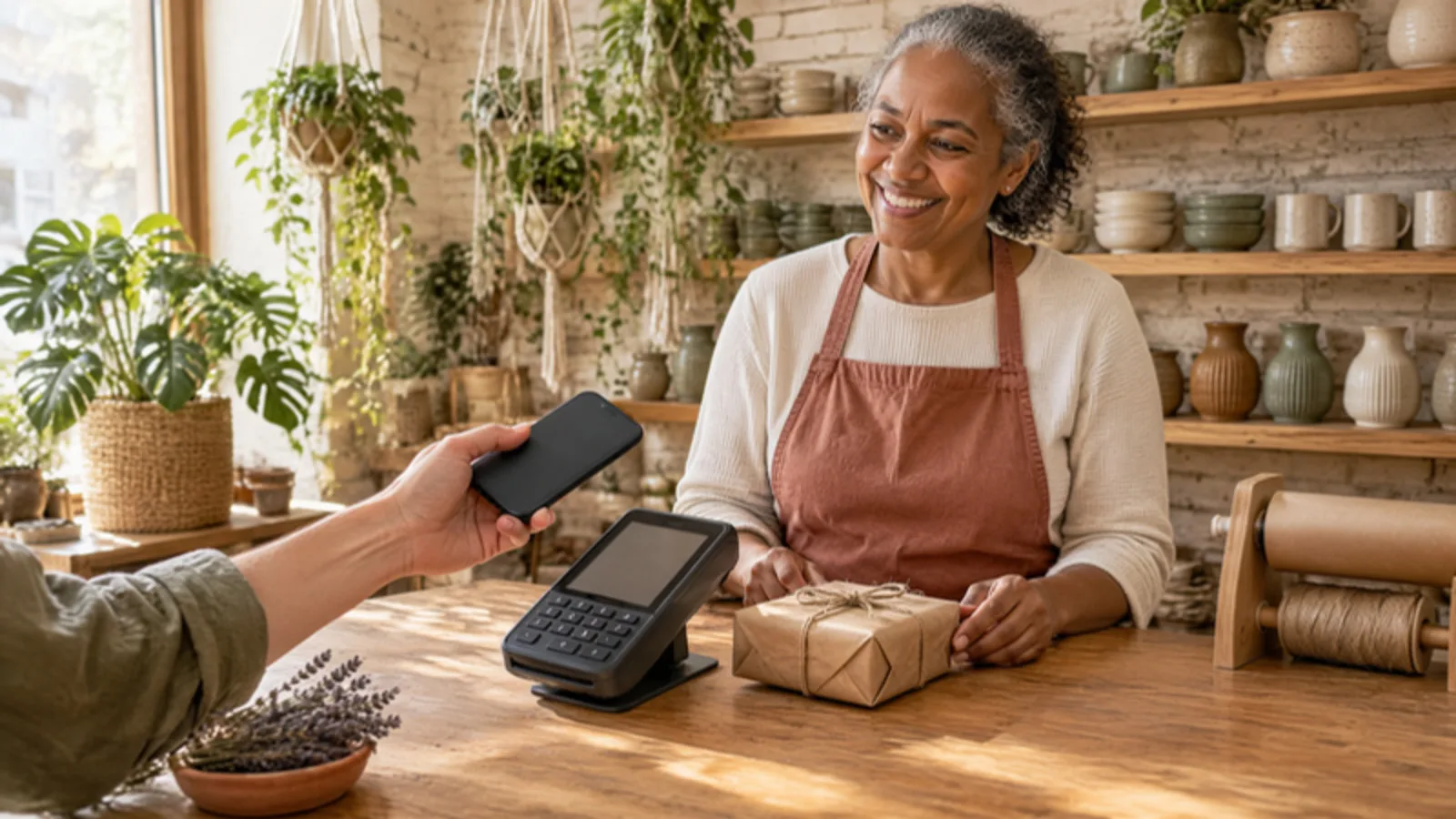
At checkout, the customer holds the iPhone or Apple Watch near your terminal and confirms with Face ID, Touch ID or their passcode. The terminal receives the device number plus a one-time security code for that purchase, and the payment travels through your processor like any other card sale. Apple says it doesn’t store customers’ original card numbers, and for card payments it doesn’t keep transaction information that can be tied back to the customer.
For you, that means two practical benefits: the card number isn’t exposed at your counter, and a stolen phone can’t be used without the owner’s face, fingerprint or passcode.
Three Ways to Accept Apple Pay
| Method | What you need | Best for | Watch out for |
|---|---|---|---|
| Contactless terminal | A card reader or POS terminal that supports contactless (tap) payments | Shops, restaurants and offices with a front counter | Older chip-only readers may not accept taps |
| Tap to Pay on iPhone | iPhone XS or later, latest iOS, a payment app that supports the feature | Mobile services, pop-up sales, deliveries, home visits | Not available in every country; transaction limits may apply |
| Online and in-app | A website or app checkout through a payment platform that supports Apple Pay | Online stores, booking sites, deposits and invoices | Your developer or platform must enable it |
Option 1: A contactless card terminal
If your terminal already takes tap-to-pay cards, it can usually take Apple Pay too, because the phone uses the same contactless technology. Ask your payment provider to confirm Apple Pay is enabled on your account. If you’re replacing an old reader anyway, choose one that accepts tap payments, chip cards and swipes so you can serve every customer.
Option 2: Tap to Pay on iPhone
Apple’s business page says Tap to Pay on iPhone lets a business accept in-person contactless payments with just an iPhone, with no need to buy or manage separate card readers. Customers can pay with a physical contactless debit or credit card, Apple Pay, or other digital wallets, including Android phones.
Getting started is straightforward:
- Check that your iPhone is an iPhone XS or later and update it in Settings, then General, then Software Update.
- Open the payment app you already use (or download one that supports Tap to Pay on iPhone).
- Turn on Tap to Pay in that app and accept the terms.
- To take a payment, enter the amount and hold the iPhone out for the customer to tap.
Apple’s developer page adds that some contactless cards may not be accepted by every payment app, and transaction limits may apply, so read your provider’s details. It also notes that transactions are encrypted and processed using the iPhone’s Secure Element.
Option 3: Online and in-app checkout
Apple’s developer site says Apple Pay works in iPhone, iPad and Apple Watch apps and on websites in Safari, and points businesses to payment service providers that support it. Most popular e-commerce platforms and payment gateways offer Apple Pay as a checkout button you switch on. The benefit is speed: customers skip typing card and address details on a small screen, which helps on mobile.
Is Apple Pay Safe for Your Business?
Apple Pay is one of the more secure ways to take a card payment, for a few reasons:
- No card number at the counter. The device number replaces the real card number, and Apple says neither Apple nor the device sends the actual card number to the app or merchant.
- Owner authentication. Each payment needs Face ID, Touch ID or a passcode, so a lost phone can’t be used to pay.
- One-time codes. Each purchase carries its own security code, which makes copied payment data far less useful to a thief.
Your own systems still matter, though. Apple Pay protects the card details in the tap. It doesn’t protect a point-of-sale computer that’s out of date, a shared password on the POS admin account or a terminal sitting on the same Wi-Fi as guests. Keep payment devices on their own network, update them, and limit who can sign in. Our guide on how criminals steal card information explains the weak points to close, and our page on network monitoring covers keeping an eye on what connects to your network.
Questions to Ask Your Payment Provider
Before you change anything, a short call with your processor clears up most of the unknowns. Ask:
- Is Apple Pay enabled on my merchant account for in-person, online and in-app payments?
- Does my current terminal accept contactless payments, or does it need a firmware update or replacement?
- Does your app support Tap to Pay on iPhone, and are there transaction limits?
- Are rates for Apple Pay transactions the same as for regular card transactions on my plan?
- How do Apple Pay sales appear in my reports and bank deposits?
- How are returns handled for a customer who paid with Apple Pay?
Write the answers down and keep them with your other payment paperwork, so whoever handles the books knows what to expect.
Getting Your Team and Customers Ready
Train staff in five minutes
- Show where the contactless area is on the terminal, usually marked with the contactless symbol.
- Explain that the customer confirms on their own device, so staff don’t need to touch the phone.
- If a tap fails, ask the customer to hold the phone closer and still for a moment, then try again.
- For Tap to Pay on iPhone, practice a test sale with a team member’s card before the first real customer.
Let customers know
Display the Apple Pay and contactless signs your provider supplies near the register, on your door and at checkout on your website. Customers who prefer phone payments look for them.
Keep records tidy
Apple Pay sales settle like other card sales, so they appear in your provider’s reports and deposits alongside card payments. Because the payment uses a device number rather than the physical card number, a customer may not recognize the digits on a receipt; your provider’s reports remain the record of truth when you need to look up a sale.
Apple Pay for Payments You Receive by Phone or Invoice
Not every sale happens at a counter. Many invoicing and booking tools add an Apple Pay button to the payment page they email or text to customers. When a client opens that link on an iPhone in Safari, they can pay in a couple of taps. This is especially handy for service businesses that take deposits, and it pairs well with a professional phone setup; our business phone system page explains how small teams keep customer calls and follow-ups organized.
Want your payment devices and network set up safely?
We can help you keep point-of-sale devices updated, separated from guest Wi-Fi and monitored, so taking payments stays simple.
Frequently Asked Questions
How do small businesses accept Apple Pay?
Through a payment provider that supports it, using a contactless terminal, Tap to Pay on iPhone, or an Apple Pay button on a website or app checkout.
Do you need a special terminal for Apple Pay?
You need a terminal that accepts contactless (tap) payments. Many current card readers already do. With Tap to Pay on iPhone, you don’t need a separate terminal at all.
What iPhone do you need for Tap to Pay on iPhone?
Apple says an iPhone XS or later running the latest version of iOS, plus a payment app that supports the feature.
Can Tap to Pay on iPhone accept Android phones and regular cards?
Yes. Apple says it accepts contactless debit and credit cards, Apple Pay and other digital wallets, including Android.
Does the merchant see the customer’s card number with Apple Pay?
No. Apple Pay sends a device-specific number and a one-time code. Apple says the actual card number isn’t sent to the merchant.
Can you accept Apple Pay on your website?
Yes. Apple Pay works in Safari and in apps when your e-commerce platform or payment gateway supports it. It’s usually a setting you turn on.