
AI Overview:
Outsourced print management helps organizations reduce costs, improve efficiency, and strengthen security by shifting print infrastructure oversight to specialized providers. Through advanced software, automated workflows, and modern devices like Xerox printers, businesses gain better visibility, lower waste, enhanced compliance, and improved sustainability. This strategic approach frees internal teams to focus on core objectives while delivering measurable productivity gains and long-term operational value.
Are you grappling with the high costs and complexities of in-house print management? In an era where efficiency is king, the strategic move to outsource print management services can significantly streamline your workflow, reduce expenses, and enhance productivity. This article will dissect the merits of delegating print management to seasoned professionals, elucidating the process of selecting the ideal service provider, and analyzing how such a partnership can yield measurable improvements in your operations. It will specifically address how advanced software solutions and innovative Xerox printers can transform your business environment, freeing up vital resources to focus on core business strategies. By engaging with this content, readers will discover pragmatic solutions to their print management challenges and unlock new avenues to bolster their operational efficacy.
Key Takeaways
- Outsourcing print management can significantly reduce operational costs and optimize resource usage
- Managed print services enhance productivity by automating workflows and minimizing manual oversight
- Environmental benefits arise from reduced hardware use and energy conservation with outsourced print management
- Employee and customer feedback is crucial for refining ongoing print management services and strategies
- Future print management optimization includes integrating software for detailed insights and policy adjustments
Understanding Outsourced Print Management Services

Businesses considering a shift in document management strategy often weigh the benefits of print management outsourcing. This process entails transitioning from in-house methods to expert service providers who oversee vital functions such as print server maintenance, analytics, and the secure handling of data and information. Through skilful management, these services aim to enhance workflow efficiency and cut costs. The forthcoming sections will dissect what print management outsourcing involves, scrutinize the core functions Contact 1800 Office Solutions a reputable provider would address, and provide a comparative analysis of in-house versus outsourced Office Equipment Leasing solutions, underscoring the operational efficiencies and strategic advantages of the latter approach.
What Is Print Management Outsourcing?
Print management outsourcing is the practice of enlisting an external provider to oversee a company’s entire printing infrastructure, which can be a pivotal aspect of digital transformation. This strategic move allows businesses to streamline operations by delegating tasks such as fleet management, print server upkeep, and print-related workflows to specialists. This shift not only reduces the strain on internal resources but often results in a more efficient use of the budget allocated for printing services and IT infrastructure maintenance.
Companies that embark on outsourcing their print management often find themselves benefiting from the service provider’s expertise in identifying inefficiencies within their existing system. By optimizing the print environment, businesses can experience a reduction in unnecessary print volumes, improve document security, and ensure their printing fleet aligns with their environmental objectives, thus directly impacting their operational cost-effectiveness and sustainability efforts.
Key Functions Managed by Service Providers
Expert service providers dedicated to print management take the helm of complex infrastructures, ensuring a seamless integration of information security protocols with the company’s print fleet. They conduct rigorous assessments to ascertain that all printing devices comply with the latest data protection standards, thus fortifying sensitive data against unauthorized access. This vigilance extends to maintaining windows server configurations, optimizing server performance for all print-related tasks, and continuously monitoring internet-based threats that could impact document integrity.
Another core function managed by these services encompasses the judicious administration of consumables such as ink and toner, alongside regular maintenance to prevent downtime. They tailor solutions that intelligently anticipate needs and adjust ink supply dynamics, thus preventing wastage and ensuring uninterrupted operations. By taking charge of such operational details, the service providers facilitate an environment where the attention of businesses can pivot to strategic growth, leaving the intricate nuances of print management to those equipped with the expertise to handle them efficiently.
Differences Between in-House and Outsourced Solutions
An in-house print management setup requires an organization to retain full responsibility for its devices, ranging from deployment to troubleshooting. This often necessitates a significant allocation of both human and financial resources to manage user needs and maintain device efficiency. Conversely, when an organization chooses to outsource, the service provider assumes these responsibilities, leveraging specialized knowledge to optimize device performance and address user issues swiftly, often resulting in enhanced productivity for the client.
Outsourcing print management frequently unearths opportunities for cost savings and productivity gains that remain unexplored within an internal framework. For example, a skilled service provider can conduct a comprehensive review of an organization’s print infrastructure, identifying underutilized devices or recommending strategies that lead to a reduction in print waste. Such insights enable an organization to streamline operations and reallocate resources more effectively, placing a stronger focus on core business objectives and product innovation.
Identifying Efficiency Challenges in Print Management

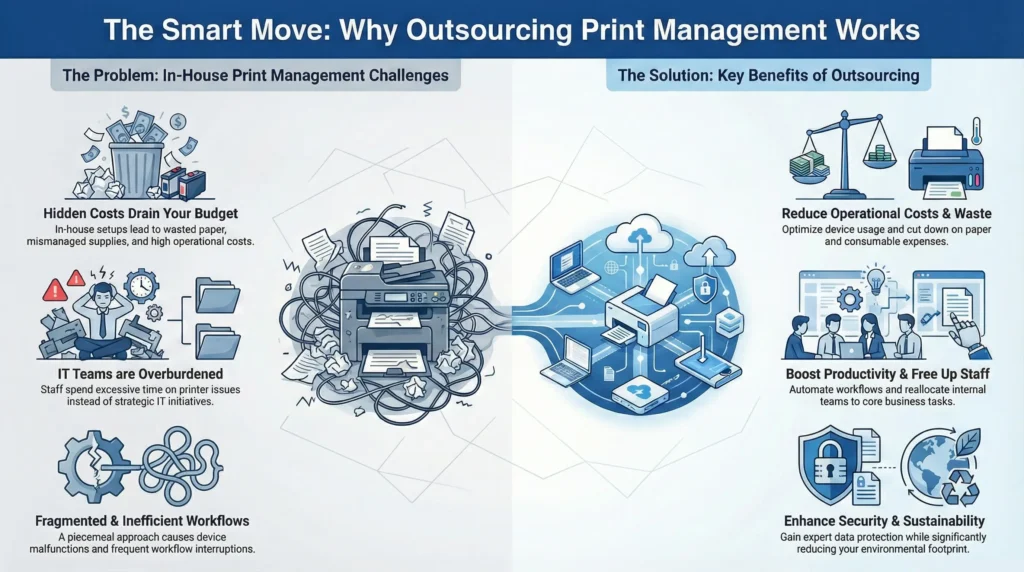
Addressing common inefficiencies in traditional print setups is crucial for businesses seeking to refine their document management processes. The impact of inefficient printing on business operations can be significant, leading to wasted paper, mismanaged print jobs, and the exhaustion of IT resources. To locate efficiency gains, companies must thoroughly assess their current print management needs, considering factors like printer driver adequacy and the potential for automation improvements. This evaluation is essential to releasing the full potential of an optimized printing environment.
Common Inefficiencies in Traditional Print Setups
In a traditional print setup, often hindered by outdated technology, companies face a myriad of inefficiencies that directly affect cost and productivity. Customers may encounter frequent device malfunctions and compatibility issues with various operating systems, which not only hamper workflow but also lead to increased downtime and maintenance expenses. Without a streamlined process, businesses can incur significant losses due to inefficacious print services management.
The absence of advanced print solutions can result in a lack of oversight and control over print jobs, leading to resource wastage and increased operational costs. When each department manages its print services independently, this often results in a piecemeal approach that lacks cohesion and oversight—compounding inefficiencies rather than resolving them:
Considering these points, the implementation of managed print services emerges as a viable solution to address the systemic inefficiencies present in conventional print environments. With the support of specialized providers, businesses are poised to overcome these challenges, transforming their print infrastructure to one that is cost-effective, customer-focused, and aligned with the latest technology standards.
| Challenge | Impact on Customer | Cost Implications | Operational Setback |
|---|---|---|---|
| Device malfunction and compatibility issues | Workflow Interruptions | Higher maintenance expenses | Increased downtime |
| Lack of print job oversight | Resource Wastage | Elevated operational costs | Piecemeal management |
Impact of Inefficient Printing on Business Operations
In the realm of business operations, inefficient printing practices can notably strain an organization’s productivity. When businesses fail to streamline their printing processes, the fallout includes excessive consumption of paper and computer resources, resulting in a tangible decline in workplace efficiency. The burden often spreads to IT departments, which are forced to allocate extensive time to printer-related issues, from authentication bottlenecks to the troubleshooting of office equipment. Such distractions can lead to a diverted focus from strategic IT initiatives that foster scalability and innovation.
Moreover, the absence of robust management tools like active directory integration in traditional print setups can lead to a fragmented approach to access control and usage tracking. In consequence, organizations encounter a lack of accountability and an increase in unauthorized printing, which in turn inflates costs. It is through these insights that businesses recognize the urgent need for managed print services, which deliver enhanced efficiency through expert oversight and integrated solutions designed to align with the company’s growth and sustainability goals:
| Deficiency | Business Impact | Cost Outcome | Operational Effect |
|---|---|---|---|
| Inadequate print management tools | Reduced access control | Increased unauthorized usage | Scattered approach to printing |
| Excessive IT department workload | Reduced focus on strategic initiatives | Opportunity cost of IT resources | Stifled business scalability |
Assessing Your Current Print Management Needs
Embarking on an assessment of current print management needs necessitates examining the accessibility of print resources for the end user, including the interface’s user-friendliness and the availability of a mobile app to manage printing needs on the go. Such an evaluation helps determine how the integration of a comprehensive print management solution can streamline workflows and bolster productivity while ensuring users have efficient access to printing services, irrespective of their location or the device they’re using.
When scrutinizing the existing print environment, businesses must account for consumable management, such as toner supply levels and usage patterns, to identify areas where waste can be minimized. An adept print management solution provides real-time insights into toner usage, allowing for proactive reordering and reducing the downtime associated with depleted supplies. Recognizing these factors is critical for businesses aiming to refine their document management strategies and ultimately enhance operational efficiency.
Advantages of Outsourcing Print Management

In today’s fast-paced business landscape, outsourcing print management services is a strategic maneuver that enables companies to reduce operational costs and minimize waste. By leveraging advanced print management software as a service, businesses not only access sophisticated tools but also elevate document security and compliance. Outsourcing aligns with sustainability efforts, reducing the carbon footprint associated with multifunction printers (MFPs) and fax machines. It also liberates internal resources, allowing teams to concentrate on core business functions while a specialized vendor handles the complexities of print services.
Reducing Operational Costs and Waste
When businesses harness outsourced print management services, they tap into an ecosystem designed to reduce the print output, alleviate waste, and increase efficiency. By enabling service providers to manage print operations, companies witness a significant decline in paper usage and consumable waste, as these experts implement tailored solutions that precisely meet the printing needs of employees without excess.
The strategic placement of multifunction devices that scan, print, and copy, managed by the outsourcing partner, ensures employees have access to necessary equipment without overloading the work environment with underutilized machines. This approach not only streamlines the workflow but also reflects in reduced energy costs and a lower carbon footprint, underscoring the cost-effectiveness and environmental consciousness of outsourcing print management.
Accessing Advanced Print Management Software
In the midst of today’s rapidly evolving office dynamics, accessing advanced print management software like PaperCut becomes a strategic move for organizations aiming to gain a competitive edge. This kind of software offers a comprehensive view of the print environment, allowing for meticulous oversight whether one is printing from a workstation or mobile device. As service providers utilize these sophisticated tools, businesses find themselves empowered to better track usage, allocate costs, and support remote printing seamlessly, which in turn leads to enhanced operational efficiency and user satisfaction.
Furthermore, the integration of print management software streamlines the interaction between various devices within an office, ensuring a user can effortlessly send a job to print from any networked device. The software’s capability to interface with multiple devices and platforms significantly reduces the complexity typically associated with managing diverse hardware. This level of convenience and flexibility, offered by outsourced print management services, epitomizes the kind of innovation that propels businesses towards digital transformation and a more efficient future.
Enhancing Document Security and Compliance
When businesses turn to managed print services, they benefit from heightened document security and compliance – areas of critical importance in the current landscape of stringent data protections. Serverless printing, a feature often included within management software, enables secure document release functionality, ensuring that sensitive data remains protected from printing until authentication by the authorized user.
Service providers specializing in managed print services implement rigorous workflows and protocols on print servers to comply with various regulatory standards. This dedication to security transcends the capabilities of standard in-house operations, positioning outsourced print management as an essential ally for companies prioritizing the integrity and confidentiality of their printed materials.
Improving Sustainability Efforts
Print management services are emerging as a key contributor to sustainability in the corporate world. By opting for cloud print management solutions, businesses can significantly mitigate their environmental impact. These services often employ strategies to reduce paper waste and energy consumption, which not only aligns with ecological goals but also reflects a company’s commitment to sustainable practices. Outsourced print management programs have a profound effect, helping firms to achieve their green initiatives without compromising on quality or efficiency.
Moreover, entities that engage print management service providers empower themselves to better utilize windows in their network infrastructure, optimizing device usage and reducing the need for physical hardware. These providers apply their expertise in overseeing consumables, advocating for responsible usage, and conducting regular maintenance—all of which are instrumental in diminishing an organization’s carbon footprint. Such interventions reflect a forward-thinking approach to operational sustainability, directly benefiting companies seeking to demonstrate environmental stewardship.
Freeing Up Internal Resources for Core Tasks
By transitioning to managed print services, businesses are able to reallocate their internal resources from the day-to-day tasks of print oversight to the core operations that propel their growth. Freeing staff from the intricacies of maintaining print servers allows them to focus on initiatives that drive competitive advantage and innovation. This strategy empowers businesses to optimize their domain expertise while the managed print provider handles the complexities of print infrastructure and server manager roles.
The adoption of serverless print solutions further enables organizations to reduce the burden on their IT staff, who otherwise spend substantial time dealing with printer issues and server maintenance. Managed print services deliver streamlined workflows, reduce print-related downtime, and effectively manage consumable supplies, letting companies prioritize strategic projects over routine maintenance and support.
| Efficiency Aspect | Impact Before Outsourcing | Change After Outsourcing |
|---|---|---|
| Internal Resource Allocation | Resources tied to maintaining printing infrastructure. | Internal teams can concentrate on business-critical tasks. |
| IT Department Focus | Significant time devoted to print server and device management. | IT staff freed for strategic initiatives, leveraging serverless print technology. |
How to Choose a Print Management Service Provider
Selecting a proficient print management service provider is crucial for businesses aiming to optimize workplace efficiency and manage device management effectively. A thorough evaluation process should consider provider expertise and track record, necessitating critical questions aimed at potential vendors. Understanding contract terms and ensuring service levels meet organizational needs is imperative, as is exploring customization and scalability options for your windows print server and printer management. Additionally, comparing client testimonials and case studies offers valuable insights into each provider’s suitability. This introduction sets the stage for a deep dive into these essential considerations, illustrating how each aspect influences a successful outsourcing outcome.
Evaluating Provider Expertise and Track Record
In the quest to streamline operations, a business must scrutinize the expertise and track record of prospective print management service providers. Companies should seek providers that not only offer robust software print management solutions but also demonstrate a proven ability to enhance print security and efficiency for end users. Evaluating past performance through case studies or a verifiable history of successful implementations can provide assurance that the provider can adeptly manage and protect sensitive documents, particularly PDFs which are commonplace in corporate communication.
Moreover, a service provider’s adeptness in a print management program is reflected in their approach to customization and scalability. Businesses should prioritize providers that exhibit the flexibility to tailor solutions to their unique demands, thereby ensuring that the software evolves in tandem with the company’s print needs. When a service provider shows a capacity for adapting to the client’s dynamic environment, it often yields long-term partnerships that cultivate an enhanced printing infrastructure resolute in efficiency and security.
Critical Questions to Ask Potential Vendors
As businesses sift through potential vendors for print management services, it’s imperative to interrogate a provider’s ability to update and secure firmware consistently. Queries directed at understanding their response mechanisms for network security breaches, particularly in a landscape with an increasingly distributed workforce, are crucial. This line of questioning ensures that any contracted service provider is fully prepared to maintain the integrity of an organization’s printing infrastructure.
Another pressing concern when selecting a vendor is scrutinizing the contract for clarity on the terms of service and the support for various brands of office equipment. Companies should inquire about the extent of technical support provided, ensuring that it aligns with the operational demands of their specific business setting. Clear communication about these contract details plays a pivotal role in forming a partnership that contributes to the seamless operation of a company’s print network.
| Question Category | Example Questions |
|---|---|
| Firmware and Security | How does the provider handle firmware updates and network security incidents? |
| Contractual Terms and Support | What are the contractual service terms, and is support available for all major equipment brands? |
Understanding Contract Terms and Service Levels
In the procurement process for print management services, understanding the contract terms and the level of service provided is foundational. These agreements outline the expectations between client and provider, detailing service level agreements (SLAs) that ensure the necessary maintenance and efficiency of hybrid working environments and network printers. An explicit contract safeguards the performance of print devices within the office space, advocating for innovation and optimal function.
When navigating contract details, businesses must be vigilant to ensure that the stipulations accommodate both current and future requirements, promoting a seamless integration with their printing infrastructure. This attention to detail in the contract phase paves the way for agile scalability of services, enhancing the capabilities of network printers and supporting continuous innovation in print management systems:
| Key Consideration | Contract Feature | Impact on Service Delivery |
|---|---|---|
| SLA Specificity | Clear definition of maintenance, response, and resolution times | Guarantees reliability and uptime for all print devices |
| Flexibility for Growth | Provisions for adding or updating services and equipment | Facilitates adaptability in an evolving workplace environment |
Customization and Scalability Options
When selecting a print management service provider, clients need options that are tailored to their specific requirements for maximum efficiency and minimal waste. A provider should offer an interface that can be customized to each client’s workflow, granting visibility and control over all printing activities. This personalization ensures that a company’s unique print demands are met while avoiding unnecessary expenditure on resources.
As organizations evolve, their printing needs may change, underscoring the necessity for scalable print management solutions. An effective service provider should enable clients to seamlessly adjust their print infrastructure in response to business growth or shifting objectives. This scalability ensures that clients maintain optimum printing efficiency without incurring additional costs associated with rigid service offerings.
Reviewing Client Testimonials and Case Studies
When vetting potential print management vendors, a discerning it manager will consider client testimonials and case studies as real-world validations of a provider’s competence. These narratives not only resonate with decision-makers but also illuminate the strategic impact of outsourcing on a company’s operations. Engaging with these firsthand accounts, businesses gauge the vendor’s proficiency in enhancing machine efficiency and crafting a management strategy that aligns with their goals.
Case studies, in particular, offer a pragmatic lens through which to view the vendor’s capabilities, providing clear examples of how they have navigated complex print management challenges. For businesses, such documentation is invaluable: it empowers them to predict the potential benefits and effectiveness of the vendor’s strategy and solutions, ensuring that their investment yields tangible improvements in their print infrastructure.
Implementing Outsourced Print Management Successfully

Launching an outsourced print management strategy calls for meticulous planning and integration to ensure seamless operations. Ensuring a successful transition encompasses an initial audit to identify areas for enhancement, careful integration with existing systems and workflows that consider print release processes, and thorough training for staff on new procedures. The establishment of clear performance metrics and goals is critical, with an emphasis on robust ongoing support and proactive relationship management to maintain efficiency in the print queue and cloud print solutions.
Preparing for the Transition Process
To prepare for the transition to outsourced print management services, a business must prioritize a comprehensive audit of its existing printing infrastructure. This step is key to identifying opportunities for reducing carbon footprint and streamlining resource allocation. It facilitates informed decisions by the administrator regarding service pricing and the scaling of operations to better meet organizational demands.
| Audit Focus Area | Efficiency Goals | Environmental Benefits | Expected Outcome |
|---|---|---|---|
| Resource Utilization | Streamline operations for optimal performance | Reduce carbon emissions and waste | Cost-effective print management |
Simultaneously, businesses must ensure the selected service provider has the capability to integrate seamlessly with the company’s current directory and administrative protocols. Clear communication on the expected pricing and resource involvement is essential, as it sets the precedent for a transparent relationship that prioritizes efficiency and sustainability throughout the transition.
Integrating With Existing Systems and Workflows
The integration of outsourced print management services with a business’s existing systems and workflows should be approached with precision to minimize downtime and manage expenses. A business engaging an external print service provider must ensure that the transition supports existing document sharing tools such as SharePoint, facilitating a smooth continuation of workflow operations. Seamless integration means a business’s copier, scanner, and printer fleet will operate in harmony with their digital ecosystem, preventing a detrimental impact on productivity.
For organizations, the goal is to implement outsourced services that complement and enhance current operations rather than overhaul them. By doing so, businesses can effectively sidestep the excessive costs associated with lengthy disruptions. An adept service provider will understand the unique demands of a business and tailor the print management solutions accordingly, ensuring copier and printer systems mesh with client workflows, thus optimizing operational efficiency while preventing unnecessary expense and downtime.
Training Staff on New Procedures
Efficient training on new print management procedures necessitates a thorough understanding of the specifications and nuances involved in optimizing print usage. Companies must ensure that staff members are fully versed in the operational aspects of new print drivers and the policy changes that accompany the outsourcing transition. This demands training tailored to the experience levels of the workforce, designed to empower them with the knowledge to utilize the print infrastructure effectively and in alignment with company standards.
The integration of outsourc
| Training Component | Purpose | Expected Benefit |
|---|---|---|
| New Print Driver Utilization | To familiarize staff with the functionalities of updated print software | Enhanced productivity and reduced print-related issues |
| Print Management Policy Adherence | To clarify changes in protocols and expectations in print resource handling | Consistent compliance and optimized usage |
| Sustainable Printing Practices | To promote responsible usage aligned with the company’s environmental goals | Reduced waste and contribution to sustainability initiatives |
ed print management often introduces changes to protocol, which can challenge the adaptability of staff. Continuous educational workshops centered on maximizing the benefits of the new systems are essential for a smooth transition. These sessions should focus on operational best practices, sustainable print usage, and adherence to internal company policy, reinforcing a culture of efficiency and security within the organization:
Setting Performance Metrics and Goals
To ascertain the long-term success of an outsourced print management system, it is critical to establish performance metrics and goals aligned with the organization’s efficiency objectives. Metrics such as the reliability of the printer server, effectiveness of data center interactions, and the seamless operation of print management systems play a pivotal role in quantifying the service’s impact. Setting clear, measurable outcomes not only incentivizes continuous improvement but also provides a benchmark for evaluating the contracted services against expected performance levels.
Additionally, incorporating goals around the utilization of printed promotional items can help businesses track marketing collateral expenditures and the efficiency of their distribution. By setting strategic metrics for monitoring the usage and costs associated with these materials, organizations can ensure that their print management system is not only optimizing operational processes but also contributing to cost-effective marketing efforts. Such precision in performance tracking enables companies to make data-driven decisions, maximizing the return on their outsourced service investments.
Ongoing Support and Relationship Management
Ongoing support from a provider of print management solutions acts as the cornerstone of a successful outsourcing partnership. As document services evolve, companies require continuous technical support to manage their output management systems effectively. This enduring assistance ensures that businesses can swiftly navigate any challenges related to their digital data workflow while benefiting from timely enhancements of print solutions.
The quality of the relationship management between a business and its chosen print management services provider is directly related to the long-term efficiency gains. It may involve regular reviews and updates to ensure the ongoing alignment of the print services with the company’s objectives – particularly as it grows and its needs evolve. This proactive engagement fosters a dynamic relationship, enabling real-time optimization of document services and output management processes:
| Support Aspect | Provider Responsibility | Business Outcome |
|---|---|---|
| Technical Support Availability | Immediate response to issues and queries related to print systems | Minimal downtime and continuous workflow efficiency |
| Strategic Relationship Management | Regularly scheduled assessments and adjustments to services | Print management solutions that evolve with business needs |
Measuring the Impact of Outsourced Print Management
In the pursuit of achieving peak operational performance, assessing the impact of outsourced print management is indispensable. Businesses must track cost savings over time, scrutinize productivity enhancements, evaluate environmental benefits, and solicit feedback from staff and clients to understand the full scope of advantages provided by outsourced MPS programs. The strategic management of print fleets and print jobs enables an organization to realize robust printer security, streamlined workflows, and a fortified bottom line. Each subsequent section will delve into how companies can methodically measure these critical aspects and identify avenues for ongoing optimization in their Managed Print Services (MPS).
Tracking Cost Savings Over Time
For businesses seeking to enhance operational efficiency, monitoring the cost savings from outsourced print management services over time provides revealing insights into the strategy’s value. Recognizing reductions in ink and paper consumption, along with the consolidation of network print services, establishes a more cost-effective approach to document handling. The internal resource reallocation, away from maintaining print security towards more productive activities, often translates into discernible financial benefits.
| Cost Factor | Before Outsourcing | After Outsourcing |
|---|---|---|
| Ink and Paper Usage | Higher due to inefficiencies | Reduced through optimized management |
| Maintenance and Downtime | Frequent, unpredictable costs | Decreased with preventive service measures |
| IT Resource Allocation | Substantial focus on print service issues | Shifted to strategic initiatives driving revenue |
The introduction of advanced print services accompanied by meticulous management often culminates in a substantial decrease in overhead costs. With the precision afforded by outsourced services, companies notice a marked reduction in the misuse of print resources and an improved adherence to security protocols across their print networks. The following table illustrates the narrative of cost-saving trajectories that enterprises typically observe:
Analyzing Productivity Improvements
Outsourcing print management services is instrumental in augmenting productivity by eliminating the time-intensive manual oversight of print servers and related infrastructure. With automated workflows and advanced print management software, companies can more effectively allocate their human resources, turning their focus from mundane printing oversight to strategic business operations. This shift not only improves outputs but also contributes to substantial reductions in overall printing costs.
The integration of mobile solutions further enhances these productivity gains, providing end-users with the ability to manage print jobs from anywhere, reducing downtime. As businesses redirect energy from server maintenance to cutting-edge innovations, they notice a marked uptick in operational speed and fluidity, ensuring that the reorganization of resources directly correlates with an upswing in workplace efficiency and performance.
Assessing Environmental Benefits
Outsourced print management services not only streamline operations but also contribute to significant environmental gains. Through thoughtful integration of advanced print technologies and secure print services, businesses minimize the excessive use of hardware, resulting in a decrease in energy consumption and a smaller carbon footprint. By adopting secure, serverless printing solutions, organizations further ensure that their operations support sustainability while maintaining document security and integrity.
The environmental benefits of leveraging advanced print management are clear when one observes the reduced need for physical hardware and the subsequent impact on resource conservation. Companies save on materials and energy, replacing numerous printers and copiers with multifunction devices, thereby promoting the efficient use of space and resources. These streamlined practices, supported by expertly managed services, secure a future where businesses operate not only with greater efficiency but also with heightened ecological responsibility.
Gathering Employee and Customer Feedback
Gathering employee and customer feedback is a pivotal step in evaluating the efficacy of outsourced print management services. Insights from staff who interact daily with the print server software can reveal the practical benefits and drawbacks of the management system, guiding managers in optimizing the admin console for improved user experience. Customer feedback, particularly after a demo of services or interaction with print MIS (Management Information System), provides critical data on service quality and can shape the evolution of service offerings.
| Feedback Source | User Experience | Operational Insights | Impact on Service Evolution |
|---|---|---|---|
| Employee | Interaction with print server software and admin console | Recommendations for system optimization | Refinements to user interface and workflow |
| Customer | Experience from service demos and usage of print MIS | Perceived quality of document handling | Enhanced service offerings and support |
These responses from users serve as a barometer for the performance of the outsourced services and give managers a clearer understanding of the impact on daily operations. Positive employee feedback often translates into increased satisfaction with workflow efficiency, while customer satisfaction indicates the reliability and convenience delivered by the service. As a result, companies can adjust their print management strategies and configures based on real-world input:
Planning for Future Optimization Opportunities
As companies continue to refine their print management strategies, future optimization opportunities often focus on integrating solutions like PaperCut software, which can provide a granular view of print activities and a reduction in paper usage across the workforce. By regularly evaluating the effectiveness of this software, businesses can adjust policies and workflows, ensuring that the brochure printing for marketing campaigns or any print-related task is executed with peak efficiency, language simplicity, and resource conservation at the forefront.
Considering the dynamism of today’s business environments, the agility of a company’s print management system is paramount. As organizations’ needs evolve, the capacity to swiftly adapt becomes a competitive advantage, allowing for scalability to meet the changing language and communication requirements of a global workforce. Enhanced analytics from print management solutions provide actionable insights, guiding companies toward continued optimization and reinforcing a commitment to sustainability and efficiency.
Frequently Asked Questions
What are outsourced print management services?
Outsourced print management services refer to external companies taking charge of a business's printing needs. This includes managing printers, copiers, and scanners, ensuring timely maintenance, and optimizing print operations for cost efficiency.
By engaging in these services, companies experience reduced printing costs, improved device performance, and access to the latest technology without the burden of direct management, allowing them to focus on core business functions.
How do print management inefficiencies affect businesses?
Print management inefficiencies can lead to increased costs and wasted resources for businesses. Poorly managed print environments often experience redundant device usage and high supply expenses, draining a company's bottom line and reducing operational efficiency.
Moreover, lack of effective print strategies may expose sensitive data and hamper compliance, posing significant security risks. Businesses striving for productivity and competitive advantage must address these inefficiencies to safeguard their information and optimize performance.
What benefits do businesses gain from outsourcing print management?
Outsourcing print management optimizes operational efficiency, as businesses can redirect their focus to core activities while experts handle printer maintenance and supplies. This streamlining of resources leads to improved productivity and reduced downtime.
Additionally, companies benefit financially from managed print services by eliminating the need for upfront hardware investments and enjoying predictable monthly expenses. This helps in budgeting and cuts down on hidden costs associated with printing, thereby enhancing cost-effectiveness.
What criteria should be used to select a print management provider?
Selecting a print management provider hinges on assessing their expertise in managed print services and customer service track record. Evaluate their ability to offer customized solutions for your printing needs, and scrutinize user reviews to gauge service quality and reliability.
Additionally, consider the provider's technological capabilities, such as advanced print management software, and their commitment to cybersecurity. It's essential to choose a provider that emphasizes secure document handling and has a proven approach to protecting sensitive information.
How do you assess the impact of outsourced print management?
Assessing the impact of outsourced print management hinges on analyzing cost-efficiency and productivity gains. Tracking expenses before and after employing managed print services can reveal direct savings on supplies and maintenance. Enhanced workflows from efficient device placement and usage also indicate positive impact.
Furthermore, evaluating internal staff workload reduction provides insight into the strategic value of outsourcing. Effective managed print solutions free employees from device troubleshooting, leading to improved focus on core business tasks. Customer satisfaction can improve due to faster document processing, serving as a qualitative measure of outsourcing benefits.
Conclusion
Optimizing print management through outsourcing transforms business workflows, unburdens internal resources, and significantly cuts operational costs over time. Enterprises gain access to sophisticated software and expertise, ensuring secure, eco-friendly, and efficient document-handling processes. By adopting outsourced print management services, companies foster scalability and innovation while safeguarding data integrity and compliance. This strategic shift not only enhances productivity but also aligns with sustainability goals, marking it as an essential move in today’s competitive business landscape.