

AI Overview:
Business Continuity and Disaster Recovery (BCDR) is a structured approach that helps organizations maintain operations and protect critical data during disruptions. This guide explains what BCDR is, why it’s essential for risk management, and how to build effective business continuity and disaster recovery plans. It covers key components, step-by-step planning, cloud, on-premises, and hybrid solutions, and best practices like regular testing and employee training—showing how a well-designed BCDR strategy minimizes downtime, safeguards assets, and strengthens organizational resilience.
A Comprehensive Guide to Business Continuity and Disaster Recovery
What is BCDR? Many businesses struggle with planning for unexpected events. This article reviews key elements of business continuity and disaster recovery, explains how to develop an effective plan, and examines various BCDR solutions. Readers will learn valuable strategies to minimize downtime and secure operations during emergencies. The information provided here offers clear solutions for overcoming the challenges associated with preparedness and recovery.
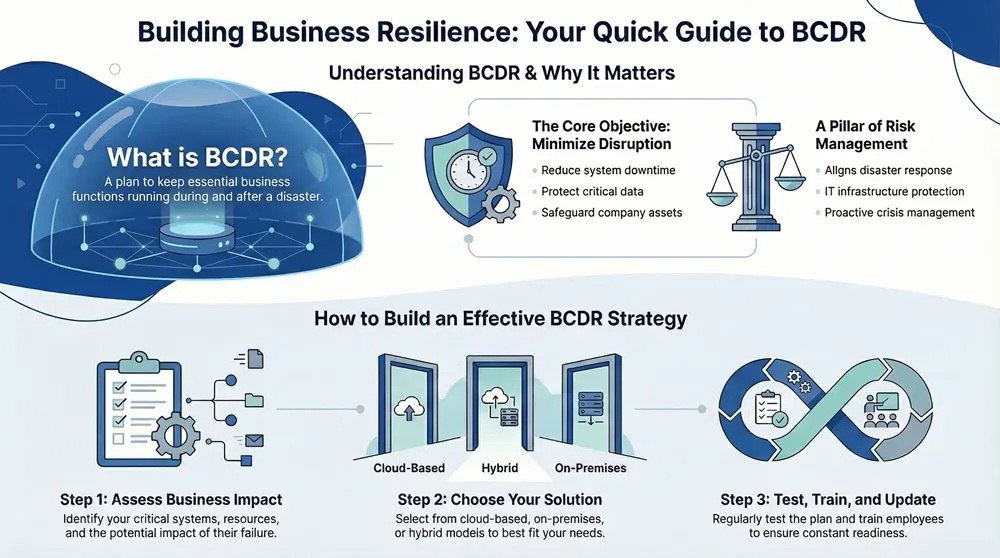
What Is BCDR?
BCDR focuses on strategies that support smooth operations through computer server management, business continuity planning, and bcp drp essentials. Each element adds value, ensuring revenue generation while maintaining solid data protection techniques.
Understanding the Concept of Business Continuity and Disaster Recovery
The framework of business continuity and disaster recovery revolves around a strategy that ensures essential operations persist during disruptions. This method involves comprehensive audits to identify vulnerabilities and implement mitigation measures that secure critical data and systems for every client.
Its core objective is to minimize the adverse effects of an unexpected disaster by establishing solid recovery procedures. The approach offers practical insights drawn from real-world scenarios, enabling organizations to stay prepared through systematic audits, targeted mitigation tactics, and effective strategy implementation.
Key Components of BCDR
An effective BCDR strategy relies on strong redundancy measures that prevent data center failures and mitigate risks, such as a critical software bug that could disrupt operations. Organizations benefit from implementing backup systems that reduce expense by minimizing downtime and ensuring continuous service availability.
Robust BCDR planning also incorporates efficient data center management and vigilant system checks to catch errors before they escalate. This approach helps an organization maintain essential operations while controlling expense and protecting valuable data assets through well-designed backup protocols.
Importance of Business Continuity and Disaster Recovery

Every business needs a reliable BCDR plan. This section covers dr bcp essentials and dr and bcp strategies that form a hybrid approach to risk management, ensuring a solid link between protection measures and community needs. The information provided establishes practical insights for businesses adopting these critical steps.
Why Every Business Needs a BCDR Plan
BCDR plans prove indispensable as they equip organizations with actionable information to address emergencies and unforeseen challenges. The plan’s design supports scalability across multiple operations and aligns with recommendations from the federal emergency management agency, ensuring that critical systems remain operational during disruptions.
Organizations benefit from BCDR strategies that offer practical insights and tailored risk management procedures, effectively reducing system downtime. This robust approach not only safeguards essential data but also supports comprehensive emergency preparedness, ensuring that all sectors within a business maintain continuity during crises.
The Role of BCDR in Risk Management
BCDR plays a critical role in risk management by aligning disaster response strategies with robust engineering practices that safeguard IT infrastructure. This approach allows organizations to implement advanced cloud computing solutions and maintain effective crisis management procedures during unexpected disruptions.
The system offers practical guidelines that support efficient disaster response planning while integrating modern engineering solutions. It also reinforces IT infrastructure through proactive monitoring, ensuring that cloud computing resources and crisis management policies work together to reduce operational risks.
How to Develop an Effective BCDR Plan

This section explains key steps in creating effective BCDR plans. It covers assessing business impact, identifying critical resources, and step-by-step guides for business continuity and disaster recovery plans. The approach integrates management analytics with database protection, clarifies bcdr meaning, and addresses phishing risks. These insights offer practical guidelines for organizations seeking resilient operational processes.
Assessing Business Impact and Identifying Critical Resources
The evaluation process starts with a detailed review of the current IT infrastructure, including computer hardware and cloud solutions like amazon s3, to secure data and ensure operational resilience. This assessment empowers leadership teams to prioritize investments that support robust internet connectivity and reduce downtime in line with small business administration guidelines.
Organizations rely on systematic impact assessments to pinpoint potential failures in critical systems and streamline response measures. Leaders use practical examples from the internet and computer hardware evaluations to inform decisive actions that protect valuable assets and maintain uninterrupted operation through a well-structured plan.
Step-by-Step Guide to Creating a Business Continuity Plan
The process begins with defining critical operations and resources, incorporating strong encryption protocols to secure sensitive data and setting up a virtual machine environment to simulate potential disruptions. This ensures high productivity levels and offers an example of a business recovery plan tailored for situations such as a flood, enabling decision-makers to respond swiftly.
Leaders should assess their current IT infrastructure and develop response strategies that incorporate critical data protection measures. They must create scenarios reflecting real-world challenges, such as flood impacts, while utilizing virtual machine configurations to evaluate the plan’s resilience and the overall efficiency of recovery steps, ultimately contributing to improved productivity.
Step-by-Step Guide to Creating a Disaster Recovery Plan
The process begins with identifying core systems and establishing strict data security protocols that guarantee high uptime during emergencies. Experts recommend integrating robust storage solutions while investing in continuous education on disaster response, ensuring teams understand the nuances of insurance claims and risk mitigation practices.
Implementing a disaster recovery plan involves regular assessments and simulations to validate the effectiveness of backup systems and data security measures. Practitioners emphasize aligning recovery steps with business impact evaluations, ensuring that storage solutions and insurance provisions work together to maintain critical uptime during disruptive events.
Types of BCDR Solutions
BCDR topics cover cloud-based technology for business continuity and disaster recovery, on-premises policy management, and hybrid approaches merging both models. The discussion addresses credit card security and effective communication strategies, providing clear guidance on each option’s value and implementation. This concise overview sets the stage for practical insights into tailored BCDR solutions.
Cloud-Based BCDR Solutions
Cloud-based BCDR solutions deliver reliable protection for business operations by leveraging cloud infrastructure to prevent data loss and support high availability, even during disruptions. The strategy enhances telecommunications avenues for remote access, ensuring that recovery processes proceed smoothly under challenging conditions.
This approach simplifies the recovery framework by integrating cloud capabilities with robust security protocols. Designed to support critical business operations, these solutions minimize data loss and bolster telecommunications networks while promoting high availability and operational continuity.
On-Premises BCDR Strategies
The company currently relies on on-premises BCDR strategies that support robust inventory tracking and protect valuable property during emergencies. This approach delivers practical emergency management solutions while reinforcing cyber resilience through regular system audits and on-site data backups.
Experts recommend companies consider on-premises strategies to maintain control over critical assets and inventories. A well-planned system ensures that comprehensive emergency management procedures are in place and that cyber resilience remains a top priority when facing potential threats.
Hybrid Approaches to BCDR
The hybrid approach combines on-premises solutions with cloud storage to address risk management challenges while reducing the complexity of traditional disaster response methods. Experts note that this method allows machines to operate efficiently in secure environments, offering strengthened defenses against malware and other threats.
This solution offers practical methods for businesses to maintain operational functionality during disruptions. Industry professionals report that integrating cloud storage and on-premises systems creates a balanced strategy for risk management, ensuring that critical machines remain secure against evolving malware threats.
Benefits of Implementing BCDR
BCDR strategies maintain operational continuity, protect essential data, and boost customer trust. Organizations benefit from virtualization, secure software, and effective snapshot practices to strengthen their supply chain and security measures. The upcoming sections offer clear insights on ensuring continuous operations, asset protection, and enhanced customer satisfaction through reliable recovery methods.
Maintaining Operational Continuity
Organizations that adopt a BCDR strategy ensure that critical assets remain secure and accessible by addressing potential vulnerabilities within their workflow. This systematic approach bolsters remote work arrangements while leveraging object storage solutions to safeguard valuable data and sustain smooth operations during unexpected disruptions.
Experts observe that a robust BCDR plan strengthens a company’s resilience by streamlining processes and preventing workflow interruptions. By integrating secure object storage and rigorous assessments of system vulnerability, the plan supports operational continuity and protects essential assets, ultimately enhancing remote work capabilities and overall business performance.
Protecting Data and Assets
The company maintains a secure computer network and employs business interruption insurance to protect valuable data and assets in the face of unforeseen challenges such as a power outage. This approach minimizes the cost impact of disruptions while effectively managing risk and ensuring the continuity of operational systems.
Organizations benefit from implementing robust strategies that safeguard sensitive information and critical assets, reducing the overall risk associated with digital and physical threats. By integrating targeted measures and industry best practices, the plan secures computer systems and provides peace of mind for stakeholders, especially when dealing with the direct consequences of a power outage or similar events.
Enhancing Customer Trust and Satisfaction
Implementing a robust BCDR plan enables organizations to protect critical data while reducing vulnerability to ransomware attacks. By incorporating trusted solutions such as Veeam, managed service providers (MSPs) can ensure a streamlined recovery process that reinforces customer trust through reliable system safeguards.
Maintaining strong disaster recovery protocols allows businesses to quickly respond and restore operations, which enhances customer satisfaction and retention. The approach leverages modern technologies that enable efficient data backup and recovery, providing MSPs with practical tools to manage risks and deliver outstanding service quality.
BCDR Best Practices and Tips
This section covers regular testing and updating of BCDR plans, training employees on effective protocols, and leveraging technology for optimal implementation. A practical checklist including IBM and cloud disaster recovery insights, paired with accounting best practices, ensures accessibility and efficient risk management for business continuity and disaster recovery.
Regular Testing and Updating of BCDR Plans
Regular testing and updating of BCDR plans is integral to preserving a resilient infrastructure, ensuring that every system component performs optimally under unexpected conditions while upholding rigorous information security standards. An experienced engineer conducts simulation tests using solutions such as datto bcdr to validate recovery procedures and identify areas for improvement in real operational environments.
Adjusting recovery plans regularly allows organizations to promptly address emerging vulnerabilities and adapt their security protocols to evolving threats. This proactive approach helps an engineer fine-tune the system, ensuring that policies remain robust and aligned with current industry requirements in information security.
Training Employees on BCDR Protocols
The organization trains its workforce on critical elements of the bcdr plan by regularly simulating failover scenarios and integrating kubernetes-based platforms to ensure disaster recovery readiness. This practical training reinforces employee safety and prepares teams to implement swift action when faced with potential disruptions.
Training programs include real-world simulations that allow staff to experience controlled disruptions and practice recovery procedures during disaster recovery drills. The approach ensures that employees understand each protocol while maintaining high standards of safety and stability for the overall bcdr plan.
Leveraging Technology for Optimal BCDR Implementation
The use of cutting-edge technology boosts the efficiency of BCDR strategies by reducing failure risks and supporting effective risk assessment across systems, ensuring high data management standards. Industry professionals rely on secure software frameworks to maintain system health and improve customer confidence during unexpected events.
Organizations incorporate advanced monitoring systems that provide real-time insights into potential failure points, thereby strengthening overall risk assessment practices and data management processes. This practical approach helps experts address customer concerns while ensuring that system health and performance remain a top priority during critical operations.
Conclusion
BCDR ensures uninterrupted operations and safeguards critical data during unexpected events. It streamlines risk management through detailed assessments, effective recovery procedures, and strong backup measures. The guide illustrates how blending cloud-based, on-premises, and hybrid solutions can optimize organizational resilience. This framework empowers businesses to reduce downtime, mitigate disruptions, and secure vital assets across operations.