
AI Overview:
This blog explains how Managed Print Services (MPS) turn unpredictable printing costs into a controlled, optimized monthly expense. It breaks down the four main pricing models, the top factors that influence cost, and how businesses typically save 15–30% by consolidating supplies, repairs, and device management.
You’ll learn how MPS eliminates hidden expenses—like emergency toner buys, surprise repair bills, and wasted IT time—and how to calculate real ROI using your current unmanaged print spending. The guide also highlights contract red flags and provides practical ways to reduce ongoing costs through fleet right-sizing, smarter print policies, and employee awareness.
Overall, the article shows how MPS delivers predictable budgeting, increased productivity, and long-term financial efficiency.
The actual cost of managed print services (MPS) is more than just an invoice amount—it’s a strategic investment that transforms printing from an unpredictable expense into a streamlined, manageable operational cost. Businesses that adopt a well-structured MPS plan typically see a 15-30% reduction in their total printing expenses. This guide breaks down the pricing models, key cost factors, and potential ROI to help you determine if MPS is the right financial move for your organization.
What Determines Your Managed Print Services Cost
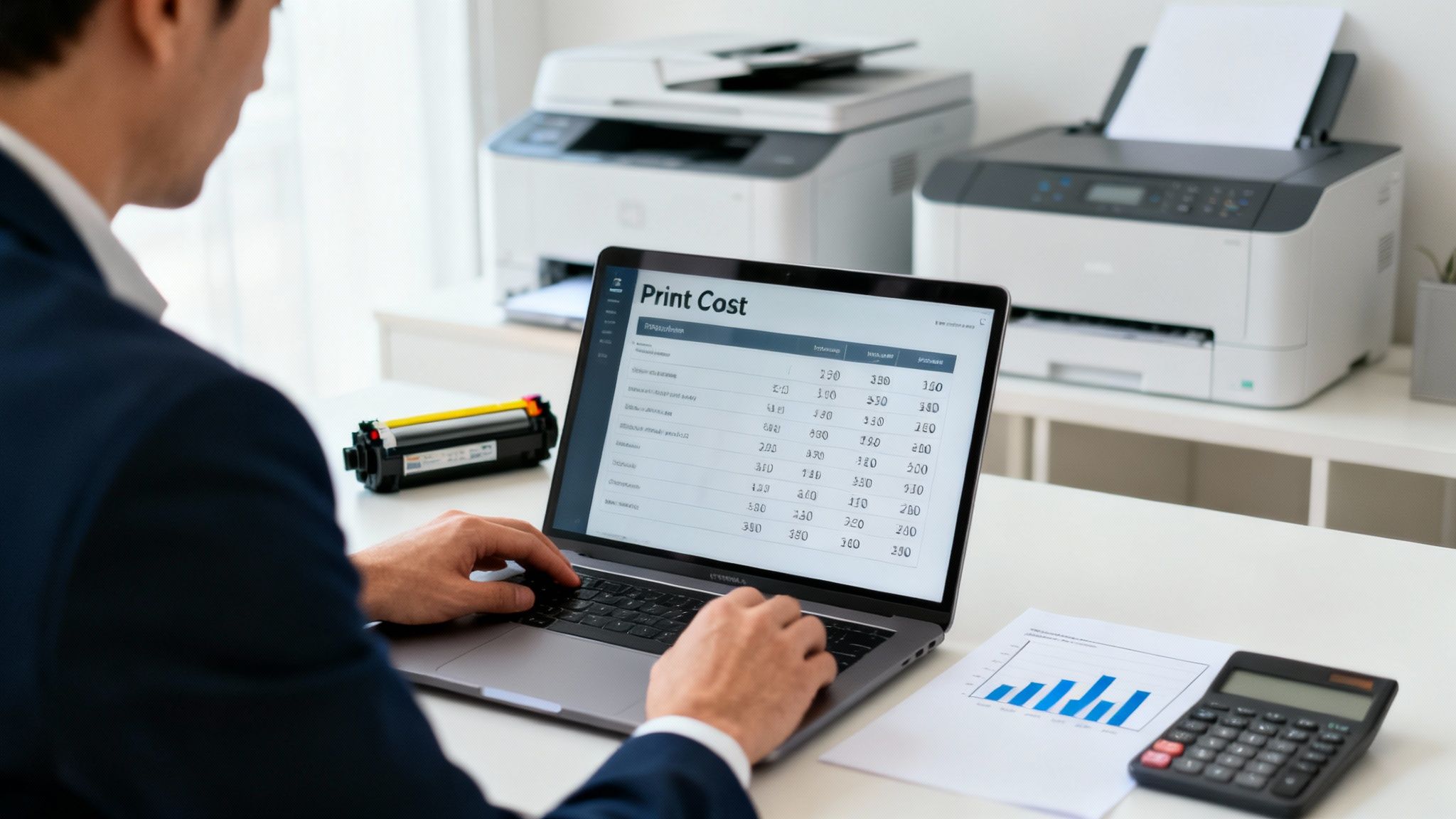
To accurately understand what you will pay for managed print services, you must look beyond a single monthly bill. Consider the hidden costs of your current unmanaged printing environment: last-minute toner purchases, unexpected repair bills, and the valuable time your IT team spends on printer-related issues. These individual expenses accumulate, creating a significant drain on your budget. The primary benefit of MPS is consolidating these scattered costs into one predictable payment that delivers far more than just ink and paper.
This guide will explain the true value you receive, detailing how hardware, supplies, maintenance, and ongoing optimization are bundled together. We will explore different pricing models, identify the key factors that influence your final price, and provide practical methods for calculating your potential savings. By the end, you will see how the right MPS partnership delivers significant operational efficiency alongside direct cost reductions.
Shifting from Unmanaged to Managed Costs
An unmanaged print environment is a minefield of hidden expenses. Consider the day-to-day reality: different departments purchase their own printers and supplies, resulting in a mismatched fleet of devices that require various expensive toner cartridges. When a machine breaks down, an employee often wastes time attempting a fix before calling a costly third-party repair service, all while productivity suffers.
A well-designed Managed Print Services plan moves your business from this chaotic, reactive state to a proactive, predictable model. Instead of putting out fires, you have a partner who anticipates your needs, automates supply deliveries, and performs preventative maintenance to keep your entire print fleet humming.
This transition is the core value proposition of MPS. It is not merely about leasing printers; it is about gaining control over a significant business expense that has likely been overlooked. By centralizing management, you gain a clear view of your actual print volume and spending. This enables you to make data-driven decisions that optimize your entire print infrastructure, turning it into a system designed to support your business goals, not hinder them.
Breaking Down the Four Core MPS Pricing Models
When evaluating managed print services, the payment structure is as important as the services included. Selecting the right pricing model is not just about finding the lowest price; it is about aligning the payment plan with your company’s workflow, printing habits, and budget predictability. A well-chosen model ensures you avoid overspending and only pay for what you use.
Let’s examine the four primary ways these services are structured. Understanding the details of each will place you in a stronger position when negotiating a contract.
The Cost-Per-Page Model
This is the most traditional and common approach, also known as “pay-per-click” or “cost-per-copy.” The premise is simple: you pay a set rate for each page you print. Your provider installs software to track print volume, distinguishing between black-and-white and color pages. Each month, you receive a detailed invoice based on your usage and the agreed-upon per-page rate, offering a direct and transparent billing method.
- Best For: Companies with unpredictable or seasonal printing needs, such as accounting firms during tax season or construction companies printing project-specific blueprints.
- Pros: Highly transparent, as costs are directly tied to actual usage. You never pay for printing you don’t do.
- Cons: The lack of predictability can be a significant drawback. A month with heavy printing can result in an unexpectedly high bill, complicating budget forecasting.
The Tiered Pricing Model
The tiered model operates similarly to a cell phone data plan. You agree to a fixed monthly cost that includes a set number of pages—for example, 10,000 black-and-white and 2,000 color pages. This provides a predictable base cost for budgeting.
If you exceed your allowance, you pay an agreed-upon overage rate for each additional page. This model offers a balance between the predictability of a flat rate and the flexibility to accommodate busier months.
The tiered model is ideal for businesses with a solid understanding of their average print volume but require flexibility for occasional spikes in activity. It simplifies budgeting while keeping overage costs clear and manageable.
The Subscription or Flat-Rate Model
For businesses that prioritize budget certainty, the subscription model is the optimal solution. It functions like a “Software as a Service” (SaaS) subscription, where you pay a single, fixed monthly fee for all-inclusive services.
This fee typically bundles hardware, all supplies, maintenance, and support into one predictable cost, often with a generous or even unlimited page count. This model is favored by accounting departments because it simplifies to a single, consistent line item each month.
- Real-World Example: A mid-sized law firm with consistent high-volume printing needs for case files and client documents opted for a flat-rate model. This eliminated invoice variability, allowing them to budget their print expenses with 100% accuracy and freeing up administrative staff from tracking supply orders and repair costs.
The Lease Plus Supplies Model
This hybrid approach separates hardware costs from service and supply costs. First, you lease the printers and multifunction devices for a fixed monthly payment, similar to leasing a company vehicle. This allows you to acquire modern equipment without a large upfront capital expenditure.
The service component—including toner, parts, maintenance, and support—is then billed separately, typically on a cost-per-page basis. This is a common arrangement for businesses that need to upgrade their entire fleet as part of an MPS agreement. This route requires a clear understanding of leasing vs buying equipment, as it sets the foundation for your long-term costs. For a deeper dive into how leasing works for office machines specifically, check out our https://1800officesolutions.com/copier-lease-ultimate-guide/.
Comparison of MPS Pricing Models
Choosing the right model involves aligning the structure with your business needs. This table breaks down the four main options to help you identify the best fit for your company.
| Pricing Model | Best For | Pros | Cons |
|---|---|---|---|
| Cost-Per-Page | Businesses with fluctuating or unpredictable print volumes. | Highly transparent; you only pay for what you use. | Difficult to budget for; can lead to surprise high bills. |
| Tiered | Businesses with fairly consistent volume but occasional spikes. | Predictable base cost with a clear structure for overages. | Can be less cost-effective if you consistently fall far below or go way over your tier. |
| Subscription | Businesses that need absolute budget predictability. | Simple, all-inclusive monthly fee. Easy for accounting. | May pay for unused capacity if print volumes are consistently low. Less flexibility. |
| Lease + Supplies | Businesses needing new hardware without a large capital expense. | Spreads out equipment costs over time; modernizes fleet. | More complex billing with two separate cost components to track. |
Ultimately, the best model depends on your printing habits, budget priorities, and growth plans. By understanding these options, you can have a much more productive conversation with a provider and land on a plan that truly works for you.
The Five Key Factors That Influence Your Price
Selecting a pricing model is only the first step. The final managed print services cost is determined by the specific details of your daily operations. These five factors are the primary components your provider will use to build a customized pricing structure for your business. Understanding them is essential for identifying potential cost savings.
1. Print Volume
The most significant cost driver is your print volume—the total number of pages your company produces each month. This is a matter of economies of scale: higher volumes typically result in a lower cost-per-page, as providers can offer better rates for bulk usage.
This decision tree provides a quick visual guide on how the predictability of your print volume can help you select the right pricing model.
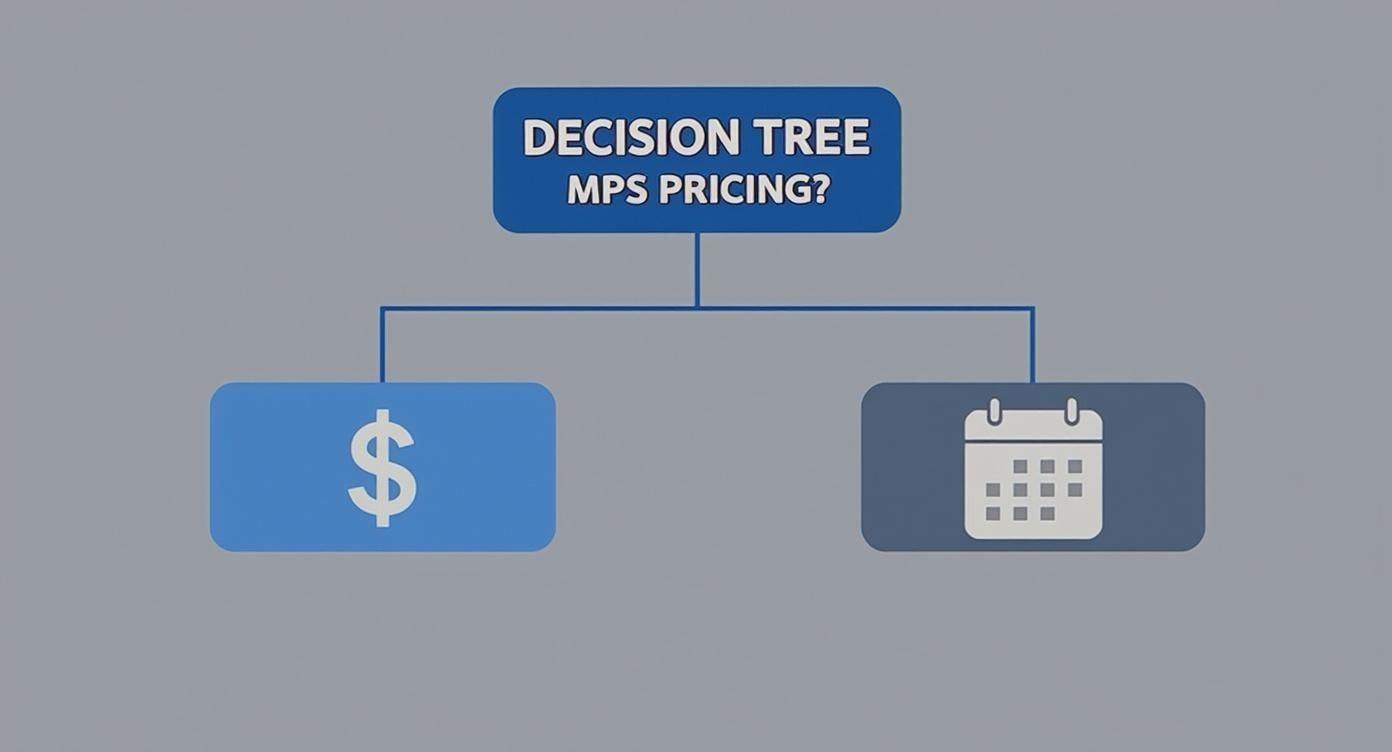
As shown, if your printing needs are stable and predictable, a fixed-rate model is often the most cost-effective choice. However, if your volume fluctuates, a pay-per-use plan may offer greater long-term savings.
2. Your Printer Fleet and Device Mix
The composition of your printer fleet, known as the device mix, is another critical factor. It is far more cost-effective to manage a streamlined set of modern, efficient multifunction printers (MFPs) than a disparate collection of older desktop printers from various manufacturers.
Older machines are often unreliable, require more frequent repairs, and consume expensive, inefficient toner cartridges. Consolidating your fleet into a smaller number of high-performance MFPs reduces the number of models to support and simplifies supplies management, directly lowering your service costs.
A provider’s first order of business is almost always to analyze your current device mix. The goal is to “right-size” your fleet—swapping out that inefficient, legacy hardware for modern equipment that crushes your total cost of ownership.
This optimization is a core benefit of MPS. For small and medium-sized businesses (SMEs), a well-executed MPS strategy often leads to a 15-25% reduction in print expenses just by placing the right devices in the right locations. As providers integrate with tools like accounting platforms, the value proposition continues to grow. You can explore more benefits for SMEs on Mordor Intelligence.
3. The Scope of Your Service Agreement
Not all MPS plans are created equal. The scope of services you select will significantly impact your final price. A basic plan might only cover toner and break-fix repairs, but the true value lies in more comprehensive agreements.
Consider these common add-ons:
- Proactive Monitoring: Software that monitors device health and automatically orders supplies before you run out, eliminating last-minute toner emergencies.
- Advanced Security: Services such as secure print release (to prevent sensitive documents from being left on the tray), user authentication, and consistent security policy enforcement across all devices.
- Workflow Automation: Software solutions that digitize paper-based processes, like scanning an invoice and routing it directly to your accounting system.
- Detailed Reporting: In-depth analytics on who is printing what, where, and when, providing valuable data for further cost reduction.
A comprehensive plan may have a higher monthly fee, but it often delivers a strong return on investment through enhanced security, improved efficiency, and real productivity gains.
4. Your Required Service Levels
Your Service Level Agreement (SLA) is the contractual guarantee of the support you will receive, and its terms are a direct cost driver. The SLA defines critical commitments, such as the response time for a technician when a machine fails.
For example, a business that requires a guaranteed four-hour on-site response time for a critical printer will pay a premium for that assurance. Conversely, a company that can operate with a next-business-day response will have a lower cost. This is a classic trade-off between cost and operational risk that must be weighed based on your business’s reliance on its printers.
5. Geographic Footprint and Logistics
Finally, your company’s physical layout—its geographic footprint—influences your managed print services cost. Servicing a single large headquarters is logistically simpler and therefore less expensive than supporting numerous small satellite offices across different regions.
Multiple locations introduce complexity:
- Technician dispatch becomes more challenging to coordinate.
- Supply chain management must be precise to deliver the right toner to the right office.
- Standardizing equipment across all sites is a larger undertaking.
A provider with a robust national service network can manage this, but the added complexity will be reflected in the price. When vetting providers, ensure they have the infrastructure to support all of your locations effectively.
How to Calculate Your Potential ROI from MPS
Determining whether managed print services will genuinely save your company money is the most critical question. Fortunately, you can build a solid business case by conducting a straightforward cost comparison between your current print spending and a proposed, predictable MPS fee.
This analysis should extend beyond toner costs. A proper evaluation illuminates hidden expenses and unlocks the substantial indirect savings from increased team productivity and efficiency. Let’s walk through how to calculate these savings and demonstrate how an MPS plan can deliver a significant return on investment.

Step 1: Tally Your Current Unmanaged Print Costs
First, you need a complete picture of your current spending. This requires digging deeper than just obvious invoices to uncover expenses that quietly drain your budget.
Gather these monthly figures:
- Supply Purchases: Sum all expenditures on toner, ink, and paper, including emergency, overpriced purchases from local office supply stores.
- Third-Party Repairs: Collect all invoices from technicians called for one-off printer fixes and maintenance.
- IT Labor Costs: Estimate the number of hours your IT team spends on printer-related issues each month and multiply that by their hourly wage to quantify the “soft cost” of their diverted time.
- Employee Productivity Loss: Estimate the time your staff loses dealing with printer jams, searching for drivers, or waiting for a device to function.
Adding these figures will give you your Total Monthly Unmanaged Print Cost.
Step 2: Compare Against a Proposed MPS Cost
Next, compare that total against a proposed MPS fee. A reputable provider will conduct a thorough assessment of your print environment before providing a quote based on one of the pricing models discussed earlier.
It is precisely these kinds of savings that are fueling the growth of the MPS market. On average, businesses reduce their print-related costs by 20-30% annually after implementing an MPS solution.
Step 3: Calculate Your Return on Investment
With these numbers, you can use a simple ROI formula to project the long-term financial impact. The formula is: ROI = [(Financial Gain – Cost of Investment) / Cost of Investment] x 100.
Applying this to our example:
- Calculate Annual Savings (Financial Gain): $475/month x 12 months = $5,700
- Calculate Annual Investment (Cost of MPS): $1,450/month x 12 months = $17,400
- Apply the ROI Formula: [($5,700 / $17,400)] x 100 = 32.7% ROI
A 32.7% return is an excellent financial result. However, this calculation only accounts for direct “hard cost” savings. It does not factor in the “soft cost” benefits, such as reclaiming productive hours for your team, enhancing document security, and reducing the administrative burden on your IT staff. When you include these advantages, the business case becomes undeniable. To see a deeper dive into these benefits, learn more about how managed print services boost ROI in our detailed guide.
A Managed Print Services agreement is designed to bring clarity and predictability to your printing costs. However, the contract itself can contain financial surprises if not reviewed carefully. A deal that appears favorable initially can become problematic if the agreement includes vague terms or hidden charges.
Understanding your MPS contract is the final and most critical step in controlling your costs. This is where you secure the value and protect your business from future budget shocks. Let’s examine the common areas where hidden fees often reside.
Scrutinizing the Fine Print for Potential Pitfalls
Before signing any agreement, it is crucial to investigate every clause. Providers structure contracts to protect their interests; your responsibility is to ensure the terms are balanced and fair for your company.
Pay close attention to these specific areas, as they are notorious for causing confusion and unexpected expenses:
- Steep Overage Charges: If you are on a tiered or per-page plan, exceeding your monthly volume is inevitable at times. Ensure the overage rate is reasonable and not a punitive multiple of your standard rate. An excessive overage fee can negate your anticipated savings.
- Automatic Renewal Clauses: Many contracts include an “evergreen” or auto-renewal clause. This feature automatically extends your contract for another full term (often 12 to 36 months) if you do not provide written notice to cancel within a specific window, which can be as narrow as 60 to 90 days before the contract ends. Missing this deadline can lock you into outdated terms with no negotiating power.
- Penalties for Non-OEM Supplies: Some agreements may penalize you for using supplies not purchased directly from the provider. While MPS should include all your supplies, this clause can become problematic in emergencies. Clarify this policy to avoid being charged a fee for using a third-party toner cartridge in a pinch.
A Checklist of Critical Questions for Your Provider
To achieve full transparency, you must ask direct and specific questions before making a commitment. A trustworthy provider will welcome these questions and provide clear, straightforward answers. Evasiveness from a vendor should be considered a major red flag.
A transparent contract is the foundation of a healthy partnership. Ambiguity in an agreement almost always benefits the provider, not the client. Your goal should be to eliminate any gray areas before a single signature is exchanged.
Before making a final decision, ensure you have satisfactory answers to every item on this list. For a more comprehensive guide, see our article on the most important questions to ask an MPS provider.
Essential Contract Questions:
- What is the exact toner coverage assumption? Most cost-per-page rates are based on a standard 5% page coverage. If you print graphics-heavy documents like marketing materials, your actual costs could be significantly higher than your quote.
- What is the escalation procedure for service issues? If a technician cannot resolve a problem on the first visit, what is the next step? You need to understand the exact process for escalating the issue to a senior technician or manager.
- What are my end-of-lease options? At the end of the contract, can you purchase the equipment, return it, or upgrade to new models? Understand the costs associated with each option.
- Are there any annual price increases? Determine if your quoted rate is locked in for the entire term or subject to an annual increase. A 3-5% annual price hike can significantly inflate your total cost over a multi-year contract.
Actionable Strategies to Reduce Your Ongoing MPS Costs
Signing a managed print services contract is the beginning, not the end, of optimizing your print spending. A strong MPS partnership is dynamic, empowering you to actively reduce your bottom line through intelligent, ongoing strategies. By implementing smart policies and collaborating with your provider, you can continuously refine your setup and lower your managed print services cost.
The most effective approach combines technology, sensible policies, and simple changes in user behavior. Instead of passively accepting the monthly invoice, you can take control and drive further savings long after the initial agreement is signed.
Right-Size Your Printer Fleet
One of the most impactful actions you can take is to “right-size” your printer fleet. Work with your MPS provider to analyze device usage data. This analysis will quickly identify underutilized, inefficient, or redundant printers.
By decommissioning unnecessary devices, you can consolidate print volume onto more efficient, centralized multifunction printers. This not only reduces your hardware footprint but also simplifies supply management and maintenance, leading to immediate and direct cost reductions.
Implement Smart Print Policies
Your provider can be your greatest ally in enforcing company-wide print rules that eliminate waste and significantly reduce supply costs. These policies are not about restricting your team but about encouraging more mindful resource consumption.
A few highly effective policies include:
- Default to Duplex: Set two-sided printing as the default setting. This single change can reduce paper consumption by up to 50%.
- Monochrome as Standard: Make black-and-white the default print setting. Users can still select color when necessary, but this prevents expensive color toner from being wasted on everyday documents.
- Restrict Large Jobs: Implement reasonable limits on the size of a single print job to prevent accidental, large-scale print runs that consume excessive paper and toner.
Secure print release technology is another game-changer for cost control. This feature holds print jobs in a secure queue until the user authenticates themselves at the printer. Studies consistently show this can slash wasted prints from forgotten or unclaimed documents by 20% or more.
Educate and Empower Your Employees
Technology and policies are only two parts of the solution; your team’s daily habits are the third. A small amount of education can have a significant impact. Host brief training sessions or send periodic email tips to encourage employees to think before they print.
Simple reminders to use “Print Preview” to catch formatting errors or to share documents digitally instead of on paper can foster a culture of cost-consciousness. When employees understand how their actions affect the company’s bottom line, they become active partners in the savings effort. To further reduce ongoing expenses, you might also explore services for selling unused toner cartridges to recover value from surplus supplies.
Your Questions About MPS Pricing, Answered
When investigating managed print services, many questions about cost naturally arise. To provide clarity and help you make an informed decision, we have answered the most common questions we receive from businesses.
Is MPS Really Cheaper Than Just Buying Our Own Printers?
In almost every case, yes—especially when considering the total cost of ownership. Purchasing a printer is only the initial expense. You must also account for ongoing costs like toner, routine maintenance, unexpected repairs, and the time your IT staff spends resolving printer issues. An MPS plan consolidates these unpredictable expenses into a single, predictable monthly payment. Businesses that switch typically reduce their overall print costs by 15-30%. This is achieved through an optimized fleet, automated supply deliveries, and proactive maintenance that prevents costly downtime.
How Can We Get Our Quoted MPS Cost Down?
You have significant influence over your final MPS price. The most effective strategy is to discuss optimization with a potential provider from the outset. A good partner will work with you to find the right solution, not just sell the most expensive package.
Here are a few effective ways to lower a quote:
Consolidate Your Fleet: Replace inefficient desktop printers with a few strategically placed, high-capacity multifunction devices to serve entire teams.
Adjust Your Service Level: If your office can function with a next-business-day repair, you don't need to pay a premium for a four-hour emergency response time.
Consider a Longer Term: Providers can often offer a better per-page rate if you commit to a longer-term agreement, such as 36 or 60 months.
Can We Keep Using Our Existing Printers with an MPS Plan?
Absolutely. A reputable MPS provider will begin by evaluating your current printers to determine which are reliable and efficient enough to be included in the new management plan. For compatible devices, they can install monitoring software to manage supply levels and service alerts.
However, they will also provide an honest assessment. They may recommend replacing older, less efficient models if the cost of maintaining them—due to frequent breakdowns or expensive toner—is higher than the cost of replacement. This is part of "right-sizing" your fleet to achieve the best performance at the lowest possible cost.
Ready to gain control over your printing expenses and discover what true savings look like? The team at 1-800 Office Solutions creates transparent, custom-tailored MPS plans designed to fit your unique business needs. Get your free, no-obligation quote today and take the first step toward a smarter, more cost-effective print environment.