

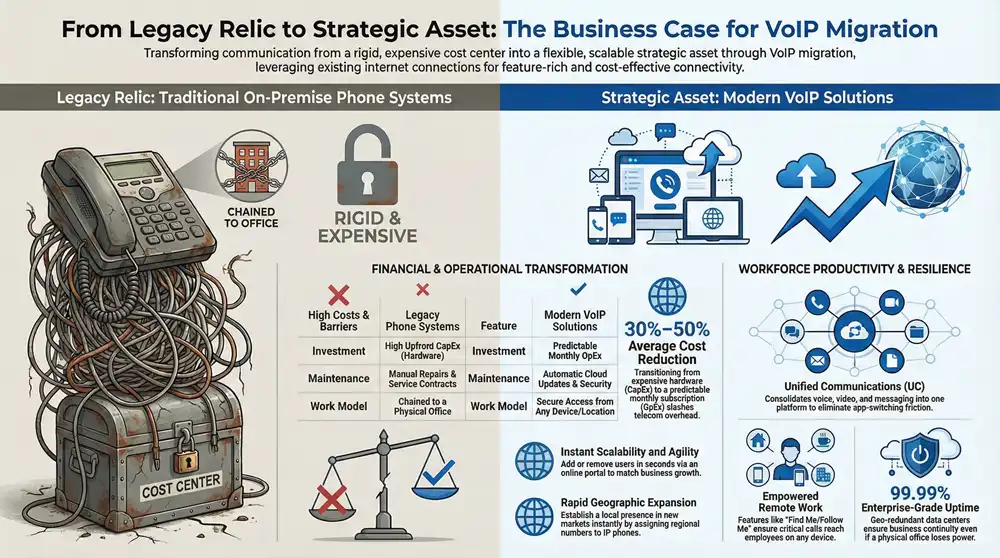
If your traditional phone system feels like an expensive, inflexible relic, you’re not alone. High costs, rigid infrastructure, and an inability to support modern work styles are common frustrations that hold businesses back. This guide explores the tangible benefits of VoIP for business, showing how upgrading your communications from a legacy cost center to a strategic asset can drive significant growth.
VoIP (Voice over Internet Protocol) is more than a new way to make calls; it’s a fundamental shift that unlocks major cost savings, unparalleled flexibility, and a suite of advanced features designed to empower your team.
Why Modern Businesses Are Switching to VoIP

Many companies are still tethered to outdated, on-premise phone systems. These legacy setups typically involve bulky hardware, restrictive contracts, and a separate, costly phone line for each employee. This model creates frustrating bottlenecks that slow down growth, especially when trying to add new team members or adapt to changing needs.
Worse, these systems are ill-equipped to support a distributed or remote workforce, effectively chaining productivity to a physical office. Voice over Internet Protocol completely changes this dynamic. By transmitting calls over your existing internet connection instead of traditional copper wires, VoIP unlocks a new world of efficiency and capability.
Transforming Communication from a Cost to an Asset
Making the switch to VoIP is a strategic upgrade to your entire business operation. It consolidates communication tools, slashes overhead, and provides the agility needed to stay competitive.
For any organization aiming to modernize and equip its teams with the right tools, the advantages are clear:
- Immediate Cost Reductions: Eliminate expensive hardware and unpredictable phone bills by moving to a simple, all-inclusive monthly fee that simplifies budgeting.
- Ultimate Flexibility and Scalability: Add or remove users in seconds through an online portal, ensuring your phone system grows and shrinks in lockstep with your business.
- Empowered Remote Work: Enable employees to use their business number anywhere, making and receiving calls from a laptop, mobile app, or IP phone as if they were at their desk.
- Enhanced Reliability: Leverage cloud-based infrastructure for superior uptime and built-in disaster recovery, ensuring you never miss a critical call.
Unlock Significant Cost Savings with VoIP
For most businesses, the decision to adopt new technology comes down to the bottom line. The financial benefits of VoIP are not a minor perk; they represent a complete overhaul of communication expenses. The model shifts from unpredictable capital spending to a clear, manageable operational cost.
Traditional phone systems lock you into expensive on-site hardware, surprise maintenance contracts, and the high cost of individual phone lines. This model simply doesn’t scale in a modern business environment.
VoIP sidesteps these issues by using the internet connection you already pay for. There’s no need for a clunky Private Branch Exchange (PBX) system in a server closet, which immediately eliminates a huge upfront investment and the need for specialized IT staff. Your billing transforms from a rollercoaster of hardware failures and service calls to a predictable, flat monthly subscription.
This is a critical advantage for businesses struggling with the limitations of older technology.
As this data shows, high costs and inflexible technology are major roadblocks to efficiency—precisely the problems VoIP is designed to solve.
Drastically Reduce Calling and Operational Costs
Beyond hardware, the day-to-day operational savings are substantial. Calling rates are a significant win, especially for businesses with a national or global client base. Traditional long-distance and international calls are notoriously expensive, adding a volatile charge to monthly bills.
VoIP systems treat all calls as data, which dramatically slashes or eliminates these per-minute fees. Most plans bundle unlimited domestic calling and offer highly competitive international rates. A once-major expense becomes a minor, predictable line item.
VoIP isn’t just about saving money on calls. It’s about optimizing your entire communications budget by removing redundant hardware, cutting maintenance fees, and consolidating services into one predictable monthly expense.
For example, a hosted phone system eliminates the need for an in-house expert to manage complex telephony hardware. All system updates, security patches, and new features are handled by your provider in the cloud. This frees up your IT team to focus on core business goals instead of wrestling with phone lines.
Quantifying the Financial Impact of VoIP
A practical cost breakdown reveals the stark difference between a legacy system and a modern VoIP solution.
These savings are not theoretical. Businesses consistently report measurable cost reductions after switching. Industry analyses cite average telecom cost savings of 30%–50%, with some companies saving as much as 75%.
This clear return on investment is achieved by shifting spending from a capital expenditure (CapEx) to a predictable operational expenditure (OpEx). For your business, this means:
- Eliminates High Upfront Investment: Avoid the five- or six-figure cost of buying and installing an on-premise PBX system.
- Predictable Monthly Budgeting: A flat per-user, per-month fee allows for accurate forecasting of communication expenses.
- Reduced Maintenance Overheads: No more surprise repair bills or expensive service contracts for aging hardware.
- Consolidated Billing: Combine voice, video, and messaging services into a single, easy-to-read invoice, reducing administrative work.
By removing the financial and operational barriers of legacy telephony, VoIP frees up capital and resources that can be reinvested directly into growing your business.
Scale Your Operations with Unmatched Flexibility
A static phone system can quickly hinder a growing business. Traditional telephony is rigid; adding lines or moving offices requires physical hardware installations, technician scheduling, and frustrating delays. VoIP solves this problem by design.
Think of VoIP as a cloud service rather than a utility. It detaches your phone number from a physical line, allowing you to add or remove users instantly from an online dashboard. This gives your business the power to adapt its communication setup in real-time to match operational demands.
Instantly Adapt to Business Changes
Imagine preparing for a seasonal rush. With a legacy system, adding temporary phone lines for customer service requires weeks of advance planning. With VoIP, you can add ten, twenty, or even a hundred new users in minutes, ensuring you are fully staffed and ready to serve customers without delay.
Conversely, when the busy season ends, you can remove those lines just as quickly, so you aren’t paying for services you no longer need. This elasticity ensures your communication costs always align with your current headcount.
The true power of VoIP flexibility is its ability to empower growth. Your phone system becomes an enabler, letting you scale up or down at a moment’s notice without technological headaches or long lead times.
Expand Your Geographic Footprint with Ease
Geographic expansion is another area where VoIP’s flexibility shines. Opening a new office with a legacy system is a massive project involving new hardware and local provider contracts.
With VoIP, setting up a new location is as simple as shipping pre-configured IP phones to the new address and plugging them in. You can also instantly establish local phone numbers for that market, giving your business an immediate local presence. A sales team in Austin can make calls that appear as a Seattle-based number, building trust with regional clients.
This flexibility is a game-changer in scenarios like:
- Onboarding New Hires: A new employee can have a live extension before their first day, with their desk phone and apps ready to go.
- Supporting Mergers and Acquisitions: Integrate a newly acquired company’s communication system online, merging teams under a unified network without a major hardware overhaul.
- Rapid Project Team Deployment: Spin up a dedicated phone line or call queue for a specific project in minutes and take it down just as easily when finished.
This level of agility, once reserved for large enterprises, is now one of the core benefits of VoIP for businesses of all sizes, enabling a communication system as dynamic as their ambitions.
Enhance Productivity with Advanced Communication Features

Moving to VoIP offers more than just internet-based calls; it unlocks a powerful toolkit of features that can fundamentally improve how your team collaborates and works. These tools transform your phone system from a simple utility into a central productivity hub.
Features that were once expensive, complicated add-ons are now standard. This evolution is known as Unified Communications (UC)—the integration of all communication methods into a single platform. Instead of switching between separate apps for phone calls, video meetings, and instant messaging, your team can manage everything from one place. This consolidation is a major benefit of VoIP for business, reducing the daily friction that consumes valuable time.
Streamline Workflows with Intelligent Call Management
One of the first productivity boosts comes from intelligent call management. These tools, once exclusive to large corporations, are now accessible to all businesses, providing a professional polish to customer interactions and ensuring every call is handled efficiently.
- Auto-Attendant: A “virtual receptionist” greets callers with a professional menu (“Press 1 for Sales, Press 2 for Support”), ensuring your business sounds polished 24/7 and directs callers correctly without tying up a human operator.
- Intelligent Call Routing: Set up smart rules based on the time of day, caller ID, or team availability. For example, calls after 5 PM can be automatically sent to a specific voicemail or an on-call team member’s mobile phone.
- Voicemail-to-Email Transcription: The system automatically converts voice messages to text and emails them to your inbox. Team members can quickly scan messages on the go, identify urgent issues, and save important information without dialing into a voicemail box.
These tools work together to eliminate manual work and reduce the risk of losing valuable leads, automating front-line communications so your team can focus on higher-value tasks.
Unify Your Communication Channels
Modern business conversations happen across multiple channels. A project may start with a phone call, move to a team chat for updates, and require a video conference for detailed reviews. A Unified Communications platform brings all these threads together.
With a UC approach, your communication tools stop being isolated silos and start working together. This integration mirrors how modern teams collaborate and is where true productivity gains are found.
For example, an employee can escalate a chat message to a video call with a single click, instantly sharing their screen to solve a problem. This seamless transition is a massive advantage over a disconnected, old-school phone system.
This consolidation also allows integration with other crucial business applications. With CRM integration, a salesperson receiving a call can see the customer’s entire profile pop up on their screen, creating a more personal and effective conversation from the start.
A Practical Look at Feature Impact
To understand the value, it’s helpful to connect features to tangible business outcomes.
Key VoIP Features and Their Business Impact
| VoIP Feature | Description | Business Benefit |
|---|---|---|
| Video Conferencing | Host multi-participant video meetings with screen sharing, recording, and chat functions directly within the platform. | Reduces travel costs, facilitates better collaboration for remote teams, and speeds up decision-making processes. |
| Instant Messaging | Enables secure, real-time text-based chat for individuals and groups, often with file-sharing capabilities. | Provides quick answers to internal questions, reduces email clutter, and fosters a more connected team culture. |
| Find Me / Follow Me | A single business number rings multiple devices (desk phone, mobile app, home phone) in a user-defined sequence. | Increases employee accessibility and responsiveness, ensuring critical calls are never missed, regardless of location. |
| Call Recording | Automatically or manually record inbound and outbound calls for quality assurance, training, or compliance purposes. | Improves customer service training, provides a clear record for dispute resolution, and ensures regulatory adherence. |
Ultimately, the advanced features included with most VoIP plans are designed to break down communication barriers and make your team more effective, creating a more agile, responsive, and productive workplace.
Empower Your Remote and Hybrid Workforce
The traditional concept of “the office” has evolved. Work is no longer a place, but what a team accomplishes, regardless of location. This is where VoIP provides one of its biggest advantages, serving as the central hub that powers a flexible, distributed team.
VoIP frees employees from being tied to a desk. It transforms a business phone number from a physical line into a digital identity that travels anywhere. An employee can answer their main office extension from a softphone app on their laptop at home, on their smartphone, or from an IP phone across the country.
This capability is a game-changer for maintaining a professional presence. A client calling your main business line receives the same experience whether the person answering is at headquarters or working from a home office. This consistency is critical for building customer trust.
Expand Your Talent Pool and Build Resilience
By removing geography from the communication equation, you directly enhance your hiring strategy. You are no longer limited to recruiting from the local talent pool and can hire the best person for the job, wherever they live.
This flexibility also makes your business more resilient. Operations are no longer dependent on a single physical building that could be disrupted by a power outage, storm, or local construction.
A team running on VoIP can continue working without interruption, protecting revenue and ensuring business continuity. If the office is inaccessible, your people can log in from home and carry on as usual.
Drive Productivity from Anywhere
Mobility is a productivity multiplier. A robust VoIP system with mobile and desktop apps empowers your team to stay connected and responsive in any situation.
Consider these common scenarios:
- Sales reps on the road can make and receive calls from their business number, maintaining a professional image instead of using a personal cell.
- Field technicians can start a video call with an office-based expert to troubleshoot a problem on-site, resolving it faster.
- Remote customer service agents can access the same call queues, CRM data, and management tools as their in-office colleagues, ensuring uniform service quality.
By providing every employee with a full-featured communication toolkit usable on any device, you eliminate the friction that slows a distributed team down, resulting in a more agile, productive, and connected workforce.
Improve Reliability and Business Continuity
A common myth persists that internet-based phone systems are less reliable than landlines. In reality, today’s VoIP solutions often provide far superior uptime and smarter disaster recovery options, making them a key asset in your business continuity plan.
A traditional phone system is tied to a single physical location, creating a single point of failure. A cloud-based VoIP system, however, is distributed across multiple, secure data centers. This geo-redundancy means if one data center experiences an issue, your service seamlessly fails over to another. Your business remains online without your customers ever knowing.
Automatic Failover and Disaster Recovery
Imagine a storm knocks out power at your office. With a legacy phone system, your lines would go dead, cutting off communication with customers. A major benefit of business VoIP is that it’s designed to handle such situations automatically.
VoIP platforms include built-in rules for automatic call forwarding and failover. If your main internet line goes down, calls are instantly rerouted to other numbers or devices.
- Reroute to Mobile Devices: Calls can be automatically pushed to your team’s cell phones.
- Forward to Another Location: Calls can be redirected to another office or location.
- Send to Voicemail: As a final safety net, calls can be sent to voicemail, with transcriptions emailed for quick follow-up.
This built-in preparedness keeps your business operational no matter the circumstances. Understanding these capabilities is a core component of building a resilient strategy, and it is worth exploring the key aspects of BCDR (Business Continuity and Disaster Recovery).
VoIP transforms your phone system from a potential point of failure into a strategic asset for business continuity. It ensures that no matter what happens at your physical location, you remain open for business.
Meeting Enterprise-Grade Uptime Standards
The reliability of VoIP is a proven fact. Top-tier providers now offer carrier-grade uptime guarantees, often reaching 99.99% or higher. Paired with a backup internet connection, a modern VoIP platform can meet the stringent continuity demands of any organization, easily rivaling traditional phone service.
This dependability is why so many businesses now trust VoIP to handle their most critical communications.
Find the Right Partner for Your VoIP Transition
Selecting the right VoIP technology is only the first step; the partner you choose to implement and support it is equally critical. The best features are meaningless without an expert team managing the transition and providing long-term support. Your goal is to find a true partner who understands your business objectives.
When vetting providers, look beyond the price tag. Examine their service level agreements (SLAs) for uptime guarantees, inquire about security protocols, and test their customer support responsiveness. A good partner will be transparent about their infrastructure and work with you to build a reliable communication system.
The Value of a Managed Services Partner
Choosing a managed services provider (MSP) that bundles VoIP with broader IT solutions can be a strategic advantage. Instead of juggling separate vendors for phones, network security, and IT support, you gain a single team responsible for your entire technology stack. This integrated approach ensures all your systems work together seamlessly.
When you integrate VoIP with managed IT, you’re not just simplifying your bills; you’re creating a single point of contact for all your tech needs. It’s a holistic strategy that boosts compatibility, tightens up security, and makes getting support a whole lot easier.
For instance, when your VoIP system and network are managed by the same experts, troubleshooting call quality issues becomes significantly faster. Security is also enhanced, as your provider can apply consistent protection across both communications and data networks. Before making a decision, it’s wise to explore the essential qualities to look for in a VoIP distributor.
The right partner does more than sell you a phone system. They become an extension of your team, offering strategic guidance to ensure your technology investment drives business growth and delivers a tangible return.
Unlock the Full Potential of VoIP with an Expert Partner
The benefits of VoIP for business—from significant cost savings to enhanced productivity and flexibility—are clear. But realizing these advantages requires a seamless transition and expert management. A trusted partner ensures your technology not only works but also aligns perfectly with your strategic goals.
Ready to upgrade your communications and streamline your IT? At 1-800 Office Solutions, we combine industry-leading VoIP with comprehensive managed IT services to provide a secure, cost-effective, and fully integrated solution for your business.