


Grasping the Concept of B2B2C in Modern Commerce

What Is B2B2C in Business-to-Business-to-Consumer Models?
B2B2C in Business-to-Business-to-Consumer Models redefines traditional supply paths and offers new growth strategies. This post explains the inner workings of B2B2C, presents real-world examples, and examines both benefits and challenges. Readers will gain clear insights to improve collaboration and market reach. The content targets suppliers seeking efficient strategies to boost productivity and market success.
This section defines the B2B2C model and its components, highlighting its unique behavior compared to other business frameworks. It explains key differences, touching on elements from fintech and consumer trends, while incorporating insights from sources like HubSpot and advancements in artificial intelligence.

Defining the B2B2C Model and Its Components
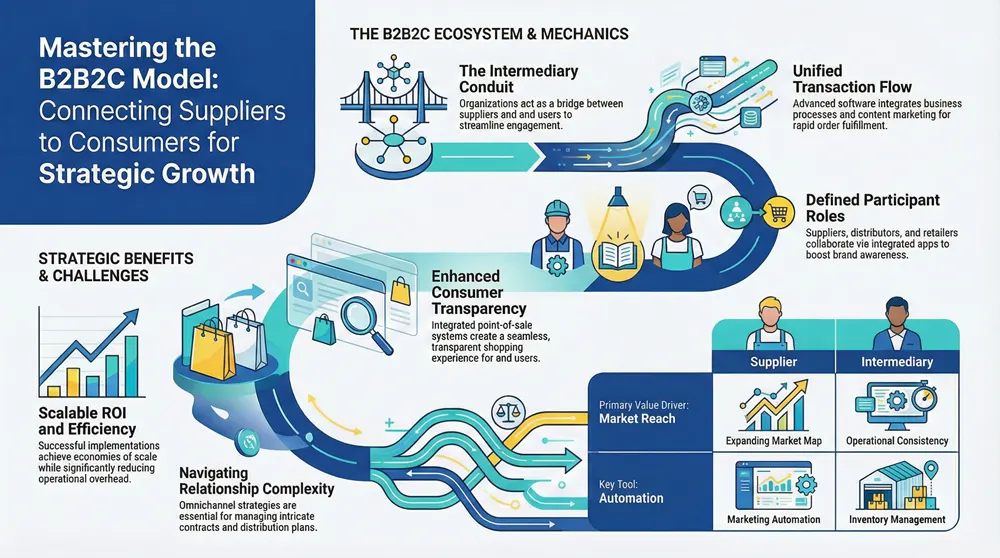
The B2B2C model represents a dynamic business model where organizations serve as a conduit between suppliers and end consumers, streamlining processes such as payment and customer engagement. This framework not only supports economic growth but also reinforces the interaction between business to business to consumer channels, fostering improved efficiency and broader market reach.
The approach emphasizes clear roles for each participant, allowing companies to optimize resources and enhance customer engagement effectively. By integrating direct communication lines among involved parties, the model supports streamlined payment processes and robust economic growth, creating a sustainable pathway for expansion within the modern business to business to consumer environment.
Key Differences Between B2B2C and Other Business Models
The B2B2C model distinguishes itself by linking suppliers and consumers with an integrated system that supports finance operations, marketing strategy, and price setting across channels. This structure provides companies with actionable insights on shopping trends and enables effective use of marketing automation tools.
The approach contrasts with traditional models by emphasizing a seamless process that connects partners and market segments. It allows businesses to address challenges in finance, manage price structures, and optimize marketing strategy while leveraging marketing automation to meet evolving shopping expectations.
Understanding the Mechanisms of B2B2C
This section outlines how transactions flow in B2B2C ecosystems and clarifies each party’s role. It discusses the use of automation and intelligence to track consumer behavior via a search engine and database, ensuring smooth operations between brick and mortar establishments and digital platforms. The content also details how companies and their sales team coordinate to maintain effective communication.
How Transactions Flow in B2B2C Ecosystems
In B2B2C ecosystems, transactions move efficiently across unified platforms where business process integration plays a central role. This system combines advanced software with content marketing strategies to facilitate rapid order processing, address customer queries effectively, and support employee benefits initiatives that improve overall productivity.
The ecosystem establishes a cohesive community by aligning various stakeholders, including suppliers and end consumers, through clear communication channels. Such platforms streamline transaction flows and ensure that each participant benefits from a robust system that promotes operational consistency and reliable content marketing execution.
The Role of Each Party in the B2B2C Model
The model assigns clear responsibilities to participants, ensuring suppliers, distributors, and retailers each contribute to the overall process. This helps improve brand awareness among end consumers while teams manage tasks such as procurement and invoice processing using integrated mobile app features and search engine optimization techniques.
Every party plays a vital role, from simplifying invoice tasks to strengthening communication that supports a streamlined supply chain. Industry professionals rely on mobile app insights and search engine optimization strategies to boost brand awareness and refine procurement processes, demonstrating the practical nature of these systems in meeting market demands.
Exploring Real-World Examples of B2B2C
This section examines case studies featuring fee-based models and successful internet initiatives within the ecosystem. It provides insights and lessons learned from practical B2B2C implementations that serve as a valuable resource, capturing attention on effective strategies. These examples guide companies toward achieving operational success in their respective markets.
Case Studies of Successful B2B2C Implementations
Industry experts have noted significant improvements in return on investment and scalability within successful B2B2C implementations, as seen in recent online food ordering ventures that leverage efficient supply chain management practices. Companies in these case studies achieve economies of scale that support rapid expansion and meet consumer demand effectively.
Practical insights from established market players reveal that robust B2B2C strategies contribute to streamlined order processing and optimized supply chain management. This approach delivers measurable benefits, including improved return on investment and scalability, which are crucial for maintaining competitiveness in today’s market.
Lessons Learned From B2B2C Success Stories
Industry experts find that successful B2B2C strategies allow companies to reduce overhead while providing a flexible option for engaging end users. The use of advanced technology and intermediary platforms, such as the app store, demonstrates the practical benefits of streamlined processes and optimized resource allocation.
Experts observe that real-world examples of B2B2C implementations offer valuable insights into managing multifaceted supply chains. These case studies highlight how integrating intermediary solutions minimizes overhead and leverages technology as a dependable option for improving customer engagement.
Assessing the Benefits of B2B2C
The B2B2C model offers clear advantages for organizations, improving enterprise resource planning and providing measurable benefits to stakeholders. It supports a robust customer base while enhancing customer retention through efficient automation. The following sections break down benefits for businesses and insights into improved end customer experiences in practical, targeted steps.
Advantages for Businesses in the B2B2C Model
Businesses adopting the B2B2C model benefit from streamlined commerce processes that integrate financial operations and customer engagement. This approach utilizes a centralized warehouse system and thorough research to ensure operational efficiency and improved customer satisfaction.
Companies gain valuable knowledge from practical implementations, which results in better resource allocation and reduced overhead costs. The model delivers actionable insights and supports continuous improvements in customer satisfaction through refined communication channels and robust research findings.
Benefits for Consumers and the End Customer Experience
Consumers benefit from an efficient digital ecosystem that simplifies how a product is selected and purchased in the online marketplace. This integrated strategy combines point of sale systems and food delivery services to create a seamless shopping experience that meets modern expectations and provides clear value.
End users enjoy improved transparency thanks to a model that prioritizes ease of access and operational efficiency. Market participants use the definition of the B2B2C model to inform strategies that optimize product delivery and streamline point of sale interactions, offering practical solutions for everyday needs.
Addressing the Challenges of B2B2C
Clear challenges emerge in B2B2C as companies balance digital transformation with logistics precision, leveraging analytics to refine user experience. Common pitfalls in strategy and complex relationships in transactions require careful review of information to ensure smooth operations. Practical insights guide the discussion of pitfalls and relationship management in subsequent sections.
Common Pitfalls to Avoid in B2B2C Strategies
Firms implementing B2B2C strategies must ensure they understand the needs of their target audience while managing intricate customer relationship management systems. They risk inefficient lead generation if they overlook the integration of real-time insights from the manufacturing sector, which can adversely affect the economy and overall operational performance.
Organizations face challenges when aligning processes across departments, as miscommunication can disrupt effective customer relationship management and hamper lead generation efforts. Experience in diverse industries shows that continuous monitoring of the manufacturing process and consumer trends aids in preventing misaligned operations that may weaken the economy and hinder proper market engagement.
The complexity of B2B2C transactions often requires meticulous inventory management and clear distribution plans, which serve to maintain strong contractual relationships among all parties. Sophisticated systems ensure that every contract for goods and services is transparent and easily monitored throughout the distribution channel.
Companies employ omnichannel strategies to balance diverse operational needs and manage complex relationships across departments. This approach allows industry experts to standardize processes for handling contracts and optimize the exchange of goods and services, creating a more stable and effective business environment.
Future Trends in B2B2C Models
B2B2C models are evolving with new innovations, driven by advanced technology that reshapes revenue streams and customer engagement. Emerging propositions leverage real-time data, voice of the customer insights, and demand trends to refine strategies and fuel growth across channels.

Innovations Driving the Evolution of B2B2C
The evolution of B2B2C models is influenced by innovations in infrastructure and data management, allowing organizations to streamline retail operations and reduce cost burdens. Industry professionals have observed that refining these elements leads to stronger partnership frameworks and improved operational performance, thereby addressing common challenges in contemporary market structures.
Recent advancements emphasize the integration of robust data management systems with reliable infrastructure to support scalable retail operations. Experts note that such innovations aid in forming strategic partnerships while mitigating cost issues, offering businesses actionable insights to enhance overall market efficiency.
The Impact of Technology on B2B2C Growth
Modern technology drives growth in B2B2C models by enabling organizations to leverage advanced platforms that improve customer targeting and advertising strategies. The integration of sophisticated analytics with digital tools supports intermediary business collaboration, leading to streamlined processes and enhanced campaign performance.
Innovative software solutions empower organizations to optimize customer engagement through real-time data and automated advertising systems. This technological progress fosters collaboration among intermediary business stakeholders and equips each organization with actionable insights to boost operational efficiency.
Conclusion
The article outlines the structure and components of the B2B2C model, emphasizing its role in connecting suppliers, distributors, and end consumers. The text details how integrated systems drive efficient transactions and optimize resource management across multiple channels. Industry professionals recognize this model for its ability to improve customer engagement, streamline operations, and support evolving market demands. The insights provided empower businesses to adopt approaches that reinforce operational resilience and drive economic growth.