
Office Equipment Service Guide
A practical breakdown of flat rate copier repair contracts, what they cover, where they save money, and how Miami offices use them to keep workflows steady.

Section 01
What Flat Rate Photocopier Repair Actually Means
The phrase gets thrown around loosely, so let’s pin it down. A flat rate photocopier repair agreement charges one set price (either a monthly fee or a fixed per-incident charge) covering diagnostic time, labor, and most replacement parts. You aren’t billed in 15 minute increments. You aren’t surprised when the technician needs an extra hour. The price you signed for is the price you pay.
Most flat rate plans roll up three things. First, scheduled preventive maintenance (cleanings, roller checks, firmware patches). Second, on demand repair visits when the machine breaks. And third, basic consumables like toner in some tiers. Paper and staples usually stay on you.
So what isn’t covered? Operator damage, water damage, spilled coffee, and major hardware swaps (a fuser replacement on a five year old machine, for instance) often sit outside the contract. Read the exclusions before you sign. 1800 Office Solutions walks every Miami client through the fine print so nothing surprises them after the first quarter.
Section 02
Why Predictable Pricing Matters More in 2026
Office budgets got tighter. Equipment got more complex. And service rates climbed. Pay per visit pricing creates real volatility. One bad month with three jams and a fuser failure can blow up a quarterly budget. Flat rate plans flatten the line.
Here’s the math most operations managers care about. The average copier service call in 2026 costs $150 to $400, plus parts. A single repair incident often lands between $300 and $1,200 once parts come into play. If your machine sees four service calls a year (which is normal for an office printing 4,000 pages a month), you can easily spend $2,000 to $4,800 on reactive repairs.
And the figure above ignores the indirect cost. Downtime hurts. According to Atlassian’s incident management research, small and midsize businesses lose between $8,000 and $25,000 per hour during major workflow outages. A copier sitting dead in your bullpen on contract day isn’t $0 lost. It’s billable hours, missed mailings, and a deal closing Tuesday instead of Friday.
Cost of a single pay per visit copier repair call in 2026, plus parts
Flat rate plans take the swing out of the equation. You pay once, and budget season gets easier. Finance teams love them for the same reason they love any subscription: forecasting becomes possible.
Section 03
Flat Rate vs. Per Incident vs. Cost Per Copy: A Side by Side Look
There are really three pricing models you’ll see when you’re shopping copier service. They each fit different print volumes and equipment ages. Here’s a clean comparison.
| Model | Typical Cost (2026) | Best Fit | Risk Profile |
|---|---|---|---|
| Pay Per Incident | $150–$400 per call & parts billed separately | Light volume offices under 1,500 pages a month | High variance, surprise bills |
| Flat Rate Monthly | $45–$180 per device per month | Mid volume offices, 2,000–10,000 pages a month | Predictable, slight overpay in slow months |
| Cost Per Copy (CPC) | $0.01–$0.015 B&W, $0.06–$0.12 color | High volume offices, 10,000+ pages a month | Volume tied, includes toner |
| Hybrid Fleet Plan | Custom, often 10–15% under per device rates | Multi machine offices and franchises | Low, fleet wide negotiated |
One pattern to notice. The break even point between pay per incident and flat rate sits around 2,000 pages a month. Print less, and the flat rate plan is probably overkill. Print more, and you’re almost certainly leaving money on the table by skipping it.
Section 04
Real Numbers From Miami Offices
South Florida runs hot, humid, and busy. Three things shortening copier life. Salt air corrodes contacts on machines near the coast. Humidity warps paper, which means more jams. And the pace of property closings, legal filings, and medical paperwork in Miami Dade pushes machines harder than the national average.
Regional context shapes pricing. A typical Miami law firm with a single mid volume Konica or Xerox device pays roughly $90 to $140 a month on a flat rate contract. A medical practice with two machines averaging 6,000 prints monthly each lands closer to $250 a month total. And a property management office running a fleet of four often negotiates a flat fleet rate of $480 to $560 a month, which is meaningfully cheaper than four separate single device contracts.
Coastal offices in Brickell and South Beach ask the most questions about humidity related issues. We bake the climate into preventive maintenance schedules with quarterly drum cleanings instead of the standard semi annual visit.
Annual savings reported by businesses switching from pay per visit to a flat rate copier maintenance contract
Section Bonus
The Hidden Cost of “Free” Repair Visits
Some office equipment vendors will offer free initial diagnostic calls to win business. Sounds great. The catch is in the next invoice. After the free first visit, hourly labor rates jump to $90 or higher per hour, parts get marked up 30 to 60% over wholesale, and rush fees pile on if the technician comes after 5 PM.
A flat rate plan eliminates the asterisks. The price you see is the price you pay, and the technician arrives knowing the contract covers them, so there’s no awkward conversation about overtime or premium parts. Miami offices report fewer disputes, fewer surprise charges, and faster issue resolution under flat rate models because the financial relationship is settled before the wrench comes out.
One quiet benefit. Flat rate technicians tend to be more thorough on each visit because they aren’t billing by the hour. They’ll check toner levels, run a firmware audit, and clean the paper path even when the immediate fix took twenty minutes. Reactive techs, by contrast, fix the urgent problem and leave. So flat rate visits tend to extend the life of the machine.
Section 05
What a Good Flat Rate Contract Should Include
Not every contract is created equal. Some look great on the cover page and crumble in the fine print. Here’s what we tell new Miami clients to demand before they sign anything.
- Defined response time. Look for a four hour or same day commitment in writing. Verbal promises don’t help when your accounting team can’t print invoices on the 15th.
- Parts coverage clarity. Some plans include all parts. Others exclude high cost items like fusers, drum units, and feed assemblies. Get the list.
- Loaner machine clause. If your copier is down for more than 48 hours, the provider should bring a loaner. Otherwise you’re stuck.
- Toner inclusion (or not). Some flat rate plans bundle toner. Some don’t. Ask, because toner can run $80 to $300 per cartridge depending on brand.
- Preventive maintenance schedule. Quarterly is standard for high volume. Semi annual is fine for low volume. Annual is usually too thin.
- Cancellation terms. 30 day out clauses are reasonable. 12 month no escape contracts are not.
- Performance guarantees. The strongest providers will refund or credit you if response time or uptime falls below their promise.
If a contract dodges any of these, raise a yellow flag. Walk slowly. Ask why.
Section 06
How to Calculate Whether Flat Rate Is Worth It For You
Before you sign anything, run the numbers. Here’s a quick three step exercise.
Step one: Pull last 12 months of repair invoices. Add them up. Include parts, labor, and any rush fees.
Step two: Add an estimate of internal time spent. Your office manager probably handles tickets, calls vendors, and reschedules meetings around outages. Multiply hours by their loaded labor rate.
Step three: Compare to the proposed flat rate annual cost. If flat rate is within 15% of your historic spend, it’s almost always worth it because of the predictability and the bundled preventive maintenance.
An example. A Coral Gables design firm tracked $3,400 in copier repairs across last year. Their proposed flat rate plan came in at $3,000 a year. They switched, gained quarterly preventive visits, and (six months in) reported zero outages of more than two hours. A clean win.
Run your own numbers. Don’t take any vendor’s word for the savings figure on their brochure. Including ours.
One more layer worth adding. Track your help desk tickets too. If your in house IT or office manager spent hours fielding copier complaints last year, fold the labor into your comparison. A typical Miami office manager bills out at $35 to $55 an hour fully loaded, and copier related distractions can eat 40 to 60 hours a year in a busy environment. Worth counting.
Section 07
How 1800 Office Solutions Helps
We’ve serviced Miami office equipment. Here’s what we bring to flat rate copier repair specifically.
If you’re shopping vendors, get three bids. We’ll send you ours, and we’ll happily walk through how it stacks up against the others. No high pressure, just numbers.
Section 08
Common Mistakes Offices Make When Shopping Flat Rate Plans
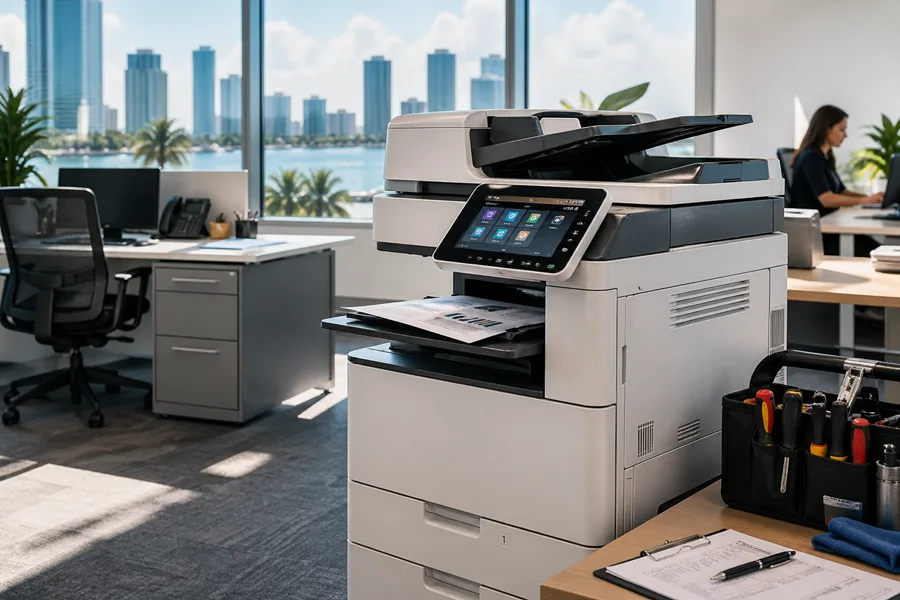
Patterns we see, every quarter, in the Miami market.
- Buying the cheapest tier. A bargain Bronze plan with 24 hour response and excluded fuser parts can cost more in downtime than a Silver plan with 4 hour response.
- Skipping the meter audit. Vendors price tiers around print volume. If your meter says 3,200 pages but you actually print 7,000 in busy months, you’ll get hit with overage fees. Audit before signing.
- Ignoring older equipment caveats. Machines past their seventh birthday often qualify only for limited contracts. Not a vendor scam; parts genuinely get scarce. Plan for replacement, not endless repair.
- Not asking about toner cartridge yield. Some plans count toner refills against your service tier. High coverage marketing print can drain a cartridge fast and trigger unexpected overage.
- Forgetting about firmware. Modern copiers are basically networked computers. Firmware updates patch security holes. CISA’s advisories regularly flag printer and MFP vulnerabilities. Flat rate plans should include firmware patching.
- Bundling unrelated services. Some sales reps roll print management software into a copier flat rate contract and obscure the price. Keep them separate so you can negotiate each on its own merits.
Section 09
Security and Compliance Considerations for Copier Repair Contracts
Copiers store data. Modern multifunction printers (MFPs) have hard drives, memory, and network connections. Every job flowing through one leaves a digital footprint. So your service contract is, quietly, also a security contract.
Three things to lock down in writing. First, technician background checks. Anyone walking into your office and connecting to your machine should have passed a vendor screening. Second, secure data wipe at end of life. The drum unit isn’t the issue; the storage is. Third, breach notification clauses. If a vendor technician misconfigures a setting and exposes your data, you need to know fast.
For Miami offices in regulated industries (healthcare, legal, finance), NIST’s Cybersecurity Framework recommends treating networked office equipment as part of the protected asset inventory. Flat rate contracts can fold security maintenance into the same monthly fee, which most offices appreciate. 1800 Office Solutions includes firmware patching and configuration audits in our Silver and Gold tier flat rate plans because we believe device security shouldn’t be optional.
One more thought. If your industry deals with regulated data, ask about HIPAA, PCI, and SOC 2 alignment. Not every managed print services provider has documentation. The ones who do are easier to defend in an audit.
Section 10
What to Watch in 2026 and Beyond
The copier service market is shifting. Three trends shape what we expect Miami offices to ask about in the next twelve months.
Trend one: AI assisted predictive maintenance. Modern copiers stream telemetry to vendor platforms. Some flat rate plans now include predictive alerts (low toner, drum drift, paper path wear) firing before a hard failure. Faster, quieter fixes.
Trend two: Subscription style hardware. A few manufacturers now offer “device as a service” where the hardware, supplies, and repair are all one bundled monthly fee. Flat rate repair is folding into the broader model. Worth watching, especially for offices preferring operational over capital expenses.
Trend three: Tighter compliance audits. Health and finance regulators have started flagging unmanaged office equipment in audits. Flat rate plans with built in security maintenance are no longer a nice to have for some industries; they’re becoming an audit requirement.
Most offices won’t need to pivot tomorrow. But if you’re signing a three year contract this quarter, ask the vendor how they’re handling these shifts. The good ones will have answers ready.
And one practical note. Many of the smarter vendors (including our copier repair team) will negotiate shorter initial terms with renewal options if you flag concern about the pace of change. A 12 month flat rate contract with optional renewal lets you re-evaluate the market without locking in three years on tech assumptions made before the AI shift accelerated. Ask for the option. Many providers will say yes if you ask.
Section 11
Practical Tips to Get the Most Out of a Flat Rate Plan
You’ve signed the contract. Now what? Here are five habits the best Miami offices form once their flat rate plan is active.
- Schedule preventive visits proactively. Don’t wait for the vendor to call you. Put quarterly visits on your office calendar, and confirm a few days before each. Visits skipped through forgetfulness leave money on the floor.
- Track your meter reads monthly. Every modern copier reports page counts. Pull the report on the first of each month and compare to your contracted volume tier. Notice trends early so you can renegotiate before overages hit.
- Train staff on basic troubleshooting. Half of all service calls in a typical Miami office are paper jams or low toner alerts. A 20 minute lunch and learn for new hires drops your service ticket count noticeably, freeing the contract for real issues.
- Keep the area around the machine clean. Dust kills paper feed rollers. Stacking boxes against the cooling vents shortens motor life. Simple housekeeping extends machine life, and your vendor will thank you for it.
- Document chronic problems. If a specific tray jams every Tuesday, note the pattern. Pattern data helps technicians fix root causes instead of just clearing the jam, which is the actual point of having a flat rate plan.
None of these are revolutionary. But offices doing all five report 20 to 30% fewer service calls and noticeably longer machine life. Small habits, real impact.
FAQ
Frequently Asked Questions About Flat Rate Photocopier Repair
How much does a flat rate photocopier repair contract cost in 2026?
Depending on print volume, machine age, and the parts coverage tier. Multi device fleet contracts often shave 10 to 15% off per device pricing.
Is flat rate cheaper than paying per service call?
Almost always, if you print more than 2,000 pages a month or experience three or more service calls a year.
What's typically excluded from a flat rate copier repair plan?
Operator caused damage, water and humidity damage, paper, staples, and (sometimes) high cost replacement parts like drum units and fusers on older machines. Read the exclusion list before you sign anything.
Does flat rate copier repair include toner?
It depends on the tier. Some flat rate plans bundle toner. Others charge for it separately or include it only up to a defined yield. Always ask about toner explicitly.
What's a fair response time on a flat rate plan?
Four hours is the gold standard for Miami business hours. Eight hours is acceptable for low volume offices. Anything longer than 24 hours is too slow for a paid service contract in 2026.
Can I get a loaner copier if mine is down for days?
Yes, on most Silver and Gold tier flat rate plans. The loaner clause should kick in if your machine sits down for more than 48 hours. Confirm this in writing before signing.
Are flat rate copier repair plans available for older machines?
Often yes, but with limits. Machines older than seven years typically qualify only for restricted plans because parts get harder to source. We sometimes recommend replacement at that age instead of an expensive repair plan.
How do I know if my office is right for a flat rate plan?
Three signs. Your monthly print volume sits above 2,000 pages. You experience two or more service calls a quarter. Or your finance team needs predictable IT and equipment line items. If any two of these match, run the numbers.
Do flat rate plans include preventive maintenance visits?
Most do. Quarterly visits are standard for mid and high volume offices. Semi annual visits work for lower volume. Skip any plan that offers only annual maintenance, since that's usually too thin to prevent buildup issues.
What happens if my print volume changes mid contract?
Good vendors will allow tier adjustments at the quarterly or semi annual checkpoint. Bad vendors will hold you to the original tier and charge overages. Ask about flexible tier adjustment as part of contract negotiation.
Are flat rate copier repair contracts compatible with HIPAA or PCI offices?
Yes, but the contract needs specific clauses. Background checked technicians, secure end of life data wipe, and breach notification language all need to be present. Healthcare and finance offices in Miami should request a compliance addendum.
How does 1800 Office Solutions price flat rate copier repair in Miami?
We start with a free meter audit and equipment review, then propose a Bronze, Silver, or Gold tier based on your actual print volume and uptime needs.
Ready to Stop Paying Per Visit?
Get a free, no pressure flat rate copier repair quote for your Miami office.
Your One Source For Everything Office