


How to Prevent Ransomware Attacks: A Proven Guide for Businesses

AI overview:
This guide outlines a multi-layered strategy to prevent and recover from modern ransomware attacks, which now commonly involve double extortion—stealing data before encrypting systems. It emphasizes three core pillars of defense: strong technical controls (patching, MFA, advanced email security, and EDR), employee training and security awareness, and continuous monitoring and testing. The article also covers critical containment methods like network segmentation, least privilege access, and Zero Trust principles to limit damage if an attack occurs. Finally, it stresses the importance of a tested incident response and backup plan, including immutable and off-site backups, to ensure business continuity without paying a ransom.
A single ransomware attack can halt operations, damage your reputation, and lead to catastrophic financial loss. Preventing such an attack isn’t about a single software solution; it’s about building a multi-layered defense combining smart technical controls, robust policies, and ongoing employee education. This guide provides a proactive, actionable playbook to build a resilient defense that protects your most critical assets.
Understanding Modern Ransomware Attacks
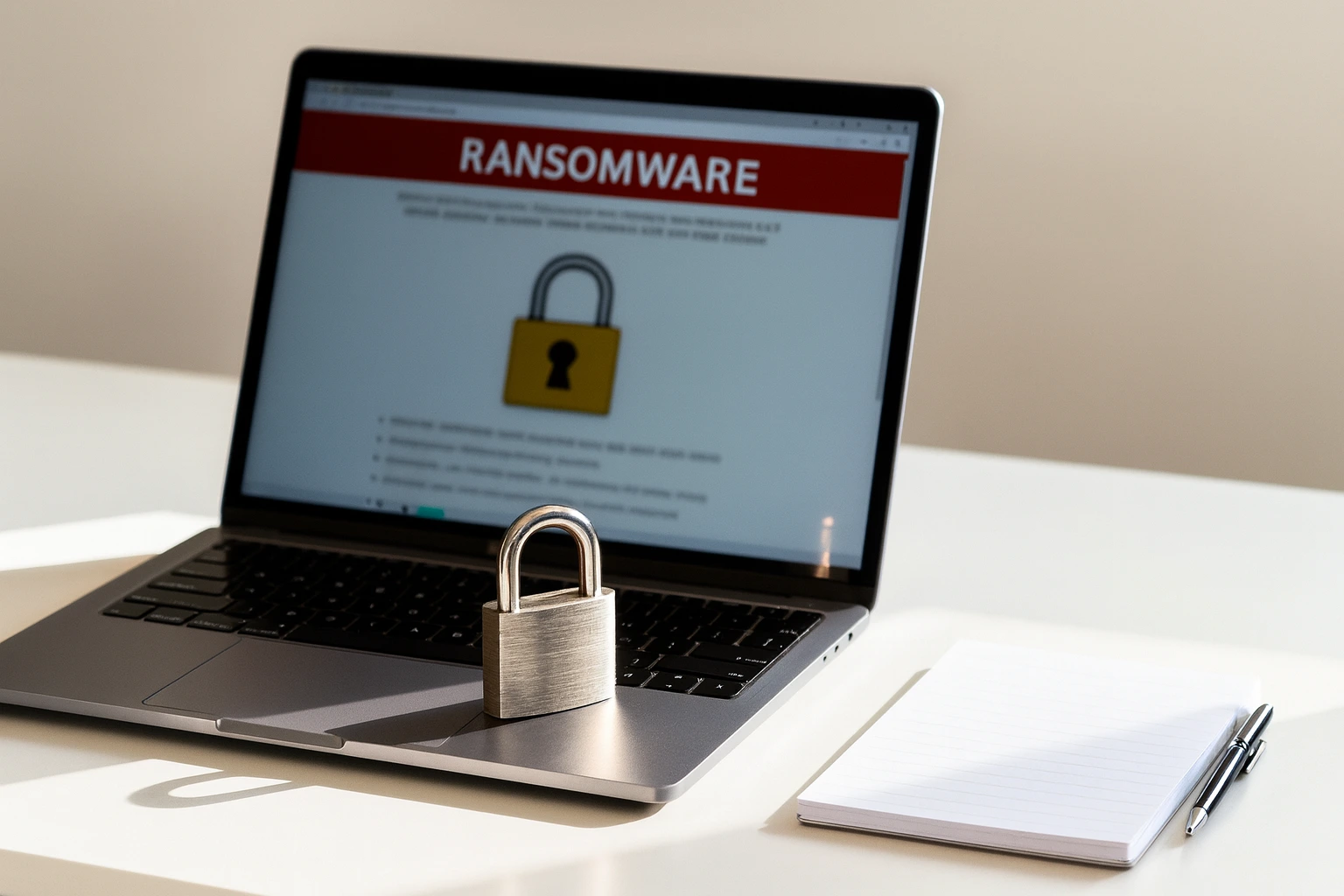
The nature of ransomware has evolved significantly. Previously, attackers would encrypt files and demand a ransom for the decryption key—a disruptive but manageable problem.
Today, “double extortion” is the standard. Cybercriminals first steal your sensitive data before encrypting it. They then threaten to leak company files, customer lists, or financial records online if you refuse to pay. This transforms an operational issue into a severe public relations and compliance crisis. For example, a healthcare provider not only loses access to patient records but also faces massive regulatory fines and public backlash if that private data is leaked.
This guide is designed to help you get ahead of these advanced threats by building a durable, proactive defense.
The Alarming Rise in Ransomware Incidents
Ransomware attacks are increasing at an astonishing rate. Recent ransomware statistics reveal the growing threat, with daily attacks projected to hit 11,000 by 2025—a staggering 3,500% increase in just five years.
The ransom demands are also skyrocketing, with the average payment expected to climb to $3.2 million by 2025. These figures underscore the urgent need for a robust prevention strategy.
A resilient defense isn’t just about preventing an attack; it’s about ensuring business continuity. The goal is to make your organization an unprofitable and difficult target, encouraging attackers to move on to easier victims.
Core Pillars of a Strong Defense
To effectively neutralize ransomware threats, your strategy must focus on three interconnected pillars. Each pillar supports the others, creating layers of security that are exponentially harder for an attacker to breach.
Here’s a high-level view of the essential components of a strong defense.
| Pillar | Objective | Key Actions |
|---|---|---|
| Prioritized Technical Controls | Harden your digital infrastructure against common attack vectors. | Patching, MFA, advanced email security, modern endpoint protection. |
| Robust Policies & Training | Minimize human error and create a security-conscious culture. | Develop clear security policies and conduct continuous employee training. |
| Continuous Monitoring & Testing | Ensure defenses are working and that you’re ready for an incident. | Actively monitor network traffic and regularly test your backup and recovery plans. |
By building up these core areas, you create a holistic defense that covers both your technology and your people. Let’s dive into the practical, actionable steps for putting these pillars in place, starting with the foundational technical controls every business needs.
Establishing Your Technical Defenses

A proactive security posture is the only effective way to stay safe from ransomware. This begins with implementing foundational technical controls that serve as non-negotiable layers of defense, directly shutting down the most common cybercriminal tactics. By hardening your infrastructure, you make your organization a much harder, and far less profitable, target.
The sophistication of today’s threats demands a serious defense. Data from recent quarters shows a staggering volume of incidents, with 520 to 540 new victims reported monthly. This represents a 25% year-on-year increase, proving that despite law enforcement efforts, threat groups are expanding. Attackers are also leaning heavily on double-extortion tactics, making prevention more critical than ever.
Implement Rigorous Patch Management
One of the most effective yet commonly overlooked defenses is diligent software patching. Ransomware operators frequently exploit known vulnerabilities in operating systems and applications—flaws for which vendors have already released fixes. Leaving systems unpatched is the digital equivalent of leaving a key under the doormat.
A solid patch management program is a systematic process to identify, test, and deploy security patches across every endpoint, server, and network device. You must prioritize critical vulnerabilities, especially those actively exploited in the wild, and apply patches within days, not weeks or months.
Enforce Multi-Factor Authentication Everywhere
If you implement only one control from this guide, make it Multi-Factor Authentication (MFA). Stolen credentials are a primary entry point for attackers, and MFA acts as a formidable barrier, stopping them even if they possess a valid username and password.
Think of MFA as requiring a second form of ID to access your digital assets. This could be a code from an authenticator app, a text message, or a physical security key.
Key Takeaway: Enforce MFA on all critical systems, with zero exceptions. This includes email accounts, VPN access, cloud applications, and administrative consoles. It is one of the single most impactful actions you can take to prevent a ransomware attack.
Deploy Advanced Email Security
Email remains the number one delivery vector for ransomware, often disguised as legitimate invoices, shipping notifications, or urgent internal memos. Standard spam filters are insufficient against today’s advanced phishing and social engineering techniques.
An advanced cloud-based email security gateway is a crucial layer of protection. These solutions use machine learning and sandboxing to analyze incoming emails for malicious links, infected attachments, and signs of impersonation before they reach an employee’s inbox. This investment is essential for blocking this massive threat vector at its source.
Upgrade to Modern Endpoint Protection
Traditional antivirus software, which relies on matching files to a list of known viruses, is easily bypassed by modern ransomware. Attackers can slightly alter their malware to evade these signature-based defenses. This is where Endpoint Detection and Response (EDR) becomes essential.
EDR platforms provide deeper security by focusing on suspicious behavior rather than just known files.
- Continuous Monitoring: EDR constantly watches endpoints (laptops, servers, desktops) for unusual activities, such as a process attempting to encrypt files or establish unauthorized network connections.
- Threat Hunting: It equips security teams to proactively search for signs of a breach across the entire network.
- Rapid Response: If a threat is detected, EDR allows for immediate action, like isolating an infected machine to stop ransomware from spreading.
A critical layer of defense involves robust endpoint security to protect the devices your employees use every day. For businesses without a dedicated security team, Managed Detection and Response (MDR) services are a game-changer. You get the same powerful EDR technology backed by a 24/7 team of cybersecurity experts who monitor, investigate, and remediate threats on your behalf.
Containing Threats With Advanced Security
Even with the best perimeter defenses, a determined attacker may find a way in. An initial breach, however, does not have to escalate into a full-blown catastrophe. Your security strategy must pivot from simply keeping threats out to actively containing them once inside.
By implementing controls designed to restrict an attacker’s movement, you can drastically shrink the potential blast radius of a ransomware event. The goal is to build a resilient internal network that makes it incredibly difficult for malware to spread from a single compromised device to your critical data.
Isolate Critical Systems With Network Segmentation
Imagine your entire network as a large, open-plan office. If one person gets sick, the illness spreads quickly. Network segmentation is like building walls and installing badge-access doors between departments, creating smaller, isolated security zones.
If ransomware infects a computer in one department, segmentation can prevent it from reaching finance servers or the production environment. This containment is crucial in preventing a minor incident from becoming a major crisis.
You can segment your network based on department, trust level, or data sensitivity:
- Guest Wi-Fi: Always keep guest traffic completely separate from your internal corporate network.
- Production Systems: Cordon off the servers and applications that run your core business operations.
- Development Environments: Provide developers a sandboxed environment that is completely walled off from live customer data.
- Critical Data: Store your most sensitive databases and file servers in a high-security zone with highly restricted access.
This way, even if one zone is compromised, the rest of your business can continue to operate.
Apply the Principle of Least Privilege
One of the most powerful yet simple security concepts is the Principle of Least Privilege (PoLP). It dictates that users should only be granted the absolute minimum access required to perform their job functions. Over time, employees often accumulate excessive access rights (“privilege creep”), which attackers seek to exploit.
Consider this scenario: if an employee with administrative rights falls for a phishing scam, you’ve handed the attacker the keys to your entire network. However, if that same compromised account only has access to a specific shared drive and their email, the attacker’s ability to move laterally and deploy ransomware is severely restricted.
PoLP is a foundational security concept. It means no user should have default access to data or systems that are not directly relevant to their role. This simple policy dramatically shrinks your attack surface.
Implementing PoLP requires a careful and continuous review of all user roles and permissions to ensure access rights remain tightly aligned with job functions.
Adopt a Zero Trust Security Model
Traditional security models operated like a castle with a moat: strong perimeter defenses with implicit trust for anyone inside. The Zero Trust model discards this notion, operating on a simple mantra: “never trust, always verify.”
Zero Trust assumes that threats could already exist inside your network. It demands strict identity verification for every user and device attempting to access any resource, regardless of their location. An employee logging in from the office is treated with the same level of scrutiny as someone connecting from a public coffee shop.
Authentication and authorization are required at every step. This constant verification makes it exceedingly difficult for an attacker with stolen credentials to move laterally undetected. Understanding how modern network monitoring spots malicious activity is a key part of this model; learn more about how Deep Packet Inspection as a threat containment tool helps identify these anomalies. Adopting this mindset creates an environment where trust is never assumed—it must be proven, every single time.
Turning Your Team Into a Human Firewall
Your technology stack is vital, but it’s only half the battle. Security tools can be bypassed or fail, which is why your team is one of the most important layers in your entire defense strategy. A well-trained, security-aware employee can spot and report a threat that automated systems might miss, transforming a potential vulnerability—human error—into an active security asset.
This process starts with a cultural shift. Cybersecurity cannot be siloed as “an IT problem”; it is a shared responsibility that involves every employee. Building this culture requires consistent effort, clear communication, and empowering your team with the knowledge to make secure decisions.
Building a Strong Security Awareness Program
An effective security awareness program is not a one-time training session but an ongoing campaign designed to keep cybersecurity top-of-mind. The goal is to build muscle memory around safe digital habits, making cautious behavior an automatic reflex.
A successful program includes:
- Engaging Training Modules: Use real-world examples, interactive quizzes, and short, digestible videos that illustrate the impact of threats like phishing and social engineering. Avoid dry, technical jargon.
- Regular Communication: Maintain an ongoing dialogue through newsletters, team chats, or meeting updates that share security tips, news about recent threats, and policy reminders.
- Clear Reporting Channels: Ensure every employee knows exactly how and to whom to report suspicious activity, without fear of reprisal.
This continuous reinforcement is critical. Small and medium-sized businesses remain a prime target, largely due to gaps in preparedness. In fact, a shocking 88% of all ransomware data breaches involved SMBs, a statistic from how ransomware attacks disproportionately affect smaller businesses on Mimecast.com that highlights the urgency of this issue.
Running Realistic Phishing Simulations
The most effective way to test and sharpen your team’s security instincts is through simulated phishing campaigns. These are controlled drills where you send harmless, fake phishing emails to employees to observe their reactions. It’s a practical exercise that provides invaluable data on your organization’s human security posture.
A successful simulation program is about creating teachable moments, not catching employees making mistakes.
When an employee clicks on a simulated phish, the goal should be immediate, positive reinforcement. Instead of getting a slap on the wrist, they should get instant feedback explaining the red flags they missed—like a suspicious sender address or a generic greeting. This simple switch turns a mistake into a powerful learning opportunity.
The data gathered from these tests helps identify which departments or individuals may need additional coaching, allowing you to tailor your training for maximum impact. Over time, you will see click rates decline as your team becomes more adept at spotting malicious emails.
Fostering a Culture of Vigilance
Ultimately, the goal is to build a security culture where every employee feels like a partner in protecting the business. An educated and empowered team becomes a proactive detection network—an essential component of your defense. They will be more likely to report a suspicious email, question an unusual data request, or flag strange pop-ups.
This proactive mindset is a game-changer. An employee who reports a phishing attempt provides your security team with a critical early warning, potentially stopping an attack before it can cause damage. To learn more about cultivating this mindset, read our guide on how to build a human firewall for your cyber defense. By investing in your people, you build one of the most resilient security layers possible.
Building a Bulletproof Recovery Plan
Even with the best defenses, a determined attacker might find a way through. While prevention is the priority, your ability to recover quickly is what ensures business survival. A well-documented and regularly tested incident response (IR) plan is a core pillar of operational resilience.
Without a plan, an attack descends into chaos, panic, and costly mistakes. With a plan, your team can execute a coordinated response that contains the damage and restores normal operations much faster.
Backups Are Your Last Line of Defense
In a ransomware attack, your data backups are your final backstop. A clean, recent backup allows you to restore operations without considering paying a ransom.
However, attackers know this. They actively search for and attempt to encrypt or delete your backups to eliminate your recovery options.
This is why the 3-2-1 backup rule is more critical than ever:
- Three Copies: Maintain at least three copies of your critical data.
- Two Different Media Types: Store these copies on at least two different storage types (e.g., local server and cloud service).
- One Off-Site Copy: Ensure one copy is stored off-site and disconnected from your main network (air-gapped).
An off-site, air-gapped copy is physically isolated, making it invisible and inaccessible to an attacker who has compromised your internal network.
Embrace Immutable Backups
To stay one step ahead, modern recovery plans increasingly rely on immutable backups. Think of them as a digital time-locked safe. Once data is written to immutable storage, it cannot be altered, overwritten, or deleted by anyone—not even an administrator with the highest credentials—for a predefined period.
This is a game-changer. Even if an attacker gains complete control of your network and backup systems, they cannot tamper with your immutable copies. This guarantees you will always have a clean, uncorrupted version of your data for restoration, removing the attacker’s primary leverage.
Core Components of Your Incident Response Plan
A solid recovery plan is more than just backups; it’s a comprehensive playbook that guides your team from the first sign of trouble to full resolution. This plan must be documented, printed (in case of network outage), and understood by key personnel before a crisis occurs.
A well-structured IR plan includes distinct stages to ensure an effective reaction. As this infographic illustrates, empowering your team to be a “human firewall” through training, testing, and reporting directly supports a faster incident response.
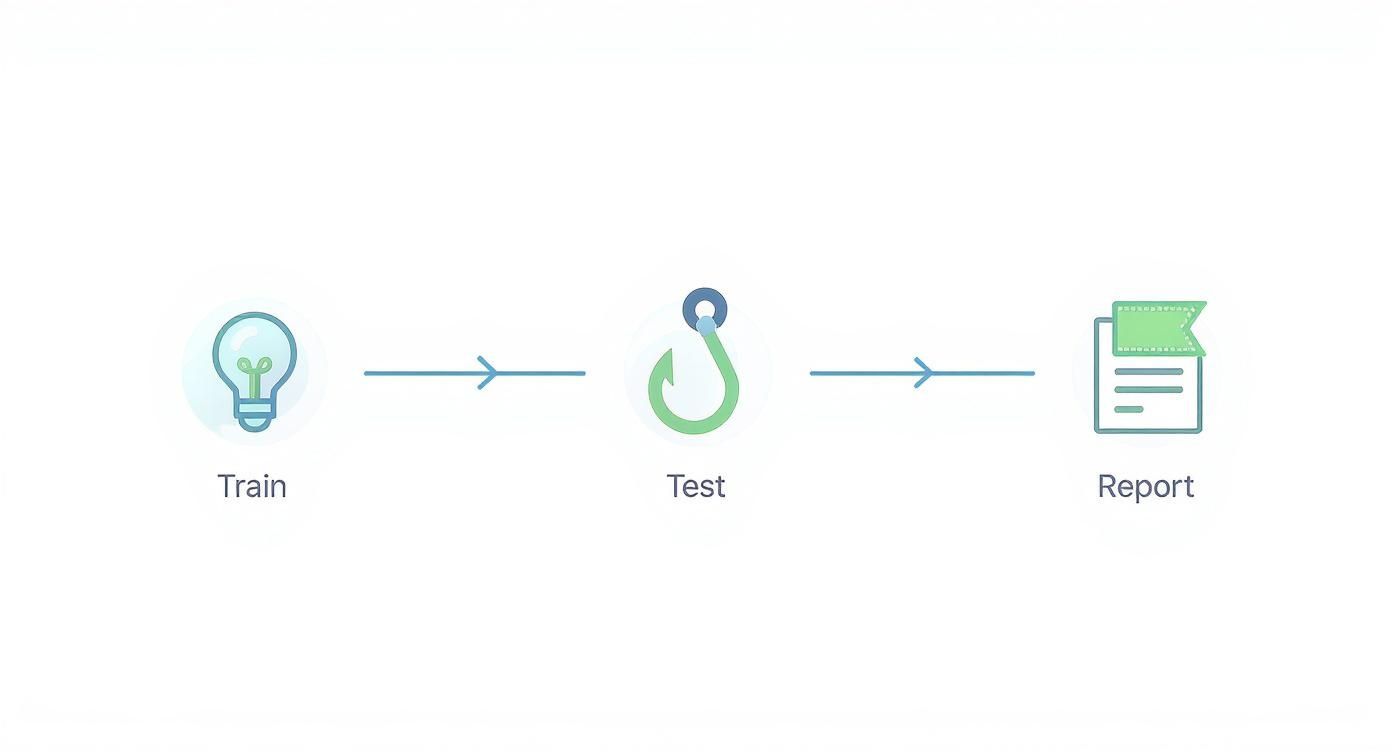
Empowering employees to report suspicious activity is often key to early detection. The following checklist breaks down the critical phases that must be documented in your formal IR plan, providing a clear roadmap for high-pressure situations.
Incident Response Checklist Key Stages
This table outlines the essential phases of an effective ransomware response, turning a chaotic event into a structured, manageable process. Each stage has a clear goal and specific actions to keep your team focused.
| Phase | Primary Goal | Critical Actions |
|---|---|---|
| Preparation | Be ready before an incident happens. | Define roles and responsibilities, establish communication channels, pre-engage legal and forensic experts. |
| Identification | Quickly determine if a breach has occurred. | Monitor for unusual activity, confirm the nature of the attack, and assess the initial scope of impact. |
| Containment | Stop the ransomware from spreading further. | Isolate affected systems from the network, disconnect backups, and preserve evidence for forensic analysis. |
| Eradication | Remove the threat from your environment. | Identify and eliminate all traces of malware, close exploited vulnerabilities, and rebuild compromised systems from scratch. |
| Recovery | Restore normal business operations safely. | Restore data from clean, verified backups; validate system integrity; and gradually bring services back online. |
| Lessons Learned | Improve your defenses for the future. | Conduct a post-incident review, document findings, and update security controls and response plans accordingly. |
By documenting these stages, you ensure that no critical steps are missed during a high-stress incident, significantly improving your chances of a successful recovery.
The Most Important Step: Test Your Plan
An untested plan is not a plan; it is merely a document. Many businesses fail to recover because they discover their backups are corrupted or their response team is unprepared in the middle of a crisis.
Key Insight: You must regularly test both your backup restoration process and your incident response plan. Conduct tabletop exercises where you walk through a simulated attack scenario step-by-step. This identifies gaps, clarifies roles, and builds the muscle memory needed for a real event.
Schedule these tests at least twice a year. Attempt to restore a random sample of files from your off-site backups to verify they work. Run a full simulation with your response team to ensure everyone knows their role and communication plan. This commitment to preparation is what separates businesses that recover from those that do not.
Got Questions? We’ve Got Answers
Navigating ransomware prevention naturally raises questions for business leaders and IT teams trying to prioritize their efforts and budget effectively. Here are answers to some of the most common questions we hear.
What's the Single Most Important Step to Prevent Ransomware?
This question has a two-part answer, covering both prevention and recovery.
For ensuring you can restore business operations without paying a ransom, the most critical element is having robust, regularly tested data backups. A solid backup strategy, especially with off-site or immutable copies, is your ultimate safety net.
However, to prevent an initial breach, the single most powerful control is enforcing multi-factor authentication (MFA) across all systems. Since many attacks begin with stolen passwords, MFA effectively shuts down this common entry point. A truly resilient defense requires both backups and MFA working in tandem.
How Often Should We Be Doing Security Awareness Training?
Security awareness training should be an ongoing program, not a one-time compliance task. A consistent rhythm keeps your team sharp and cybersecurity top-of-mind.
A highly effective cadence includes:
Quarterly Formal Training: Deeper dives into current threats, policy refreshers, and best practices.
Monthly Phishing Simulations: Realistic, safe phishing tests are invaluable for sharpening skills and creating teachable moments.
Ongoing Communication: Maintain a steady flow of security tips and alerts through company newsletters or team chat channels.
The goal is not just to educate but to build a security-conscious culture where vigilance is second nature.
An organization's security is only as strong as its most unaware employee. Continuous training transforms this potential weakness into a powerful, proactive line of defense against initial intrusion attempts.
Is a "Zero Trust" Strategy Too Complicated for a Small Business?
While "Zero Trust architecture" can sound daunting, small businesses can benefit from its core principles without a massive overhaul. The mindset is simple: "never trust, always verify."
Any business can start implementing this with a few high-impact steps:
Deploy MFA Everywhere: This is the cornerstone of Zero Trust and provides the biggest security return on investment.
Embrace Least Privilege: Systematically review and reduce user permissions. Employees should only have access to the exact data and systems necessary for their jobs.
Segment Your Network: Even basic segmentation, such as separating guest Wi-Fi from the corporate network or isolating critical servers, can effectively stop an attacker's lateral movement.
By focusing on these practical steps, any business can begin its Zero Trust journey and become a much harder target.
Do We Still Need Antivirus if We Have an EDR Solution?
For most businesses today, the answer is no. A modern Endpoint Detection and Response (EDR) solution has effectively made traditional antivirus obsolete.
Modern EDR platforms include Next-Generation Antivirus (NGAV), which uses behavioral analysis and machine learning to block threats, including never-before-seen ransomware variants. EDR also provides visibility and response tools to hunt for hidden threats and react instantly. For businesses without a dedicated security team, a Managed Detection and Response (MDR) service is even better, pairing powerful EDR technology with a 24/7 team of security experts who monitor, investigate, and neutralize threats for you.
Ready to build a resilient defense against ransomware? 1-800 Office Solutions offers comprehensive managed IT and cybersecurity services designed to protect your business. From advanced endpoint protection and 24/7 monitoring to strategic consulting, we provide the expertise and tools you need to stay secure. Contact us today for a free cybersecurity assessment.