
Flexible Workspaces & Office Modernization
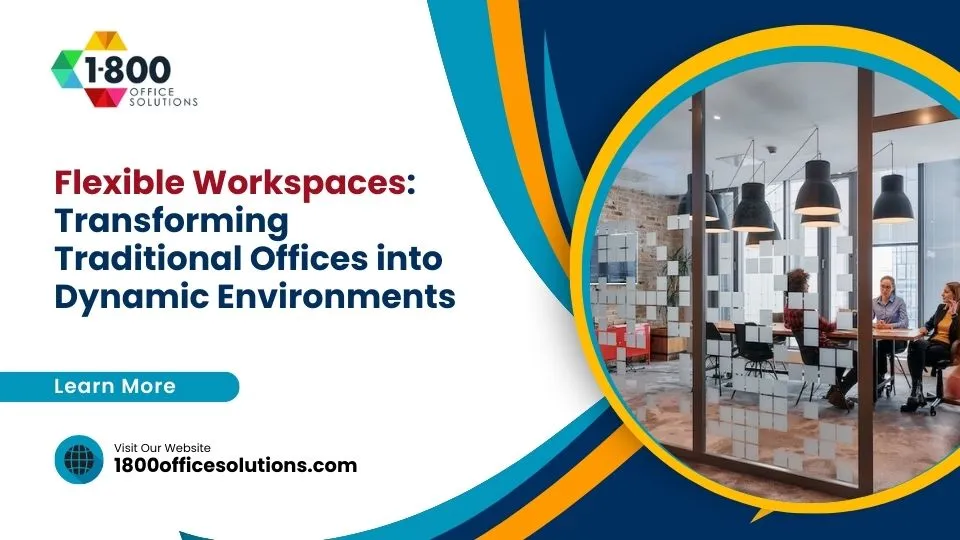
Flexible Workspaces: Transforming Traditional Offices into Dynamic Environments (2026 Guide)
How South Florida companies redesign offices for hybrid work, productivity, and lower real-estate cost in 2026.
Quick Answer
A flexible workspace swaps fixed desks and rigid schedules for movable zones, shared seating, and hybrid scheduling. In 2026, companies redesigning this way cut real-estate spend by 25% to 35%, lift retention by roughly 69%, and give staff 7.6 hours a week back from avoided commutes. The winning formula blends three ingredients: the right furniture, the right office technology, and a cybersecurity plan built for a rotating workforce.
The Shift
Why Traditional Offices No Longer Fit the Way We Work
Offices used to run on one simple rule. Everyone in, every day, same seat. The model made sense before laptops, broadband, and a decade of knowledge-work tools. It does not make sense now. Attendance is uneven. Projects are cross-functional. Focus time often requires quiet, and collaboration often requires a room no one booked.
Hybrid scheduling is the dominant model in 2026. Gallup data shows 53% of remote-capable U.S. workers are hybrid, and 83% of workers prefer the mix. Yet many offices still look like the early 2000s. Long rows of assigned desks. One printer per department. Huddle rooms packed at 10 AM and empty by 3 PM. So the mismatch is where the waste sits.
Good news? The fix does not require a gut renovation. It needs a new philosophy about what the office is for, plus the tools and infrastructure to make it work. Flexible workspaces deliver exactly this.
And companies are moving. A recent CoworkingCafe report shows flexible office inventory in Miami now accounts for 7.6% of total office stock, one of the highest concentrations in the country. The South Florida market saw 11% year over year growth in flex inventory. Miami is not waiting.
The Definition
What a Flexible Workspace Actually Is
A flexible workspace is not a buzzword. It is a design approach. It assumes people move during the day and need different spaces for different tasks. The model comes in several flavors, and most offices end up blending two or three.
Common Flexible Workspace Formats
- Hot desking. No assigned seats. Employees book a desk for the day or grab one when they arrive.
- Neighborhoods. Teams get a general zone but not fixed desks. Useful for project-based work.
- Activity-based zones. Quiet pods for focus, open tables for collaboration, phone booths for calls, lounges for casual meetings.
- Hybrid anchor days. Tuesday and Thursday in office, the rest remote. Predictable without being rigid.
- Coworking memberships. Rent access by desk rather than square foot. Growing fast in Miami and Fort Lauderdale.
- On-demand meeting space. Book a room by the hour when the home office is not enough.
Each format solves a slightly different problem. Hot desking frees real estate. Neighborhoods protect team cohesion. Activity-based zones raise focus quality. Anchor days balance flexibility and presence. The right mix depends on company size, culture, and the work itself.
Projected global flexible office market by 2034, up from $51.99B in 2026. Source: Fortune Business Insights.
The Numbers
What the 2026 Data Says About Flexibility and Productivity
Most office overhauls happen on gut feel. They should happen on data. Here is what the research tells us right now.
- Hybrid teams are 5% more productive than fully in-office or fully remote teams, per Stanford research, with a 33% drop in turnover.
- 66% of employers now report hybrid work boosts productivity, and 84% of employees say they do better work outside a traditional office.
- 69% of companies credit hybrid arrangements with improved retention.
- 95% of offices have added flexibility already, and another 82% plan more changes this year.
- Companies using desk utilization analytics report cutting real-estate spend by up to 35%.
- 73% of global hybrid employees say they get more done, saving roughly 7.6 hours a week.
Put those numbers together and a pattern jumps out. Flexibility is not a perk anymore. It is a productivity lever, a retention lever, and a cost lever at the same time. Few office decisions move three dials at once.
The Cost Picture
What Flexible Workspaces Cost in 2026 (and What They Save)
Pricing is where most executives focus. Fair enough, because offices are expensive. The national average full-service office rate reached $32.79 per square foot in February 2026, per Yardi Matrix. Miami itself runs higher, with Class A asking rents around $63 per square foot according to Colliers and effective rents near $48 per square foot after concessions.
So what do the alternatives look like?
| Workspace Type | Typical Cost | Best For | Key Tradeoff |
|---|---|---|---|
| Traditional Class A lease (Miami) | $45 to $63 per sq ft / year | Established companies with stable headcount | Long commitment, rigid footprint |
| Coworking membership | ~$220 per person / month | Teams of 1 to 15, remote-first firms | Shared amenities, limited customization |
| Serviced office suite | ~$456 per desk / month | Growing teams wanting a private identity | Premium price, easier exit |
| Hybrid redesign (own lease, flex inside) | $40 to $90 per sq ft one time refresh | Firms with 25 to 500 employees | Upfront capital, bigger long-term savings |
| On-demand day pass | ~$30 per day | Occasional meetings, traveling staff | Not a long-term home |
The headline finding from CoworkingCafe is striking. Coworking beat a traditional lease on cost in 97% of the 102 U.S. cities studied, with savings of up to $103,000 per year for a 10-person team in the most favorable markets. Coworking will not win every scenario. Bigger teams usually still lease their own space. But flex pricing creates a real ceiling on what landlords can charge before tenants walk.
The bigger savings story hides inside companies keeping their lease but reducing their footprint. Analytics-driven redesigns often shrink space by 25% to 35% without reducing headcount. On a $60 per square foot Miami lease, the math adds up fast.
Maximum annual savings found for a 10-person team switching from a traditional lease to coworking. Source: CoworkingCafe 102-city analysis.
The Technology
The Office Technology Stack Flexible Workspaces Actually Need
Buying beanbags and calling it flexible does not work. Flexibility lives or dies in the technology stack. Here is the layer cake truly worth your attention.
1. Network and Wi-Fi
Every employee expects the same bandwidth at any seat. Enterprise access points, VLAN segmentation, and seamless roaming across the floor are the baseline. Guest traffic belongs on its own network. So do printers and IoT devices. Managed IT services cover this layer end to end.
2. Video Conferencing and Meeting Rooms
If any meeting room does not support plug and play video, people stop booking it. Cameras, microphones, and a simple touch panel are the minimum. Room booking software links the schedule to the door.
3. Printing and Document Security
Shared desks make shared printers essential. Privacy becomes a real concern. Secure release (the kind where a document only prints when you tap your badge) solves it. Managed print programs also track usage, so the office keeps only the devices it needs.
4. Voice and Collaboration
Desk phones are rare now. Cloud VoIP handles calls on laptops, mobile, and dedicated handsets when needed. A good platform ties voice into Microsoft Teams or Zoom, so employees switch devices without missing a call. See our VoIP phone systems overview for options.
5. Space Management and Booking
The final piece is software. Desk booking, room reservations, wayfinding, and occupancy analytics all live in one tool. Without this layer, employees hunt for a seat and leaders guess at utilization.
The Cybersecurity Angle
Why Flexible Offices Demand a Stronger Security Plan
More rotation equals more risk. Shared desks, visiting contractors, and hot-desking staff all bring new endpoints into the environment. The old assumption that everyone on the LAN is trusted does not hold up when anyone can plug in a laptop at any desk.
A sensible cybersecurity plan for a flexible office does six things. First, multi factor authentication on every app. Second, network segmentation so guests, printers, and IoT cannot reach the core systems. Next comes storage encryption on every endpoint, followed by automated patching and monitoring. Phishing training runs quarterly, with special attention to executive impersonation scams. Finally, the whole setup gets tested at least once a year.
These controls line up with guidance from NIST and alerts from CISA. They also map directly to SOC 2, HIPAA, and PCI DSS if your business carries the compliance lift. 1800 Office Solutions builds these controls into our cybersecurity assessments so the security plan and the real estate plan move together, not in isolation.
Here is a useful reframe. Security is not a blocker for flexible work. Weak security is. Do the plan once, and flexibility becomes easier, not harder.
The Physical Layer
Furniture, Layout, and Small Design Choices Deciding Whether Flex Works
Tech gets the headlines. Furniture decides whether people actually use the space. A few patterns consistently separate offices employees love from offices they avoid.
Variety Over Volume
Ten identical desks beat nothing. Five desks, three lounges, two phone booths, and a standing table beat ten desks for most teams. People self-sort by task. Give them options.
Power and Cable Management
Dead outlets kill hot desking. Every seat needs power within reach plus USB C where possible. A workspace forcing a cable safari gets abandoned by lunch.
Acoustic Zoning
Open floors sound great until three calls happen at the same time. Soft ceilings, fabric partitions, and acoustic clouds cut noise without killing the open feel. Phone booths carry the rest of the load.
Lighting Designed to Shift
Tunable LED fixtures go cooler in morning, warmer in evening. A small change, a real impact on focus and mood. Many Miami offices now pair this with natural light strategies to reduce afternoon glare.
Small Touches Signaling Care
Coffee working every morning. Plants still alive. Whiteboards clean of marker ghosts. Seats with actual adjustment. None of this is flashy, and all of it signals the company actually respects the people who show up.
The South Florida Picture
What Miami and South Florida Companies Are Doing Right Now
Florida offices are not copying New York or San Francisco. The market has its own rhythm. Miami in particular has become a growth market, with new corporate arrivals hiring aggressively and existing tenants expanding.
Royal Caribbean is finishing a new headquarters in 2026. Kaseya expanded its footprint. Citadel moved operations to Miami. Those moves pulled Class A vacancy down to 12.8% in early 2026 from 15.7% a year earlier, per MIAMI REALTORS data. Yet landlords are still offering concessions worth roughly a 32% gap between asking rent and effective rent over the first three quarters of 2025, per a Bisnow analysis. Translation: now is an unusually good window for tenants to negotiate.
Smaller Miami firms are using the window to swap into smaller, better spaces. Many pair a footprint reduction with a full flex redesign. The landlord gets a renewal, the tenant gets a fresh office, and the monthly bill usually drops.
For firms nervous about hybrid, South Florida has a unique advantage. The weather supports outdoor workspace design rarely possible in colder climates. Rooftop lounges and shaded courtyards extend usable square footage cheaply. Several Brickell and Coral Gables renovations have used this approach to turn a flat 10,000 square foot office into something feeling like 13,000.
The 1800 Office Solutions Approach
How 1800 Office Solutions Helps Build a Flexible Workspace
1800 Office Solutions has supported Miami and South Florida offices. Flexible workspace design is where several of our service lines meet. Here is how our team typically engages on a redesign.
The outcome we aim for: one partner you can call for the whole office, not five vendors who each blame each other when something fails. We have run this single-throat-to-choke model.
The Rollout
A 90-Day Plan for a Flexible Workspace Pilot
Big-bang rollouts rarely go well. Pilots do. Here is a tested sequence South Florida firms have used to test flex without betting the whole office on it.
Days 1 to 14: Baseline
Collect utilization data. Badge swipes, meeting room usage, printer logs. Survey staff. Pick one floor or one team for the pilot.
Days 15 to 45: Design
Choose two or three flex formats. Hot desks, phone booths, a neighborhood. Spec the technology. Order furniture. Pilot group gives feedback on seating charts and anchor days.
Days 46 to 75: Launch
Install, train, and go live. Daily desk booking is live. IT on the floor for walk-up support. Managers hold short weekly retros.
Days 76 to 90: Learn
Compare utilization and satisfaction against baseline. Fix two items still not working. Present results to leadership and decide whether to scale.
Pilots do three valuable things. They flush out issues cheaply. They build internal champions. And they give leadership real data rather than opinions. For a walkthrough of how we run these 90-day programs, see our office solutions overview.
The Common Pitfalls
Mistakes Sinking a Flexible Workspace Rollout
Most failed flex rollouts share a handful of root causes. Avoid these and the odds shift.
- Skipping baseline data. Without utilization numbers, every design decision is a guess. Spend the two weeks measuring first.
- Underinvesting in booking software. Excel and shared calendars will not hold up past 25 people. Get the tool before the furniture.
- Ignoring managers. Team leads decide whether employees feel comfortable moving around. Bring them in early.
- Treating security as a later problem. Shared desks raise risk. Do the security review in the design phase, not the go-live phase.
- Copying another company’s plan. A law firm is not a design agency. Pick the flex mix fitting your actual work.
- Forgetting the quiet crowd. Not everyone loves open plans. Guarantee enough quiet and private options or expect attrition.
The honest tradeoff: flexibility is not free. It takes planning, money, and patience. Companies wanting the upside without paying the price usually get a half-finished space and frustrated staff. Better to do it right once than badly twice.
Ready to Design a Flexible Workspace Built to Actually Work?
Get a free consultation from our team. We will map your current space, technology, and security posture, then build a plan fitting your goals and budget.
GET A FREE CONSULTATION
Or call (888) 574-5120
Your One Source For Everything Office. Serving South Florida.
FAQ
Frequently Asked Questions About Flexible Workspaces
What exactly is a flexible workspace?
A flexible workspace is an office built around mobility and choice. Staff pick where they work on a given day, shifting between focus rooms, collaboration zones, private booths, and shared desks. The goal is to match the space to the task, not the other way around.
How much money can a Miami business save by switching to a flexible model?
Savings vary by headcount and footprint, but recent analysis from CoworkingCafe found coworking cheaper than traditional leases in 97% of U.S. cities, with savings of up to $103,000 per year for a 10-person team. Many South Florida companies also shrink their square footage by 25% to 35% after right-sizing around hybrid attendance.
Is hybrid work actually more productive?
Stanford research on hybrid teams reported a 5% productivity edge over fully in-office or fully remote peers, plus a 33% drop in turnover. Gallup and Owl Labs data show 73% of hybrid workers globally feel more productive, saving about 7.6 hours a week formerly spent commuting.
How much office space do we need per employee in a hybrid model?
Traditional offices ran 150 to 250 square feet per worker. Hybrid offices now run 75 to 150 square feet per worker because not everyone is in on the same day. Badge data and desk-booking tools help tune the number to real usage.
What technology do flexible workspaces need to run well?
Four layers matter most: enterprise Wi-Fi with seamless roaming, multi-function printers with secure release, video conferencing gear in every meeting room, and a desk or room booking platform. Without those four, hot desking frustrates staff rather than freeing them.
Are flexible offices safe from a cybersecurity standpoint?
They can be, but only with intentional design. Shared desks mean shared risk. Follow NIST guidance on endpoint hardening, enforce multi-factor authentication, segment guest and printer networks, and train staff on phishing. 1800 Office Solutions offers a cybersecurity consultation mapping those controls to your office layout.
Do copiers and printers fit into a flexible office plan?
Yes, and they matter more than people expect. A managed print program with secure release, follow-me printing, and usage reporting keeps documents safe when desks rotate. You typically need fewer devices once you consolidate, which cuts toner, energy, and service costs.
How do I measure whether our flexible workspace is working?
Track four signals: desk utilization during peak hours, room booking cancellations, employee satisfaction pulse scores, and real-estate cost per full-time employee. If utilization stays below 40% or cancellations creep above 25%, the design needs another pass.
What is the fastest way to pilot a flexible workspace without a full redesign?
Pick one floor or one team. Add a booking platform, turn half the desks into hot desks, and build two focus rooms from unused offices. Run the pilot for 90 days, collect usage data, then scale the parts that worked.
Can 1800 Office Solutions help with furniture, tech, and cybersecurity?
Yes. Our team has supported Miami and South Florida offices across copiers, printers, managed IT, VoIP, furniture refreshes, and cybersecurity. Call (888) 574-5120 or request a free consultation to map a plan for your space.
Will a flexible workspace hurt company culture?
Not if leaders stay deliberate. Culture comes from rituals, not assigned seats. Anchor days, team neighborhoods, and in-person onboarding weeks usually preserve culture while still freeing up real estate. The office works best as a tool for connection, not attendance.
What is a realistic budget for redesigning a mid-size Miami office?
For a 10,000 to 20,000 square foot South Florida office, a right-sized refresh typically lands between $40 and $90 per square foot, covering furniture, AV, partitions, and network upgrades. This is before any real-estate savings from trimming footprint, which often recoup the investment inside two years.
Flexible Workspaces Are Not a Trend, They Are the New Baseline
Every serious data point tells the same story. Flex boosts productivity. Retention rises. Real-estate spend drops. And the companies leading their industry tend to be the ones who figured out flexible work sooner, not later.
Still, flexibility only pays off with a real plan. Furniture alone is theater. Software alone is shelfware. Security alone is a binder on a shelf. The magic shows up when office technology, layout, and security all move in the same direction, tuned to how your team actually works.
If Miami is your market, the window is open. Landlord concessions are high, new inventory is coming online, and flex stock is expanding. For companies moving now, 2026 is a rare chance to upgrade the office and cut the bill at the same time.
Reach out and we will help you draw the plan. It starts with a conversation, not a contract.
Talk to 1800 Office Solutions
Copiers, printers, managed IT, VoIP, and cybersecurity under one roof.
GET A FREE CONSULTATION
Or call (888) 574-5120
Your One Source For Everything Office.