

Visual Storytelling in Marketing: Designing Story-Driven Posters & The Impact of Images

AI Overview:
Visual storytelling helps brands cut through content overload by delivering clear, emotional messages in seconds. This blog explains how posters—digital or print—use strong imagery, minimal text, and intentional design to build brand identity, boost engagement, and drive conversions. It outlines why visuals are more memorable than text, highlights the psychological impact of color, motion, and human faces, and provides a step-by-step guide to designing story-driven posters. The key takeaway: a great poster isn’t just an ad—it’s a concise visual story that captures attention, creates connection, and inspires action.
Consumers are bombarded with content, making it crucial for brands to communicate their message quickly and effectively. One of the most powerful ways to do this is through visual storytelling using images, design, and layout to tell a compelling story.
Posters, whether digital or print, are a perfect medium for visual storytelling in marketing. They combine striking imagery, minimal text, and strategic design to convey emotions, messages, and brand identity in seconds.
If you’re looking for an easy way to start, consider creating your free printable poster templates, allowing you to design stunning, story-driven visuals without hassle.
Why Visual Storytelling Matters in Marketing
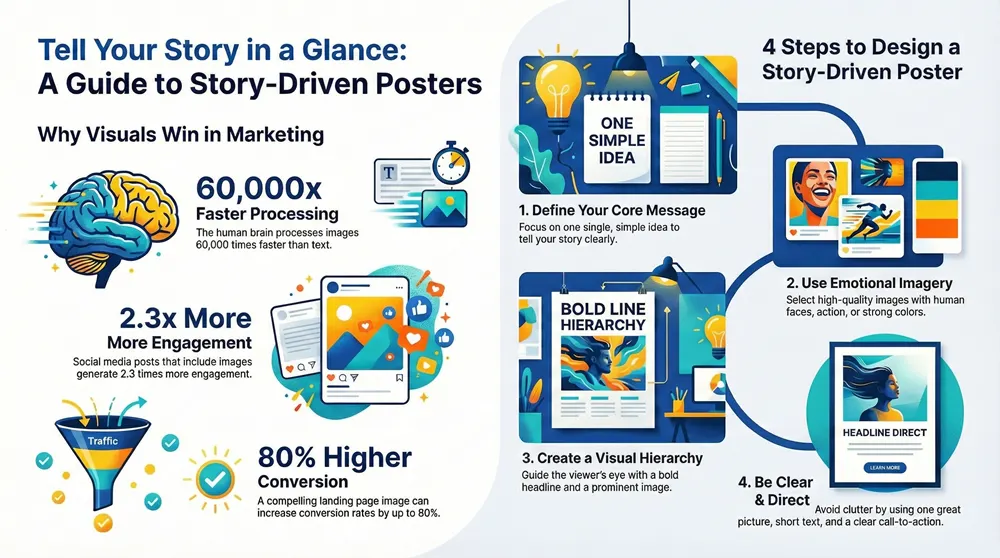
People are naturally drawn to stories. Studies show that humans remember pictures 65% better than text. A well-crafted picture can evoke feelings, simplify information, and trigger action faster than words.
Chief Benefits of Visual Storytelling in Marketing
Grabs Attention Immediately – People process images 60,000 times faster than text, hence visuals are an immediate attention grabber.
Builds Brand Identity – Picture-based narration leads to a solid and memorable brand image.
Engagement Rate Increased – The image-based posts generate 2.3 times more engagement than non-image-based posts.
Conversion Rate Increased – An attractive landing page image can lead to a rise in the conversion rate by 80%.
A good poster is not just an advertisement; it is a small story that grabs interest and incites action.
Story-Backed Posters: How to Design Them Step by Step
Designing a story-based poster requires more than just throwing an image and text on a page.

Here is how you design a poster that tells a great story:
- Define Your Story & Message
Pre-design, define the story you are going to tell. Is it about a future event? A company mission? The benefits of a product? Keep the message concise and simple one key idea per poster. - Choose a Strong Visual Theme
The theme must be compatible with your brand and message. For instance:A clean theme for a high-end brand
A bright, funky theme for a music festival event
A classic theme for an old-product launch - Utilize High-Quality, Emotional Imagery
Images must be emotive and resonate with your audience. Bear in mind:Faces: Humans are inclined towards facial expressions.
Action Shots: Movement keeps visuals alive and interesting.
Contrast & Colors: Dazzling contrasting colors boost visibility and atmosphere.
- Use of Hierarchy in Design
Guide the viewers’ eye with an organized placement of elementsHeadline: This is what your message boils down to – strong, easy-to-read, and attention-grabbing
Subtext: An explanation of a CTA, which means, in one line.
Image: The key element of your message
Logo & Contact Info: They have their place but must not overshadow other elements. - Clear and Direct
Too many graphics clutter a poster. Stick with a great picture, short words, and an attractive CTA.
Impact of Images in Posters: How They Affect Audience Perception
The right imagery is what will either make or break a poster. Here’s why:
- Colors Stir Emotions
Color psychology is a significant factor in marketing.Red: Passion, urgency, excitement (used in sales and food advertising).
Blue: Trust, serenity, professionalism (used by banks and computer firms).
Yellow: Happiness, energy, friendliness (commonly used in entertainment and retail). - Faces Elicit Connection
Humans relate to human movements. The smiling face creates a poster for a welcoming sense, while piercing stare creates dramatic interest. - Composition & Layout Draws Attention
Position is everything. Human reads from the top to the bottom, and left to the right. When the important aspects are placed, it becomes very readable. - Motion & Action Contribute Energy
Dynamic photos (such as a runner in motion or a musician performing) are more effective at drawing attention than static photos. They evoke the illusion of movement and immediacy. - Trust is Established Through Authenticity
Generic-feeling stock images have their place. Actual photos, tailored illustrations, or branded graphics better establish a relationship and seem more genuine.
Examples of Effective Visual Storytelling in Posters
Apple’s Product Launch Posters
About Apple’s minimalist yet powerful posters, a message of one product with a complex design, illustrating the story of innovation and simplicity.
Music Festivals & Event Posters
Festival posters use colors which are vibrant and rugged, a dynamic image of energy.
Social Awareness Campaigns
Posters for causes such as climate change or mental health, uses powerful, emotional imagery to provoke action and empathy.
Final Thoughts: Mastering the Art of Story-Driven Posters
A well-crafted poster is more than an advertisement it’s a story that captures, informs, and persuades. Promoting an event, product, or cause, employing powerful images, thoughtful compositions, and evocative imagery will have maximum effect.
Want to make your own? Begin by selecting strong images, crafting your narrative, and designing with intent. Done correctly, visual storytelling in posters has the ability to leave a lasting impression on your audience.
 Digital Forensics & Cyber Risk Assessment for Business Security, Business Office Tech & Security | Managed Print, IT & Cyber Solutions, Complete Business Tech & Security | IT Support, Cybersecurity 2025