

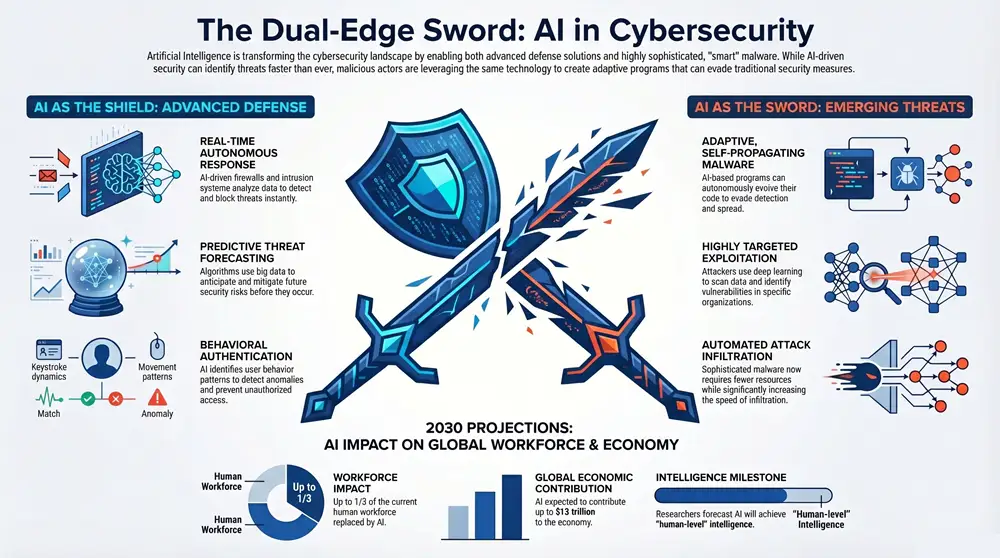
The potential of Artificial Intelligence (AI) is becoming increasingly recognized in the tech world. AI is being used to both enhance security measures to protect against malicious attacks and to even develop smart malware of their own. By leveraging the power of AI, companies can now identify threats faster than ever before and create solutions to prevent them from causing any harm.
AI-driven malware is becoming more sophisticated every day. AI is being used to create malicious programs that can detect and evade security measures and spread to other vulnerable systems. These threats are not easily detected by traditional security systems, making it essential for businesses to implement advanced AI-based security measures in order to keep their networks safe. AI is also being used to detect any unauthorized activity on a system, alerting companies to potentially dangerous activity and preventing malicious attacks from occurring.
Overview of Artificial Intelligence (Ai)

Artificial Intelligence (AI) is an ever-growing field of research and development which is transforming the way humans interact with the world. AI is a broad term which encompasses algorithms, machines, and software that are built to mimic human intelligence, allowing computers to learn from data sets, automate tasks, and make predictions. AI has been in development since the 1950s, and advancements in AI technologies have increased exponentially in the past decade.
AI has the potential to transform every industry, from healthcare to finance, and is being used to automate processes, develop products and services, and to analyze big data.
Definition and History of Ai
Transitioning from the previous section, we can now start to dive into the definition and history of Artificial Intelligence (AI). AI is a broad term used to describe when machines take on tasks that typically require human intelligence. This includes activities such as speech recognition, decision-making, problem-solving, and translation. AI is a combination of a variety of elements such as algorithms, machine learning, and natural language processing.
The history of AI dates back to the 1940s where it originated from the work of Alan Turing and his concept of a ‘universal machine’. This “universal machine” could be used to simulate any other machine, and this was the beginning of the development of computers. The development of AI in this era was focused on creating machines that could think like humans, and this was referred to as “strong AI”. However, this was not achieved until the 1950s when several researchers began to develop artificial neural networks.
In the 1960s and 1970s, AI research began to focus on using computers to solve problems. This was known as “Expert Systems”, and it was used to solve complex problems such as medical diagnosis and financial analysis.
Benefits of Ai
As the world continues to innovate, artificial intelligence (AI) has grown to become an integral part of our lives. With AI, machines can make decisions, identify objects, and even predict events. The potential of AI is seemingly endless, and as the field continues to evolve, its applications are becoming more and more diverse. AI has been used to revolutionize many sectors, and its use is only expected to grow in the foreseeable future.
The benefits of AI are vast, but some of the most notable are:
- Automating mundane tasks: AI systems can automate mundane tasks, such as data entry or customer service inquiries. This helps to free up employees’ time to focus on more meaningful work, and it can also improve accuracy and reduce costs.
- Improving decision-making: AI algorithms can help to identify patterns in data sets, which can then be used to inform decision-making. This can improve accuracy and reduce the time it takes to make decisions.
- Enhancing customer experiences: AI can be used to personalize customer experiences, by providing tailored recommendations or automated customer service. This can help to improve customer satisfaction and loyalty.
Overall, AI has the potential to revolutionize many industries and transform the way we live our lives.
Overview of Ai Applications
Today, AI is being used in various industries and sectors, and its potential to transform and automate many tasks is growing. AI applications have the potential to improve efficiency in many areas, from healthcare to transportation, finance, and more. From autonomous vehicles and robots to natural language processing and advanced algorithms, AI is being used to automate and optimize a variety of processes. AI has the potential to replace many traditional jobs, while at the same time creating new job opportunities in the field of AI development and research.
The use of AI has been increasing rapidly over the past few years, with government investment in AI research and technology innovation. For example, AI technology is being used to develop products and services in many sectors and industries, including healthcare, finance, education, and transportation. AI is also being used to automate processes in sectors such as manufacturing and retail. AI can also be used to analyze large amounts of data to predict future trends and behaviors.
AI has also been used to develop self-driving cars, voice recognition systems, and autonomous robots. These AI-driven technologies have the potential to make substantial changes in the way we live and work. AI is also being used to develop products and services that can interact with humans in a more natural way.
Enhancing Security Measures
The use of Artificial Intelligence (AI) technology and its related systems, such as machine learning and deep learning, is transforming the way the security sector operates. Autonomous and self-driving systems are being deployed to automate processes, identify potential cyber threats, and use AI-based solutions to detect and mitigate security risks.
AI-driven technologies can leverage big data and data sets to forecast and predict future security threats, as well as to create more advanced defense strategies. AI can also be used to recognize human-level speech and natural language processing, providing more efficient analysis of large amounts of data.
Automating Processes
Having explored the overview of Artificial Intelligence (AI) and its various applications, the subsequent section will focus on enhancing security measures through automation processes. AI systems are able to conduct autonomous processes that involve intricate decision-making, allowing for the automation of mundane tasks and freeing up valuable resources. Furthermore, AI-based security solutions are being developed to identify potential cyber threats and mitigate the effects of a security breach.
AI and machine learning are making their way into every sector, from healthcare to manufacturing. Automation is becoming more widespread, with autonomous vehicles and self-driving cars gaining traction in the market. The technology has the potential to transform the future of work, and the McKinsey Global Institute suggests that by 2030, AI could potentially replace up to one-third of the current human workforce.
The advancement of AI technologies has enabled the use of large amounts of data to create powerful AI models. AI algorithms are capable of natural language processing and deep learning, allowing them to make decisions at a human-level. AI researchers are now working on developing AI that can foresee the future, such as suggesting that AI could predict future stock market trends.
Technology companies are investing in AI to develop AI-driven products and services, and to solve complex AI problems.
Ai-Based Security Solutions
With the rise of Artificial Intelligence (AI), security measures are also being enhanced to protect data and secure systems. AI-based security solutions leverage the power of machine learning, deep learning, and other algorithms to automate processes, identify potential cyber threats, and provide secure end-to-end solutions for every sector.
AI-based security solutions offer a number of advantages, such as:
- Automation:
- AI-driven technologies can autonomously analyze massive amounts of data to detect and respond to cyber threats in real-time.
- Automation of processes can reduce the amount of manual work needed to detect and respond to security threats.
- Identification of potential cyber threats:
- AI and machine learning algorithms can detect and respond to potential cyber threats more accurately than human-level AI.
- AI-based solutions can identify patterns in data sets to detect and respond to cyber threats quickly.
- Future of security:
- AI and machine learning algorithms can be used to identify emerging technologies and anticipate future threats.
- AI could be used to automate processes and improve security in areas such as autonomous vehicles and self-driving cars.
Identifying Potential Cyber Threats
In the wake of the continued advancements in Artificial Intelligence (AI), it is becoming increasingly important to identify potential cyber threats. AI has the potential to automate processes, create AI-based security solutions, and identify potential cyber threats with enhanced accuracy. AI systems, powered by machine learning algorithms, can be applied to detect malicious activities. The application of AI and deep learning to cybersecurity can help in identifying potential cyber threats in the banking and finance, healthcare, and other sectors. Autonomous AI systems can be used to monitor data sets for signs of cyberattacks and suspicious activities. Big data and self-driving technology can be used to uncover potential cyber threats and malware in real-time.
The potential of AI to identify potential cyber threats is immense. AI may be used to detect anomalies in online transactions and customer activities that can help forewarn of potential cyber threats. AI algorithms can be used to detect malicious activities without requiring human intervention. AI’s impact on the security landscape is evident, as AI-driven products and services are being used to identify potential cyber threats and to protect against cyber threats.
Moreover, AI has the potential to foresee potential cyber threats and to help protect against them. AI researchers are looking to create human-level AI that can detect potential cyber threats in the same way as a human can.
Developing Smart Malware
Automating processes, AI-based malware solutions, targeting specific victims and organizations are all components of developing smart malware. With the application of artificial intelligence, malware solutions can be more sophisticated and autonomous. Machine learning, deep learning, and algorithms can be used to automate processes and enable greater accuracy. With the use of AI, organizations can use big data sets to target specific victims and guarantee success. AI and machine learning can also be used to automate processes in order to save time and resources. Self-driving technology is an example of how AI could be used to automate processes in the future.
Automating Processes
After enhancing security measures, the next step in the development of smart malware is to automate processes. Artificial Intelligence (AI) and Machine Learning (ML) are technologies that are rapidly advancing and have the potential to revolutionize the way malware functions. With the application of AI, malware can become more efficient and targeted, allowing it to perform its tasks with minimal effort and maximum effect. By using AI and ML algorithms, malware can analyze data sets and autonomously find new ways to exploit vulnerabilities.
AI-based malware solutions are rapidly gaining traction in the sector, as they provide a way to automate processes and target specific victims and organizations. AI could be used to identify and exploit weaknesses in security systems, as well as to automate the task of creating malicious code. AI-driven malware could also be used to forecast and predict future malicious activities, allowing for proactive measures to be taken.
The use of AI in malware could also have a substantial impact on the future of work. As more technologies become automated and the need for human labor decreases, AI could be used to replace certain jobs. The Mckinsey Global Institute suggests that AI and emerging technologies could result in substantial changes to the workforce by 2030.
Ai-Based Malware Solutions
As security measures become increasingly sophisticated, so do the strategies of malicious developers. Developing smart malware with Artificial Intelligence (AI) systems is a growing trend that requires careful attention and consideration. AI systems are able to autonomously automate processes, target specific victims and organizations, and use deep learning algorithms to analyze large amounts of data. This means that AI-based malware solutions could be used to infiltrate systems quickly, with fewer resources needed for development.
The potential applications of AI in the development of malware are vast and far-reaching. AI could be used to create adaptive malware that can anticipate and respond to changes in the environment in real-time. Machine learning algorithms could be used to identify patterns in data sets that could be used to target victims and organizations. AI could also be used to automate processes, such as analyzing large amounts of data, which could be used to identify security vulnerabilities in systems.
The use of AI in malware development has the potential to cause significant damage to governments, businesses, and individuals. AI could be used to deploy targeted attacks that are difficult to detect, and the potential of AI for malicious purposes could be used to infiltrate systems and steal sensitive information. AI technologies could also be used to create autonomous malware that can self-propagate, making it difficult to trace and detect.
Targeting Specific Victims and Organizations
Transitioning from the previous section, which focused on enhancing security measures, the subsequent section will look at the development of smart malware, specifically targeting specific victims and organizations. With the rise of artificial intelligence (AI) and machine learning, malicious actors have the potential to automate their processes and create more sophisticated methods of attack. AI-based malware solutions can be used to scan large amounts of data in order to identify vulnerabilities, target specific victims and organizations, and launch more advanced attacks.
By leveraging AI and machine learning, attackers can:
- Automate processes: AI algorithms can be used to automate processes such as harvesting data, analyzing large data sets, and creating customized malware. Automation can also be used to launch more targeted attacks, as the malicious actors can use AI-driven technologies such as natural language processing to identify potential victims.
- Target specific victims and organizations: AI and machine learning can be used to identify vulnerable systems and organizations, allowing malicious actors to launch targeted attacks. AI can also be used to identify patterns in data, allowing attackers to identify organizations that are likely to be vulnerable to attack.
- Leverage big data: AI and machine learning can be used to analyze large amounts of data, allowing attackers to identify potential targets and launch more sophisticated attacks.
Implications of Ai
AI, or artificial intelligence, is a rapidly evolving technology with wide-reaching implications in many sectors. AI systems, powered by algorithms, deep learning and machine learning, have the potential to automate tasks, analyze large amounts of data, and even foresee future events. It has already been adopted in a variety of industries, from autonomous vehicles to natural language processing. AI poses both positive and negative implications on security, malware, and privacy.
AI-based security implications include the potential to automate the detection of malicious activity, use AI to create more sophisticated malware, and also the risk that AI itself can be hacked.
Ai-Based Security Implications
The implications of Artificial Intelligence (AI) on the security sector cannot be understated. From AI-driven automation and self-driving cars to the use of AI in digital future products and services, AI is transforming the information technology sector. AI algorithms and machine learning technology could automate many existing processes, potentially freeing up employees to focus on higher stakes projects. AI could also enable faster and more accurate detection of malicious activity, allowing for quicker responses to security threats. Additionally, the use of AI and deep learning to detect fraudulent activity has been increasingly explored, suggesting that AI may be able to detect and prevent fraudulent activities that humans cannot.
The potential of AI to transform every sector is immense. AI researchers are investing heavily in AI and machine learning, making advances in AI research that could see AI reach human-level intelligence in the foreseeable future. The potential of AI to transform the way we live has prompted government investment in AI, with many government agencies investing in AI research projects to explore the potential of AI and its applications for government services.
The potential of AI to transform the future of humanity is vast, and the implications of AI on the security sector are no different. AI is predicted to revolutionize the sector, allowing for more secure data management and use of AI to detect suspicious activities.
Ai-Based Malware Implications
Transitioning from the discussion about developing smart malware, the implications of AI on security and privacy are a hot topic of discussion. AI-based malware implications are particularly concerning to individuals and organizations.
AI-based malware has the potential to be more sophisticated and damaging than the traditional malware. AI can be used to automate many of the functions of a malicious program, such as self-propagation, data manipulation, and evasion. AI algorithms, when combined with machine learning and deep learning, can be used to detect vulnerabilities in systems and networks, allowing attackers to quickly identify and exploit them.
AI-based malware is also capable of generating unique variants of malicious code and can spread quickly and autonomously, making it difficult to detect and contain. AI-based malware can be used to target specific individuals or organizations, and the attackers can use machine learning to learn from the victims’ behavior and adapt accordingly. This makes it especially difficult to protect against.
Moreover, AI-based malware can be used to target specific data sets or applications, allowing attackers to steal or manipulate data. AI could be used to automate processes, such as gathering data from multiple sources to create new threats.
Potential Impact of Ai on Privacy
With the rapid advances in artificial intelligence (AI), it is now becoming increasingly clear that AI has the potential to upend the current privacy landscape. AI-driven automation tools, natural language processing, and speech recognition have the potential to transform how much data is collected, stored, and shared, which could have a significant impact on privacy.
AI has the potential to revolutionize privacy in several key ways:
- Data Collection: AI technologies have the potential to collect, store, and process massive amounts of data in ways that were previously not possible. AI algorithms can automate data collection processes, allowing for faster and more efficient collection. Additionally, AI can be used to identify patterns in data sets that may not have been visible to humans. This could enable companies to collect data more easily and on a larger scale, potentially increasing privacy risks.
- Data Analysis: AI can be used to automate analysis of data sets, allowing for faster and more accurate analysis. This could enable companies to gain insights into customer behavior that may not have been possible previously. This could potentially lead to more targeted marketing and advertising, which could lead to increased privacy risks.
- Data Sharing:
Ai Security Solutions
AI Security Solutions are increasingly being adopted in the modern world. AI-based Firewalls, AI-based Intrusion Detection and AI-based Authentication Systems are examples of AI Security Solutions which are employed to protect businesses and individuals alike.
AI-based Firewalls are powered by Artificial Intelligence (AI) and Machine Learning (ML) algorithms, and use deep learning to identify and block malicious traffic. AI-based Intrusion Detection Systems are able to detect malicious activity by identifying patterns in data traffic, and AI-based Authentication Systems offer an additional layer of security by using AI to detect suspicious user behavior.
Ai-Based Firewalls
It is clear that artificial intelligence has the potential to revolutionize the way we live and work. But, with this potential comes the need for security solutions. AI-based firewalls are one such solution, as they are designed to protect networks from malicious attacks.
AI-based firewalls are designed to detect potential security threats and take appropriate countermeasures. They utilize a combination of artificial intelligence algorithms and machine learning to recognize patterns in data and detect potential threats. AI-based firewalls can also be customized to meet the needs of specific applications and environments.
AI-based firewalls use algorithms to analyze data and identify suspicious behavior. They can detect anomalies in network traffic and take pre-configured actions to protect the network. Some AI-based firewalls also analyze user behavior and take appropriate action when suspicious activity is detected. The following are some of the features of AI-based firewalls:
- Data Analysis: AI-based firewalls analyze data from networks and applications to detect malicious activities.
- Pattern Recognition: AI-based firewalls use pattern recognition algorithms to detect unusual activities in the network.
- Autonomous Response:
Ai-Based Intrusion Detection
Having discussed the implications of AI on our society, it is important to understand the security solutions that have been developed to protect us from potential malicious use of AI. One such solution is AI-based Intrusion Detection. AI-based Intrusion Detection is a technology that uses Artificial Intelligence (AI) algorithms to detect malicious activity within computer networks. AI-based Intrusion Detection systems are designed to monitor network traffic, detect suspicious activities, and alert administrators to any malicious activity.
AI-based Intrusion Detection systems use a combination of machine learning algorithms and deep learning models to analyze the behavior of network traffic and detect abnormal activities. AI-based Intrusion Detection systems can identify malicious activity such as unauthorized access to systems, malicious files, and malicious code injections. AI-based Intrusion Detection systems can also detect suspicious activities such as network scans and port scans, which can be used to gain access to a network.
AI-based Intrusion Detection systems are highly effective at detecting malicious activities. AI-based Intrusion Detection systems can detect a wide range of malicious behaviors, from script-based attacks to attacks that use advanced AI techniques. AI-based Intrusion Detection systems can also detect unknown attacks, as they can detect patterns that indicate malicious behavior.
Ai-Based Authentication Systems
With the implications of AI discussed, it is now time to look at potential security solutions that leverage AI. AI-based authentication systems, for instance, have the power to protect digital data from malware, malicious bots, and other cyber threats.
At the core of AI-based authentication systems is the use of algorithms to identify and authenticate users. AI-driven algorithms can identify patterns in user behavior, such as the type of device used, the frequency of access, and the IP address, and can detect anomalies that could signal unauthorized access. AI can also assess the risk of malicious activity based on the data collected, helping to better protect networks and digital assets from malicious actors.
AI-based authentication systems have the potential to revolutionize online security. For example, machine learning algorithms can be used to automatically detect and block suspicious activity, such as unauthorized logins. Furthermore, AI can be used to detect and respond to malicious attacks, such as Distributed Denial-of-Service (DDoS) attacks, in real-time.
AI-based authentication systems can also be used to better protect sensitive data, such as financial information and health records.
Ai Malware Solutions
AI Malware Solutions are a rapidly evolving field of information technology that could revolutionize the way we protect our digital assets. AI systems and algorithms are being applied to detect, analyze, and prevent malicious attacks on our networks and devices. Artificial Intelligence could automate the process of scanning for malware, using deep learning to recognize threats that would otherwise go undetected. Big data sets, powerful AI technologies, and autonomous systems could be used to monitor our networks and devices for malicious activity.
The potential of AI is being explored in the sector, with AI researchers forecasting a “human-level AI” by 2030.
Ai-Based Malware Detection
Having examined the various AI Security Solutions available, it is now time to focus on AI-based Malware Detection, one of the most important components of AI Malware Solutions. The application of AI and Machine Learning algorithms to malware detection has been a major focus of AI research over the past few years. By leveraging AI and Machine Learning technologies, organizations are able to quickly detect and respond to malicious threats.
AI-based Malware Detection systems employ a variety of AI algorithms to identify malicious activity. These include supervised learning algorithms, which are trained to detect certain patterns of behavior, and unsupervised learning algorithms, which identify anomalous behavior. Additionally, AI-based Malware Detection systems leverage Natural Language Processing to detect malicious content within texts, as well as Neural Networks to detect malicious software.
AI-based Malware Detection systems are able to analyze massive amounts of data, enabling them to detect threats that would otherwise be missed. By combining AI and Machine Learning with traditional security methods, organizations are able to detect malicious threats much faster and with a higher degree of accuracy. AI-based Malware Detection systems are becoming increasingly popular, with many organizations investing in AI technologies to bolster their security posture.
Ai-Based Malware Analysis
Transitioning to the subsequent section, AI-based Malware Analysis looks at the potential of leveraging artificial intelligence and machine learning to improve malware detection. AI-based malware analysis can help organizations better detect, investigate, and respond to malicious software. By using AI-based techniques, such as deep learning, companies can detect malicious software more quickly and accurately. AI-based malware analysis can also be used to identify new types of malicious software and create new defenses against them.
AI-based malware analysis can be used in a variety of ways, such as identifying malicious code signatures, analyzing malicious code behavior, and predicting future malicious behavior. AI-based malware analysis can also be used to detect malicious software that has never been seen before. By using AI-based techniques, such as supervised learning, companies can quickly identify new malicious software and respond to it in a timely manner.
AI-based malware analysis can also be used to detect and respond to new types of malware. AI-based malware analysis can be used to identify patterns in malicious code and use those patterns to create new defenses against malicious software. For example, AI-based malware analysis can be used to identify new malicious code signatures and create new defenses against them.
Ai-Based Malware Prevention
Having discussed AI security solutions, it is now time to turn our attention to AI-based malware prevention, an area that is becoming increasingly important in the digital world. AI and machine learning algorithms can be used to automate the detection and analysis of malware, which is vital for organisations and individuals to stay secure. With the application of AI, it is possible to detect malware faster, more accurately and with a greater degree of assurance.
AI-based malware prevention solutions are designed to detect malicious software before it can cause any damage. These solutions utilise AI algorithms to identify malicious behaviour, such as unusual network activity or suspicious files, and prevent malicious code from executing on a user’s device.
AI-powered solutions can also detect and quarantine malicious files before they can cause harm to a user’s device. Additionally, AI-driven solutions can predict and prevent future malware threats by examining large amounts of data and identifying patterns that indicate a potential attack.
AI-powered malware prevention is one of the most effective ways of protecting against malicious software. AI enables organisations and individuals to detect and prevent cyberattacks much faster, allowing for greater protection of networks and systems. AI-driven solutions can also provide valuable insights into malware trends and help organisations stay ahead of the latest threats.
The Future of Ai

Advances in AI technology have seen a rapid increase in the past few years, with AI systems becoming more autonomous and machine learning algorithms becoming more advanced. AI could be applied to a variety of sectors, such as autonomous vehicles and self-driving cars, to automate the process. Big data and data sets are used to power AI technologies, and deep learning allows AI to work with greater accuracy.
AI may also be used to automate mundane tasks, such as customer service. The potential of Artificial Intelligence is transforming the way the world and the information technology industry works, with AI algorithms providing more accurate results and potential for greater automation.
Advances in Ai Technology
Advancements in Artificial Intelligence (AI) technologies promise to be a major driver of global transformation in the foreseeable future. AI has the potential to automate tasks and processes, help discover new insights from large amounts of data, and enable autonomous systems. AI could be used to improve efficiency in many sectors, including healthcare, finance, and transportation.
AI systems are being integrated into many products and services, such as self-driving cars and digital assistants. Technology companies are investing heavily in AI research and development, suggesting that AI may soon become a part of everyday life.
AI is being used to develop algorithms that can simulate human decisions and learn from data, enabling machines to replicate human-level intelligence. AI and machine learning are also being used for natural language processing and speech recognition.
AI algorithms and deep learning can be used to automate processes, discover new insights from large data sets, and enable autonomous systems like self-driving cars. AI enables the development of new products and services, and has the potential to transform many industries.
The amount of data available to AI researchers is increasing exponentially, which is allowing for more sophisticated algorithms and faster AI solutions. AI is being used to solve complex problems in many fields, such as healthcare, finance, and transportation.
Ai-Based Security Solutions
Since the dawn of the digital age, AI-based security solutions have been at the forefront of security research and development. As AI technologies have advanced, so have the potential solutions for mitigating potential security threats. From automated security systems to AI-enabled malware detection systems, AI-based security solutions have revolutionized the way security is handled and managed.
Today, AI-based security solutions can be found in virtually every sector, from healthcare to banking to retail. AI-based security systems are used to detect malicious activities, protect networks from unauthorized access, and automate the process of security monitoring.
AI-based security solutions are also being utilized to detect and block malicious software, which is becoming increasingly complex and hard to detect. AI-based malware detection systems can detect and analyze malicious code and patterns, making the detection of malicious software much easier and faster than manual methods.
Additionally, AI-based security solutions are being used to automate the process of security protocol enforcement. AI-based systems can be used to identify and respond to security threats in real-time, minimizing the time it takes to respond to a security breach. This type of automation can significantly reduce the amount of time and resources needed to secure an organization’s network.
Ai-Based Malware Solutions
The future of AI-based malware solutions holds great potential for both security and malicious actors. From deep learning and pattern recognition technologies to machine learning and automated threat detection techniques, AI-based malware solutions are becoming increasingly sophisticated and capable of detecting and reacting to threats faster than ever before. In the near future, AI-based malware solutions will allow security professionals to assess threats more quickly and accurately, while malicious actors will have unprecedented access to powerful tools to launch devastating cyber attacks.
AI-based malware solutions are rapidly evolving and offer a wide range of capabilities:
- Data Collection and Analysis: AI-based malware solutions are capable of collecting and analyzing large amounts of data from sources such as emails, web traffic, and social media posts to detect patterns that could indicate malicious activity. This data can then be used to generate detailed reports and visualizations that can help security professionals identify potential threats.
- Automatic Threat Detection: AI-based malware solutions can detect, isolate, and respond to threats faster than ever before. By using algorithms and machine learning systems, AI-based malware solutions can detect and respond to threats in real-time, allowing security professionals to take quick and decisive action to protect their networks.
- Self-Learning AI Systems:
Preparing for Ai
Strengthening Cyber Security, Adapting to AI Technology, and Mitigating AI-based Security Risks are all essential components of preparing for AI. With the increased use of AI technologies and applications, the need for robust security systems has never been more important. AI-driven solutions bring a range of new challenges, as well as exciting possibilities for the future.
The application of AI is rapidly expanding, from self-driving cars and autonomous vehicles to predictive analytics and natural language processing. It is essential to identify potential security risks associated with AI-based technologies and devise strategies to mitigate them.
Strengthening Cyber Security
As the future of AI continues to take shape, preparation for its impact is an essential part of the journey. Strengthening cyber security is one of the key components of this preparation. AI technologies, such as machine learning and deep learning algorithms, are being used to automate processes and secure data sets, potentially making cyber security stronger than ever before. Autonomous applications of AI, such as self-driving cars, could be used to detect and respond to cyber threats more quickly and accurately than a human ever could.
The potential of AI to transform cyber security is already being realized. AI-driven technology systems are being used to detect malicious activities and protect networks from cyber threats. AI can be used to monitor user behavior and detect suspicious activities, such as unauthorized access to sensitive information. AI is also being used to automate the process of detecting and responding to cyber threats. In addition, AI can be used to analyze massive amounts of data and predict future cyber threats.
The U.S. government is investing heavily in AI research and development, suggesting that AI could revolutionize the field of cyber security. AI algorithms are being developed to detect and respond to cyber threats more quickly and efficiently than humans ever could. AI could also be used to automate tedious tasks such as analyzing massive amounts of data.
Adapting to Ai Technology
As the future of Artificial Intelligence (AI) rapidly approaches, it is essential to begin preparing for the impact this technology will have on our lives. This includes adapting to the use of AI technologies in various sectors, from automation to self-driving vehicles. Companies, governments, and individuals must be prepared for the potential of AI to revolutionize every industry and the future of work.
AI technologies are becoming increasingly capable, with advancements in machine learning, deep learning, and natural language processing. AI algorithms are being used to automate processes and analyze large amounts of data to predict future outcomes. AI has the potential to transform products and services, and even replace humans in certain tasks. This potential is making AI increasingly attractive to businesses, and is leading to a surge of government investment in the field of Artificial Intelligence.
AI can already be seen in many forms, from autonomous vehicles to speech recognition applications. This technology is rapidly advancing, and AI researchers forecast that AI could achieve “human-level” intelligence by 2030. AI is already affecting the way businesses operate, and the McKinsey Global Institute suggests that AI could contribute up to $13 trillion to the global economy by 2030.
As the use of AI grows, so do the security risks associated with it.
Mitigating Ai-Based Security Risks
As we look ahead to the future of AI, it is important to consider how to mitigate the security risks that may come with the application of AI. AI systems are, by their very nature, difficult to secure; while they are capable of creating powerful algorithms and automating much of the decision-making process, they can also open up new pathways for malicious actors to exploit. By leveraging advances in AI and machine learning, cybercriminals are able to launch more sophisticated attacks, while AI may also be used to create autonomous systems that can launch attacks of their own.
The potential of AI to automate and expedite malicious activities means that organizations must be proactive in mitigating AI-based security risks. To do this, we must invest in the right technologies, such as Big Data analytics, natural language processing, and deep learning. We must also develop more secure and resilient AI algorithms, and use AI to detect threats before they can cause damage. Furthermore, organizations must stay up-to-date on the latest AI-related research and emerging technologies, as well as the potential societal impacts of AI.
It is also important to ensure that AI-driven systems are transparent and accountable.
Government Regulations
Government Regulations should take into account the growing prevalence of Artificial Intelligence (AI) and Machine Learning (ML). The application of AI and ML can be seen in the automation of processes, the production of autonomous vehicles, and the use of AI to create sophisticated products and services.
To ensure the ethical use of AI, governments must create AI-based regulatory frameworks that prioritize data privacy and regulate AI-based solutions. This could include investments in AI research, the implementation of AI ethics, and the development of technology systems and tools to ensure the safe use of AI.
Ai-Based Regulatory Frameworks
With the development of artificial intelligence (AI) and its potential to transform the world, governments around the world are increasingly taking steps to ensure AI-based regulatory frameworks are in place. This is due to the fact that AI has the potential to automate many processes, making them more efficient and cost-effective, while also having the potential to make decisions without human intervention, leading to greater accuracy and reliability.
AI-based regulatory frameworks are needed to ensure that AI-driven technologies, such as autonomous vehicles, are safe for the public. Regulations should also be in place to ensure that data privacy is maintained and that AI-based solutions are not used for unethical purposes. Governments need to ensure that AI-based solutions are adequately regulated and that they adhere to ethical standards.
Government investment in AI is increasingly important, as AI has the potential to revolutionize many sectors and create new jobs. Governments should invest in AI research and development to ensure that AI technologies remain at the forefront of innovation. They should also invest in AI-based tools and products to ensure that these technologies are fully utilized and that their potential is realized.
As AI technologies continue to evolve, it is crucial that governments take steps to ensure that AI-based regulatory frameworks are in place.
Ensuring Data Privacy
The power of Artificial Intelligence (AI) and its potential to transform society should not be underestimated – and it is crucial that it is regulated effectively to ensure data privacy. AI-driven technologies can collect and analyze massive amounts of data, allowing organizations to automate decision making and access information beyond human capacity. While this technology can provide great benefits, it is also essential to consider the ethical implications of its potential uses and the implications of data privacy.
AI systems rely on data sets to understand the world and make decisions. In order to ensure data privacy, it is necessary to create AI-based regulatory frameworks that guarantee the protection of personal data while allowing for the safe use of AI technologies. Governments must create regulations that require organizations to take appropriate steps to protect the privacy of individuals’ data. Organizations must also be held accountable for any misuse of personal data.
It is also important for governments to create regulations that address the growing use of AI-based solutions. Regulations should be created to ensure that AI-based technologies are used responsibly and ethically, and that data privacy is maintained. AI-based solutions should be subject to stringent rules and regulations that guarantee the protection of personal data.
Finally, governments must invest in AI research to ensure that AI-based technologies are developed responsibly and safely.
Regulating Ai-Based Solutions
Having laid the groundwork for the application of AI, the next step is to consider the implications of regulating AI-based solutions. Governments have to ensure that the systems are safe, secure and have appropriate privacy safeguards in place. As AI continues to evolve and become increasingly intertwined with our lives, governments must consider how to create the necessary regulatory frameworks so that AI-based solutions can be used safely and responsibly.
The use of AI and Machine Learning (ML) has the potential to change many aspects of our lives, from self-driving cars to autonomous robots performing complex tasks. In order for AI-based solutions to operate safely and efficiently, they must be subject to rigorous testing and evaluation. Governments must create a framework to ensure that the safety, security and privacy of citizens are never compromised.
The development of AI algorithms presents unique challenges. AI algorithms are often trained using massive amounts of data sets which could contain confidential information about individuals. Governments must ensure that data privacy is maintained and the confidential information of citizens is not improperly disclosed.
AI is already being used in many industries, from healthcare to finance. As AI continues to evolve, the amount of data used to train the algorithms will increase, and governments must consider how to protect the data of citizens.
Ethical Considerations
AI is transforming the way we work and live and is increasingly impacting our lives, with the potential to revolutionize every sector. Automation, self-driving cars, big data and machine learning are just some of the applications of AI that have already made an appearance, and AI-driven autonomous vehicles are already being tested.
U.S companies are investing heavily in AI research and technological innovation. AI algorithms, deep learning, natural language processing and neural networks are just some examples of AI technologies that are advancing at a rapid pace.
Ensuring Responsible Ai Usage
Having explored the regulatory implications of artificial intelligence (AI), it is now time to shift our focus to the ethical considerations of AI usage. Ensuring responsible AI usage must be a top priority for any organization that is implementing AI-driven systems into their operations. The potential of AI and machine learning is vast, and it has the power to transform every sector, from healthcare to finance to transportation. But in order for AI to reach its fullest potential, it is imperative that organizations take the necessary steps to ensure responsible AI usage and development.
At the heart of responsible AI usage lies a number of key principles:
- Accountability: Organizations should be held accountable for any potential harm caused by their AI-driven systems, and they must be able to clearly explain the decisions made by their systems.
- Transparency: AI systems must be transparent and explainable, so that users can understand how the system works and how decisions are made.
- Data privacy: AI systems must ensure the privacy and security of personal data that is used in the development and execution of the system.
- Fairness: AI systems must be designed with the intent of minimizing any potential biases so that their decisions are made fairly and without prejudice.
Developing Ai Policies
The development of AI policies is a vital part of the process of ensuring responsible AI usage. Governments and other entities must understand the potential of AI to both create and disrupt in order to craft policies that will ensure its responsible use. The policies must recognize the potential of AI to both automate and enhance current processes, and thus should include safeguards to protect against any misuse.
In order to develop these policies, there must be a thorough understanding of the technology, its applications, and potential risks associated with its use. AI is a rapidly growing and evolving field, and its applications are becoming increasingly expansive, so it is important to account for the potential of AI to change the way we work and live.
To create effective policies, the following must be taken into account:
- Ensuring Responsible AI Usage: AI systems must be designed to align with ethical values, prioritize safety and security, and respect the privacy of individuals. AI should be used responsibly to ensure that its application does not create harm or unfair advantages.
- Addressing AI-related Concerns: AI policies should include measures to address potential misuse and unexpected consequences of AI applications.
Addressing Ai-Related Concerns
Having discussed the implications of government regulations on the use of AI, it is important to also consider the ethical considerations of this rapidly developing technology. Addressing AI-related concerns is critical in order to ensure responsible AI usage, develop relevant AI policies, and harness the full potential of this technology.
AI is a powerful tool that has become increasingly commonplace in a variety of sectors ranging from finance and healthcare to transportation and media. Its application has enabled AI systems to automate mundane tasks quickly and accurately, leveraging big data and deep learning algorithms to learn from the data sets they process. Autonomous vehicles, self-driving cars, natural language processing, and neural networks are just a few examples of the advances in AI that could lead to substantial changes in the foreseeable future.
Mckinsey Global Institute suggests that AI technologies could potentially transform every industry, with the potential of AI to penetrate every corner of society and create a digital future. However, the ethical implications of such a future are of paramount importance, and must be taken into account by AI researchers, developers, and government officials.
The impact of AI on humanity is complex, and the use of AI has the potential to cause disruption on a massive scale.
Conclusion
The use of Artificial Intelligence (AI) is rapidly expanding and its potential to improve security measures and develop smart malware is tremendous. AI solutions can be applied to both security and malware, providing an effective way to address the ever-evolving threats.
However, as AI technology continues to advance, governments must establish regulations that are ethical and consider the implications of deploying AI.
Businesses must also be prepared to implement AI solutions, while also being aware of their potential to introduce both security and malware risks. AI may be the future of security and malware, but the industry must be prepared to use it responsibly.