
AI Overview:
This blog explains how IT consulting transforms technology from a reactive expense into a strategic driver of growth. It highlights eight key benefits—strategic planning, cost optimization, cybersecurity, faster implementation, specialized expertise, scalability, business continuity, and change management—showing how expert guidance aligns IT with business goals. Through real-world examples, the article demonstrates how organizations can reduce costs, strengthen security, scale efficiently, and empower staff, ultimately building a resilient, future-ready technology foundation that delivers measurable business value.
Navigating complex technology challenges is essential for maintaining a competitive edge. Many organizations struggle to align their IT infrastructure with core business objectives, leading to inefficient operations, security vulnerabilities, and missed growth opportunities. Investing in technology without a clear strategy often results in disconnected systems and wasted resources, hindering rather than helping growth. This is where external expertise becomes a critical asset.
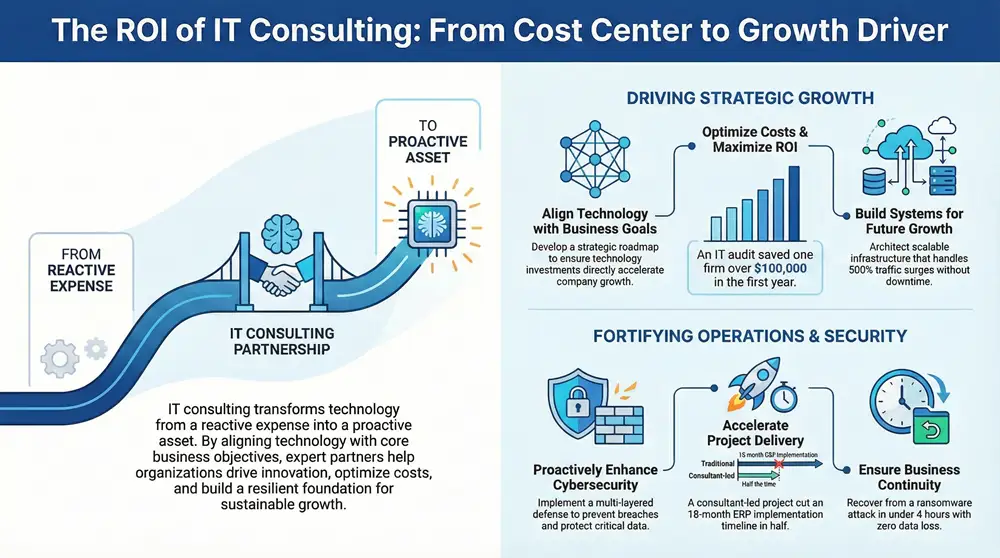
The primary benefits of IT consulting lie in transforming technology from a reactive cost center into a proactive driver of innovation and profitability. A strategic partner provides an objective perspective, specialized skills, and a clear roadmap to ensure every IT investment directly supports long-term goals. This approach bridges the gap between current capabilities and a desired future state, ensuring businesses have the right tools and processes to scale effectively.
This article provides a detailed guide to the tangible outcomes of a skilled IT consulting partnership. We will explore eight critical areas where consultants deliver measurable value, from cost optimization and enhanced cybersecurity to strategic planning and business continuity. Each section offers practical insights and real-world examples to help you make informed decisions and build a resilient, future-ready technology foundation for your business.
1. Strategic Technology Planning and Digital Transformation
One of the most significant benefits of IT consulting is gaining a clear, strategic direction for your technology investments. Instead of reacting to tech problems as they arise, a consultant helps you proactively align every technology decision with your core business objectives. This process, often part of a digital transformation, involves creating a detailed roadmap that ensures your IT infrastructure not only supports but actively accelerates your company’s growth.
An IT consultant acts as a strategic partner, bridging the gap between executive vision and technological capabilities. They analyze your current systems, identify inefficiencies, and map out how new technologies can improve operations, enhance customer experience, and open up new revenue streams. This prevents wasteful spending on trendy but ill-fitting solutions and ensures every dollar invested in technology delivers a measurable return.
Real-World Application: The Omnichannel Retail Revolution
A prime example is the retail industry’s shift to an omnichannel strategy. A mid-sized apparel brand partnered with an IT consulting firm to unify its in-store and e-commerce operations. The consultant guided the integration of their point-of-sale (POS) and inventory management systems. Within six months, the brand launched a “buy online, pick up in-store” service, which increased foot traffic by 20% and boosted online sales conversion rates by 15%, demonstrating a direct link between strategic IT and business growth.

Actionable Steps for Implementation
To effectively leverage a consultant for strategic planning, follow a structured approach:
- Start with a Comprehensive IT Audit: Before planning the future, you must understand the present. A thorough audit reveals vulnerabilities, inefficiencies, and opportunities within your existing tech stack.
- Involve Cross-Departmental Stakeholders: Technology impacts everyone. Include leaders from sales, marketing, finance, and operations in the planning process to ensure the final strategy supports the entire organization.
- Define Measurable Business Outcomes: Don’t just aim to “improve efficiency.” Set specific, quantifiable goals, such as “reduce customer service response time by 25%” or “increase online sales conversion by 15%.”
- Plan for Phased Implementation: A complete digital transformation doesn’t happen overnight. Break the roadmap into manageable phases with clear milestones to maintain momentum and manage change effectively.
By partnering with an expert, businesses can transform their technology from a cost center into a strategic asset that drives innovation and secures a competitive edge. This foundational work is crucial for any organization looking to thrive in a digital marketplace. To get started on your own roadmap, explore how expert guidance can help. Learn more about IT strategy consulting and digital transformation planning.
2. Cost Optimization and Operational Efficiency
One of the most immediate and tangible benefits of IT consulting is the ability to drive significant cost savings and boost operational efficiency. Consultants bring an objective, expert eye to analyze your technology spending, processes, and infrastructure. They identify areas of waste, redundancy, and inefficiency that internal teams might overlook, leading to smarter investments and a leaner, more effective operation.
An IT consultant functions as a financial and operational strategist for your technology stack. They move beyond simple budget cuts to uncover opportunities for true optimization. This includes scrutinizing software licenses, consolidating redundant systems, and automating manual processes. The goal is to reduce your Total Cost of Ownership (TCO) while simultaneously enhancing performance, ensuring every dollar spent on technology is maximizing its value.
Real-World Application: The Mid-Sized Business Software Audit
A manufacturing firm with 300 employees engaged a consultant to review its software expenditures. The audit revealed the company was paying for 50 unused licenses for a premium project management tool, amounting to $30,000 in annual waste. The consultant also identified that migrating their on-premise data storage to a hybrid cloud solution could reduce their infrastructure maintenance costs by 40%. These targeted changes resulted in over $100,000 in first-year savings.
Actionable Steps for Implementation
To leverage a consultant for cost optimization, a systematic approach is essential:
- Conduct a Detailed TCO Analysis: Work with the consultant to calculate the complete cost of your technology, including hardware, software, maintenance, and support staff time. This provides a baseline for measuring savings.
- Focus on Quick Wins First: Identify low-hanging fruit, such as unused software subscriptions or renegotiating a vendor contract. Early successes build momentum and fund more extensive optimization projects.
- Leverage Consultant Expertise in Negotiations: Use your consultant’s industry knowledge and experience to secure better terms and pricing from hardware, software, and service vendors.
- Implement Continuous Monitoring: Cost optimization isn’t a one-time project. Establish key performance indicators (KPIs) and regular review cycles to ensure savings are sustained and new efficiencies are continuously identified.
By bringing in an expert partner, businesses can transform their IT budget from a necessary expense into a finely tuned engine for growth. This strategic approach to spending frees up capital that can be reinvested into innovation and other core business priorities. To start identifying savings in your organization, consider an expert IT assessment. Find out how with customized IT consulting services.
3. Enhanced Cybersecurity and Risk Management
Navigating complex cyber threats is a full-time job, and one of the core benefits of IT consulting is gaining an expert defender for your digital assets. Consultants specializing in cybersecurity move your organization from a reactive stance—responding to breaches after they happen—to a proactive one. They design and implement a comprehensive security framework that protects your data, reputation, and bottom line from ever-evolving threats.
An IT security consultant serves as a specialized strategist who identifies your unique vulnerabilities through penetration testing, security audits, and risk assessments. They then develop a multi-layered defense strategy, create robust incident response plans, and ensure your business complies with industry-specific regulations like HIPAA or PCI DSS. This expert guidance helps prevent catastrophic data breaches, minimizes financial liability, and builds trust with your customers.
Real-World Application: Fortifying Healthcare Data
A regional medical clinic needed to ensure its patient data management systems were fully HIPAA compliant. An IT consulting firm conducted a thorough security audit and identified critical gaps in their network security and data encryption protocols. The consultant implemented multi-factor authentication for all system access, deployed end-to-end encryption for data both in transit and at rest, and provided staff training on phishing awareness. This not only brought the clinic into full compliance but also reduced its cyber insurance premiums by 25%.
Actionable Steps for Implementation
To harness a consultant’s expertise for better cybersecurity, focus on these critical steps:
- Conduct a Comprehensive Risk Assessment: Begin with a thorough evaluation of your digital environment to identify all potential threats, vulnerabilities, and the potential business impact of a breach.
- Develop a Layered Security Strategy: Implement a “defense-in-depth” approach. This means using multiple security controls, including firewalls, endpoint protection, email filtering, and multi-factor authentication, so that if one layer fails, others are still in place.
- Establish a Formal Incident Response Plan: Don’t wait for an attack to figure out what to do. Create a detailed, step-by-step plan that outlines roles, communication protocols, and containment procedures, and test it regularly.
- Foster a Security-First Company Culture: Technology alone isn’t enough. Your consultant can help develop training programs to educate all employees on recognizing phishing attempts and following security best practices.
By engaging a security consultant, businesses can protect themselves against sophisticated cyberattacks and build a resilient security foundation. This proactive investment is essential for safeguarding critical assets in a high-risk digital world. To understand how continuous monitoring can be a part of this strategy, discover how to benefit from managed SOC services.
4. Faster Technology Implementation and Project Execution
A critical advantage of IT consulting is the ability to significantly accelerate project timelines and ensure successful execution. Internal teams, often stretched thin with daily operational duties, can struggle to dedicate the focused effort required for large-scale technology initiatives. Consultants bring specialized project management methodologies, deep technical expertise, and a dedicated team focused solely on delivering the project on time and within budget.
IT consultants act as a catalyst for change, navigating the complexities of new technology rollouts. They manage everything from initial planning and vendor selection to deployment, training, and post-launch support. This focused approach minimizes common pitfalls like scope creep, resource bottlenecks, and communication breakdowns, allowing organizations to realize the benefits of their technology investments much sooner.
Real-World Application: Rapid ERP System Deployment
A mid-sized logistics company needed to replace its outdated accounting software with a modern Enterprise Resource Planning (ERP) system. The internal team estimated an 18-month timeline. By bringing in an IT consulting partner with ERP implementation experience, the company was able to leverage a proven methodology for data migration and system integration. The consultant-led project was completed in just nine months, enabling faster access to unified financial data and improving supply chain visibility six months ahead of schedule.
Actionable Steps for Implementation
To leverage a consultant for faster project delivery, a clear framework is essential:
- Establish Clear Project Governance and KPIs: Define roles, responsibilities, and communication channels from the start. Set key performance indicators (KPIs) for milestones, budget adherence, and quality to track progress effectively.
- Invest in Knowledge Transfer and Documentation: Ensure the consultant’s processes and system knowledge are thoroughly documented and transferred to your internal team. This prevents long-term dependency and empowers your staff to manage the new system post-launch.
- Utilize Consultants for Critical Path Activities: Assign consultants to the most complex or time-sensitive tasks that could delay the entire project. This ensures your most critical milestones are met by experienced experts.
- Implement Agile Methodologies for Flexibility: Adopt an agile approach with sprints and regular check-ins. This allows for continuous feedback and adjustments, preventing major roadblocks and ensuring the final product meets evolving business needs.
By bringing in external experts, businesses can avoid common implementation delays and transform ambitious technology goals into reality faster. This allows you to capitalize on market opportunities before competitors. To accelerate your next project, explore how specialized expertise can help. Learn more about IT project management and implementation services.
5. Access to Specialized Expertise and Technical Knowledge
One of the most immediate benefits of IT consulting is gaining on-demand access to a deep reservoir of specialized skills. Technology evolves rapidly, and it is impractical for most companies to hire full-time experts in every emerging field like artificial intelligence, multi-cloud architecture, or advanced cybersecurity. Consultants provide a crucial bridge, bringing in high-level expertise precisely when and where it is needed, without the long-term overhead of a full-time hire.
An IT consultant offers knowledge honed across diverse industries and complex scenarios, providing insights that are nearly impossible to cultivate internally overnight. This allows your business to tackle sophisticated projects, adopt cutting-edge technologies, and solve niche problems with confidence. Instead of a long and expensive learning curve, you can immediately leverage an expert’s experience to accelerate projects and avoid common pitfalls, ensuring your initiatives are executed correctly from the start.
Real-World Application: Implementing AI in Customer Service
A SaaS company wanted to implement an AI-powered chatbot to handle common customer support queries and reduce wait times, but their in-house team lacked machine learning expertise. They engaged a specialized IT consultant who helped them select and integrate a suitable AI platform with their existing CRM. The consultant also trained the chatbot on the company’s knowledge base. Within three months of launch, the chatbot was successfully resolving 40% of incoming support tickets, freeing up human agents to focus on more complex customer issues and improving overall customer satisfaction scores.
Actionable Steps for Implementation
To maximize the value of specialized consultant expertise, follow a structured engagement plan:
- Clearly Define the Required Expertise Upfront: Before starting your search, create a detailed project scope that outlines the specific technical skills, certifications (e.g., AWS Certified Solutions Architect, Certified Information Systems Security Professional), and experience needed.
- Prioritize a Detailed Knowledge Transfer Plan: Ensure the consultant’s contract includes a plan for training your internal team. The goal is not just to complete a project but to build your organization’s long-term capabilities.
- Verify Industry Experience and Track Record: Request case studies or references from past clients in your industry. A consultant who understands your specific market challenges will provide more relevant and effective solutions.
- Document All Recommendations and Learnings: Create a central repository for all documentation, configurations, and strategic advice provided by the consultant. This becomes an invaluable internal resource long after the engagement ends.
By strategically engaging external experts, companies can innovate faster, overcome technical roadblocks, and stay competitive. This approach transforms a skills gap from an obstacle into an opportunity for growth and learning. To explore how specialized knowledge can benefit your next project, discover our managed IT and cybersecurity services.
6. Improved System Scalability and Performance
A critical benefit of IT consulting lies in designing systems that grow with your business, not against it. As your company expands, your technology infrastructure must handle increased demand without faltering. A consultant architects solutions that are inherently scalable, ensuring that your applications, websites, and internal systems perform reliably whether you have a hundred users or a hundred thousand. This proactive approach prevents the technological bottlenecks that can stifle growth and lead to poor customer experiences.
An IT consultant focuses on building a resilient and flexible foundation. They analyze your current architecture, identify performance chokepoints, and implement solutions that can dynamically adjust to fluctuating workloads. This involves more than just adding servers; it’s about intelligent design, from load balancing and database optimization to implementing cloud-native services that scale automatically. This strategic foresight ensures your systems are an asset during peak periods, not a liability.
Real-World Application: The E-Commerce Holiday Rush
An online retailer was experiencing annual website crashes during its Black Friday sales, resulting in significant lost revenue. An IT consultant helped them migrate their e-commerce platform to a cloud-based, auto-scaling architecture on AWS. The new system automatically provisioned additional server capacity as traffic surged and scaled back down during quiet periods. The following Black Friday, the site handled a 500% increase in traffic without any downtime, leading to a record-breaking sales day and improved customer trust.
Actionable Steps for Implementation
To build a scalable and high-performing system with a consultant, focus on these key actions:
- Establish Clear Performance Baselines: You cannot improve what you do not measure. Work with your consultant to define and monitor key performance indicators (KPIs) for system response time, transaction throughput, and error rates.
- Plan for 3-5 Year Growth Projections: Design your architecture not just for today’s needs but for where you anticipate your business will be in the coming years. This prevents costly and disruptive re-engineering down the line.
- Conduct Realistic Load Testing: Before a major launch or peak season, simulate high-traffic conditions to identify and resolve potential breaking points in a controlled environment.
- Automate Scaling Processes: Leverage cloud-native tools and automation scripts to enable your infrastructure to scale up or down without manual intervention, ensuring rapid response to changing demands.
By partnering with an IT consultant, businesses can ensure their technology infrastructure is a powerful engine for growth. This investment in scalability and performance is fundamental to maintaining a competitive edge and delivering a consistently excellent user experience. To learn how a scalable infrastructure can support your expansion, explore our managed IT and cloud solutions.
7. Business Continuity and Disaster Recovery Readiness
Unplanned downtime can be catastrophic, costing businesses thousands of dollars per minute in lost revenue, productivity, and customer trust. One of the most critical benefits of IT consulting is the development of a comprehensive Business Continuity and Disaster Recovery (BC/DR) plan. This acts as an insurance policy against crippling disruptions, from hardware failures and cyberattacks to natural disasters.
An IT consultant transitions your organization from a reactive to a proactive state of readiness. They analyze your critical business functions, identify potential threats, and design a resilient infrastructure and set of procedures to ensure operations can continue with minimal impact. This strategic foresight protects your revenue streams, preserves your reputation, and ensures you can serve your customers even when faced with a major incident. IT consultants can also help businesses prepare for unforeseen events by assisting with implementing a robust security incident response plan.
Real-World Application: Surviving Ransomware with Zero Data Loss
A regional law firm was hit by a ransomware attack that encrypted their entire case file server. Because they had worked with an IT consultant to establish a BC/DR plan, they had immutable, off-site backups of all critical data. Following their documented incident response plan, their IT team was able to isolate the infected server, restore all data from a clean backup to a new machine, and have the firm fully operational within four hours. They avoided paying a ransom, suffered no data loss, and maintained client confidentiality.
Actionable Steps for Implementation
To build a resilient BC/DR strategy with a consultant, focus on these practical steps:
- Define Recovery Objectives: Work with your consultant to establish clear Recovery Time Objectives (RTO) and Recovery Point Objectives (RPO). These metrics define how quickly you need to be back online and how much data you can afford to lose.
- Document and Automate Procedures: Create detailed “runbooks” that outline step-by-step recovery processes. Where possible, automate failover to backup systems to minimize human error and reduce recovery time.
- Conduct Regular, Rigorous Testing: A plan is only effective if it works. Schedule full disaster recovery tests at least twice a year to validate procedures, train staff, and identify any gaps in the strategy.
- Maintain Offsite, Encrypted Backups: Ensure your critical data is backed up to a secure, geographically separate location. Encrypting these backups is essential for protecting sensitive information from unauthorized access during a recovery event.
By engaging an IT consultant for business continuity planning, you transform a potential corporate disaster into a manageable, documented event. This preparation is a fundamental component of modern risk management and a key advantage for any business that relies on its digital infrastructure.
8. Organizational Change Management and Staff Enablement
Introducing new technology without a plan for how your team will adopt it is a recipe for failure. One of the most vital benefits of IT consulting is gaining expertise in organizational change management—a structured approach that guides your team through technology transitions. This ensures new systems are not just implemented but are fully embraced, leading to higher productivity and a greater return on your investment.
An IT consultant acts as a change agent, focusing on the human side of a technological shift. They develop communication plans, create comprehensive training programs, and establish feedback loops to minimize resistance and build enthusiasm. By managing expectations and equipping employees with the skills they need to succeed, consultants turn potential disruption into a smooth and successful evolution, ensuring the technology serves the people, not the other way around.
Real-World Application: Successful CRM Adoption
A sales-driven organization implemented a new CRM platform but struggled with low adoption, as the sales team found it cumbersome and continued using their old spreadsheets. They hired an IT consultant specializing in change management. The consultant conducted workshops to demonstrate how the CRM’s automation features could save each salesperson five hours per week on administrative tasks. They also identified and trained departmental “super-users” to provide peer support. Within three months, CRM usage increased from 20% to over 90%, leading to more accurate sales forecasting and improved lead tracking.
Actionable Steps for Implementation
To ensure new technology is adopted effectively, leverage a consultant to guide you through these steps:
- Communicate the ‘Why’ Before the ‘How’: Start by clearly articulating the business reasons for the change and the specific benefits it will bring to employees. This builds buy-in from the very beginning.
- Identify and Empower Change Champions: Select influential and respected employees from various departments to act as internal advocates. Provide them with early training and information to help them lead their peers.
- Provide Diverse Training Formats: Offer a mix of training options like live workshops, on-demand video tutorials, and detailed documentation to cater to different learning styles and schedules.
- Establish Robust Feedback Mechanisms: Create safe, open channels for employees to ask questions, voice concerns, and provide feedback. Use this input to adjust your training and support strategy.
- Measure Adoption and Provide Ongoing Support: Track key adoption metrics to understand usage patterns and identify areas where more support is needed. Continue offering help long after the initial launch to ensure long-term success.
By focusing on your people, you can maximize the value of any technology investment. Building a strong foundation of support and training is essential for a truly modern workplace. Explore ways to empower your team by developing an internal knowledge base for modern workplaces.
From Strategy to Execution: Realize the Full Potential of Your Technology
The multifaceted benefits of IT consulting provide a clear blueprint for tangible business growth. Expert guidance transforms your technology infrastructure from a reactive cost center into a proactive, strategic asset that drives innovation, enhances security, and secures a competitive advantage. The cumulative impact of these benefits creates a more agile, resilient, and efficient organization.

A strategic partnership provides a clear technology roadmap, optimizes spending, and fortifies your defenses against cyber threats. It accelerates project delivery by leveraging specialized expertise, ensuring your systems can scale with your growth. Crucially, it also ensures your team is equipped to embrace new tools through effective change management, maximizing your return on investment. The core message is clear: the benefits of IT consulting are a connected ecosystem of improvements that elevate your entire business operation.
Take the Next Step Towards IT Excellence
Conduct an internal assessment to identify your key technology challenges and define clear business goals. Look for a consulting partner with demonstrated experience in your industry and a proven methodology for delivering results. A true partner invests time in understanding your unique challenges to co-create a strategy for success.
Ready to transform your IT from a cost center into a competitive advantage? The expert team at 1-800 Office Solutions provides comprehensive IT consulting, managed services, and cybersecurity solutions tailored to your business needs. Contact us today for a complimentary consultation to discover how a strategic partnership can drive your success.