
Selecting the right managed service provider (MSP) is a critical business decision that directly impacts your operational efficiency, security posture, and ability to grow. This guide provides a proven framework to help you navigate the process, ensuring you find a strategic partner equipped to support your specific business goals, not just a temporary fix for technical issues.
The process boils down to three core phases: first, perform a detailed assessment of your internal IT needs and pain points; second, evaluate a provider’s technical capabilities and service offerings; and finally, scrutinize their contracts, security protocols, and onboarding plan. Following these steps will lead you to a partner who can become a true extension of your team.
The Framework for Choosing the Right MSP Partner

Choosing a managed service provider (MSP) is a foundational decision that impacts your daily efficiency, data security, and capacity for growth. The wrong partner can lead to recurring technical issues, unexpected costs, and critical security vulnerabilities. A well-chosen MSP, however, becomes a seamless extension of your team, proactively managing your technology so you can focus on core business operations.
Outsourcing IT is no longer a niche strategy. The global managed services market reached approximately USD 297.20 billion in 2024 and continues to expand. Mid-sized companies are driving this trend, accounting for 61% of new MSP contracts as they seek expert support for cybersecurity, cloud management, and regulatory compliance.
Why a Structured Approach Matters
A common mistake businesses make is engaging with MSPs without a clear evaluation strategy. They become influenced by a compelling sales presentation rather than determining if the provider can solve their specific operational challenges. A methodical approach allows you to cut through the marketing noise and compare providers on a like-for-like basis.
To make an informed decision, your framework must cover:
- A deep-dive into your own needs. You cannot find the right partner without a clear definition of your requirements.
- A hard look at their technical and service alignment. This step confirms they have the necessary skills and tools to deliver the support you need. For a quick refresher, it’s helpful to understand what a managed service provider is and the full scope of their role.
- A thorough review of the nitty-gritty details. This includes contracts and security policies that protect your business from unfavorable terms and future threats.
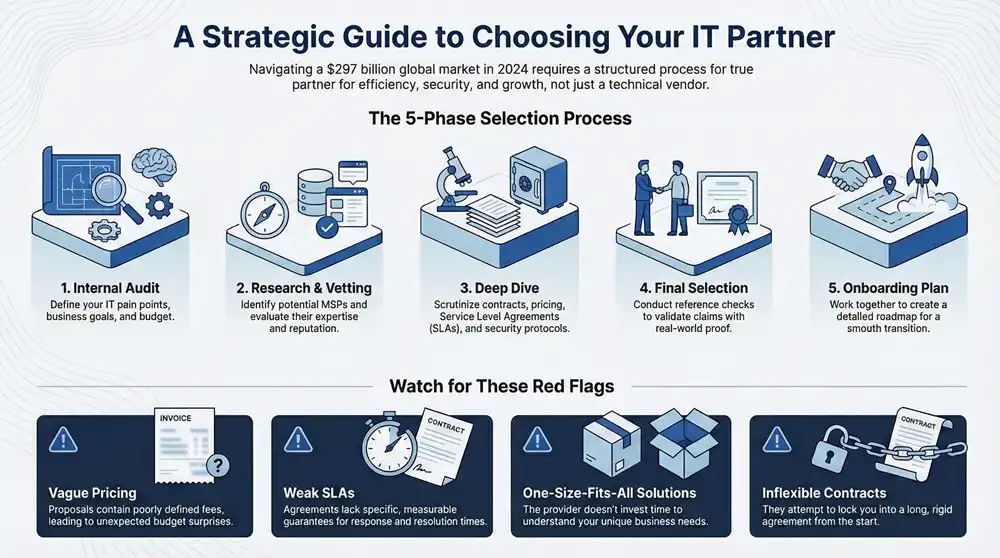
The graphic below outlines the five essential phases of the selection process, serving as your roadmap to a successful partnership.
This process clarifies that finding an MSP is a significant commitment. It begins with an internal assessment of your company, progresses to evaluating potential partners, and concludes with the critical legal, security, and logistical steps of formalizing the relationship. By following these steps, you build a solid foundation for a successful partnership.
MSP Selection Checklist
To keep your evaluation on track, use this checklist to ensure you cover every critical stage.
| Phase | Key Action | Why It’s Critical |
|---|---|---|
| 1. Internal Audit | Define your specific IT pain points, budget, and business goals. | You can’t find the right solution if you don’t know exactly what problem you’re trying to solve. |
| 2. Research & Vetting | Identify potential MSPs and evaluate their services, expertise, and reputation. | This ensures you’re only spending time on providers who are a genuine fit for your needs. |
| 3. Deep Dive | Review SLAs, pricing structures, contracts, and security protocols in detail. | The fine print is where you uncover hidden costs, weak guarantees, and potential risks. |
| 4. Final Selection | Conduct reference checks, run a pilot project (if possible), and make your choice. | This validates their claims with real-world proof and gives you confidence in your decision. |
| 5. Onboarding Plan | Work with the chosen MSP to create a detailed transition and onboarding roadmap. | A smooth start prevents disruptions and sets the tone for a successful long-term partnership. |
Treating this process with the seriousness it deserves is the best way to secure a partner who actively contributes to your success, rather than simply being another vendor on your expense list.
Auditing Your Needs Before Starting Your Search
Before contacting any potential MSPs, the most critical work begins within your own organization. Businesses that enter the market with a vague goal like “better IT support” often end up with an unsuitable partner. To avoid this, you must first create a precise blueprint of your requirements.
This process starts with a thorough internal audit of your technology, workflows, and the persistent problems that hinder productivity. This is not just a task for the IT department; involving key stakeholders from across the business is essential to uncover mission-critical needs that might otherwise be missed.
Assembling a Cross-Functional Team
Begin by forming a team that represents your company’s operational reality. This group should include leaders and daily technology users from various departments.
- Sales & Marketing: What tools are essential for them to meet their targets? Is unreliable remote access to the CRM a persistent issue? Are their marketing automation platforms frequently malfunctioning?
- Operations & Logistics: Are they struggling with outdated inventory software? Do they rely on specialized systems that require expertise your current support lacks?
- Finance & HR: What are their primary concerns regarding sensitive employee or financial data? Do they require assistance with regulatory compliance?
- Executive Leadership: What are the company’s strategic goals for the next few years? How is technology currently limiting growth, and what changes are needed to transform IT into a strategic asset?
By bringing these diverse perspectives together, you can create a list of requirements directly tied to business success, forming the foundation for a smart decision.
Documenting Your Technology and Pain Points
With your team assembled, document your entire technology stack—from servers and routers to every software application and cloud service. Then, list the specific frustrations and challenges associated with them.
A common error is focusing only on what is broken. A comprehensive audit also identifies what works well and where opportunities for improvement exist. This balanced view helps you prioritize what matters and ensures you don’t lose valuable functions during a transition.
Your goal is a detailed document that answers key questions:
- Productivity Blockers: Where are legacy or unreliable systems hindering your team’s performance?
- Operational Costs: Is your current print infrastructure inefficient? Are you paying for unused software licenses?
- Security Gaps: Do you have a documented and tested disaster recovery plan? How confident are you in your data backup strategy?
- Future Needs: What technology will you need to support your growth plans over the next 3 to 5 years?
A formal audit can be complex. To ensure a thorough review, you can learn more about what an IT assessment is and why you need one to leave no stone unturned.
Prioritizing Your Requirements
Finally, transform your findings into a prioritized list that will guide your entire selection process. This document enables you to quickly disqualify unsuitable providers and focus on those who align with your business.
Categorize your list into three tiers:
- Must-Haves: These are non-negotiable requirements, such as 24/7 cybersecurity monitoring, compliance with industry regulations like HIPAA, or dedicated support for a critical business application.
- Should-Haves: These are important capabilities that would add significant value but are not immediate deal-breakers, like proactive network optimization or strategic IT consulting.
- Nice-to-Haves: These are bonus features that would be beneficial but are a lower priority, such as implementing a modern VoIP phone system or upgrading conference room technology.
This structured requirements document empowers you to lead conversations with potential MSPs, ensuring you receive clear, relevant answers instead of a generic sales pitch. It is the most valuable tool you have for choosing the right partner.
Evaluating an MSP’s Service Offerings and Expertise

With your internal audit complete and requirements list in hand, you can begin evaluating potential partners. A valuable managed service provider offers more than a helpdesk; they provide a comprehensive suite of integrated services that form a unified technology strategy for your business.
Look for a provider that can seamlessly manage IT, print services, cybersecurity, and communications under one roof. A holistic approach eliminates the complexity of juggling multiple vendors and ensures all your systems are designed to work together cohesively.
The shift toward comprehensive solutions is driving significant market growth. The managed services market is projected to grow from USD 335.37 billion in 2024 to USD 731.08 billion by 2030. For small and mid-sized businesses, this growth reflects the demand for partners who can handle everything from high-level IT consulting to advanced cybersecurity, reducing downtime and providing expert guidance. You can explore a complete analysis of this managed services market growth.
Assessing Technical Expertise and Certifications
Once you find a provider with the right mix of services, investigate their technical expertise. Vague claims of being “experts” are insufficient. You need tangible proof that they possess the skills and knowledge relevant to your technology and industry.
Start by checking for key certifications and official partnerships that align with the software and hardware your business relies on.
- Microsoft Solutions Partner: This designation indicates deep expertise in Microsoft products, from Azure cloud services and Microsoft 365 to critical security solutions.
- SOC 2 Compliance: A SOC 2 report demonstrates that an MSP has robust internal controls for managing customer data, focusing on security, availability, and confidentiality.
- Vendor-Specific Certifications: Do they employ certified technicians for your core infrastructure, such as Cisco, Fortinet, or your specific VoIP system?
These credentials represent a genuine commitment to maintaining high standards and staying current with technological advancements.
Verifying Industry Experience and Scalability
An MSP that excels for a law firm may not be the right fit for a manufacturing plant. It is crucial to verify their experience within your industry.
Ask for relevant case studies or client references from businesses similar to yours in size and sector. Speaking with a current client provides invaluable, unfiltered feedback on an MSP’s performance, responsiveness, and problem-solving capabilities.
A direct question to ask a reference client: “Can you share an example of a time they went above and beyond to solve a critical issue for you?” The response—or lack thereof—will reveal whether they are a true partner or just another vendor.
Finally, consider their ability to scale with your business. An MSP with a proven, nationwide presence has the operational maturity to support your growth, which is essential for businesses with multiple locations or ambitious expansion plans. This ensures consistent, high-quality service across all your operations. This thorough evaluation ensures you are not just hiring a contractor but a team capable of managing your entire technology environment effectively, both now and in the future.
Decoding Contracts, Pricing, and SLAs
An impressive sales presentation is one thing, but the success of your partnership depends on the details within the contract and Service Level Agreement (SLA). These documents serve as the blueprint for your relationship, defining expectations, responsibilities, and remedies when issues arise.
Here, you move from promises to firm commitments. The terms must align with your operational needs. A key part of this is understanding the fundamentals of a Service Level Agreement (SLA) so you know what to look for and can identify ambiguous language before signing.
Scrutinizing the Service Level Agreement
The SLA is the most critical document to analyze. It must contain specific, measurable commitments, not vague assurances of “good service.” You need to know precisely what you are paying for and what level of performance is guaranteed.
Begin by examining their defined support metrics. Look for clear definitions of issue severity levels, from minor glitches to critical system failures. Each level should have a guaranteed response time (how quickly they acknowledge an issue) and a resolution time (how quickly they resolve it).
A strong SLA will also detail the financial penalties or service credits you receive if they fail to meet these guarantees. The effectiveness of these SLAs often depends on their internal workflows; you can gain insight into their commitment management by learning about the impact of PSA ticketing systems on SLA compliance.
Here are the key SLA metrics to review:
- Uptime Guarantee: For critical systems, this should be 99.9% or higher. Ask how this is calculated and what is excluded.
- Response Time: How quickly will they begin working on a ticket after it is submitted? This should vary based on the issue’s priority.
- Resolution Time: What is the target for completely resolving an issue? This is often more important than the initial response time.
- Penalties for Non-Compliance: What are the consequences if they miss a target? This demonstrates their commitment to their promises.
Analyzing Pricing Models and Contract Terms
Once you are confident in the service guarantees, turn your attention to the pricing structure and contract terms. A trustworthy MSP provides predictable, transparent billing without hidden fees or unexpected charges for standard services.
Common pricing models include:
- Per-User or Per-Device: A flat monthly fee for each employee or piece of hardware supported. This model is simple and predictable.
- Tiered Packages: These bundle services at different price points (e.g., Bronze, Silver, Gold). Ensure the tier you select includes all necessary services.
- À La Carte: You pay only for specific services. This can be flexible but may lead to higher costs if your needs are extensive.
Be cautious of overly complex pricing or invoices that are difficult to understand. Your monthly bill should clearly itemize all charges, making it easy to track spending and verify you are receiving the services you paid for.
Finally, carefully review the contract length and termination clauses. An MSP confident in its service will offer flexible terms rather than locking you into a rigid, multi-year agreement from the start. Look for a reasonable initial term with clear, fair conditions for renewal or termination.
Clarifying these points upfront builds a partnership based on mutual trust and prevents costly surprises later on.
Validating an MSP’s Security and Compliance Capabilities
When evaluating a managed service provider, their security and compliance posture is not just another checklist item—it is the most critical consideration. A single security incident can cause devastating financial and reputational damage, making this the most important part of your due diligence.
Begin by investigating their internal security practices. How do they protect the systems they use to manage their clients? Next, assess the sophistication of their cybersecurity services. Basic antivirus and firewall management are no longer sufficient. You need an MSP that offers advanced, proactive solutions indicative of a mature security practice.
Beyond Basic Protection Services
A top-tier MSP is a strategic security partner, not just a reactive problem-solver. Their service offerings should demonstrate a deep commitment to combating modern threats.
Key services that distinguish leading providers include:
- Managed Detection and Response (MDR): This goes far beyond simple alerts. MDR involves a team providing 24/7 threat hunting and real-time response to neutralize attacks before they cause significant harm.
- Proactive Threat Hunting: Does the MSP actively search for hidden threats within your network, or do they only react to alarms? Proactive hunting is the hallmark of a highly skilled security team.
- Virtual CISO (vCISO) Services: Access to a virtual Chief Information Security Officer provides high-level strategic guidance, helping you build a long-term security roadmap aligned with your business goals.
To better understand these advanced offerings, consulting a practical guide to managed network security solutions can clarify what to look for and why these services are essential.
Verifying Compliance Expertise
If your business operates in a regulated industry such as healthcare or finance, compliance is non-negotiable. You need definitive proof that a potential MSP can navigate your specific regulatory landscape, whether it involves HIPAA, CMMC, GDPR, or another standard.
Do not just take their word for it. An MSP that truly understands compliance will provide evidence. Ask to see recent audit reports, certifications, and anonymized case studies demonstrating how they have helped other clients achieve compliance.
This is not about being difficult; it is about thorough due diligence. When you partner with an MSP, their compliance posture becomes a direct extension of your own.
The Growing Demand for Security-Focused MSPs
Market data confirms this trend. By 2025, the US MSP market is expected to reach USD 69.55 billion, with cybersecurity being a major growth driver. A significant 66% of US IT outsourcing is now focused on building resilience against data breaches.
Furthermore, mid-sized companies are signing 61% of new MSP deals specifically for security and compliance services. This highlights the immense demand for partners with proven expertise in areas like MDR and compliance management. You can discover more insights about these market trends.
This is a fundamental shift in how businesses select IT partners. It is no longer just about maintaining operations; it is about protecting the entire organization from a vast array of digital threats. Choosing an MSP without rigorously validating their security and compliance capabilities is a risk modern businesses cannot afford to take.
Ensuring a Smooth Onboarding and Transition
You have completed your due diligence and selected your new managed service provider. However, the work is not over. The transition phase is critical and will set the tone for the entire partnership.
A chaotic onboarding process can cause significant business disruptions, including frustrated employees, lost productivity, and an immediate erosion of trust. This is the first true test of your new partner’s capabilities.
What a Detailed Onboarding Plan Looks Like
A reputable MSP will have a documented, field-tested onboarding plan. Request to see it and have them walk you through each step before signing a contract. This plan should be a collaborative roadmap, not a generic template, showing exactly how they will manage the transition.
The quality of their onboarding plan is a reflection of their operational standards. A detailed, strategic, and clear plan indicates a well-organized partner.
A well-structured onboarding process is about more than just moving data and installing software; it is about change management. A great MSP understands that they are introducing new workflows and will have a plan to make the transition as seamless as possible for your team.
So, what should you look for? There are several non-negotiable components.
Key Components of a Successful Transition
Your potential partner must provide concrete details, not vague promises. Their transition plan should be a detailed project outline covering all critical logistics.
First, insist on a dedicated project manager. This individual will be your single point of contact, coordinating all activities and keeping you informed. Without a clear owner, communication can break down quickly.
Next, look for a clear timeline with specific milestones. This should map out the entire process, from initial discovery and system audits to the final cutover, allowing you to prepare your teams accordingly.
Most importantly, the plan must detail their strategy for data migration. How will they handle your company’s most critical asset? This is the riskiest part of the transition, and you need to see a proven, secure, and meticulous approach that minimizes downtime and protects your information.
Finally, the plan should explicitly cover communication and post-launch support. Ask them:
- Communication Cadence: How often will we receive updates, and who will provide them?
- Employee Training: What is the plan for training our staff on new tools, such as submitting helpdesk tickets or using new security software?
- Post-Launch Support: What support is available in the first week after going live? Is there a “hyper-care” period to address any initial issues quickly?
By demanding this level of detail, you are making a smart business decision. You will be able to confidently choose an MSP who is not just a technology vendor but a capable, organized partner ready to begin your relationship on solid footing.
Your MSP Questions, Answered
Choosing a managed service provider involves numerous technical, financial, and strategic questions. As you near a decision, final considerations will likely arise. Here are straightforward answers to some of the most common questions from business leaders.
What Are the Biggest Red Flags When Choosing an MSP?
Certain warning signs should prompt further scrutiny. Vague pricing is a major red flag; if a proposal contains poorly defined “add-on” fees, you can expect budget surprises. An SLA that lacks specific, measurable guarantees for response and resolution times is equally problematic, as it indicates a lack of accountability.
Another red flag is a provider who pushes a one-size-fits-all solution without taking the time to understand your unique business needs. Finally, be wary of any provider attempting to lock you into a long, inflexible contract from the start. A confident provider does not need to trap you in a restrictive agreement.
Is It Better to Choose a Local or National MSP?
The best choice depends on your business structure and needs. A local MSP can offer a personal, hands-on approach, which may be suitable for single-location businesses with straightforward IT requirements.
However, for companies with multiple locations, a remote workforce, or complex needs like advanced cybersecurity and compliance, a national provider is often the better choice. They offer scalability, a deeper pool of specialized experts, and true 24/7/365 support across all time zones. The standardized processes and greater resources of a national MSP ensure consistent, high-quality service everywhere you operate.
How Is MSP Pricing Typically Structured?
You will encounter a few common pricing models. Most MSPs structure their fees in one of these ways:
- Per-User or Per-Device: A flat monthly fee for each employee or piece of equipment they manage.
- Tiered Packages: Plans (e.g., Gold, Silver, Bronze) that offer different levels of service.
- À La Carte: A menu of individual services where you only pay for what you select.
Do not just focus on the lowest monthly cost—consider the overall value. An MSP that prevents a single major security breach or one day of downtime delivers a return on investment that a cheaper, reactive-only provider could never match.
Always insist on a clear, itemized breakdown of what is included in any fee. This level of transparency is non-negotiable and the only way to truly understand the value you are getting for your investment.
Ready to partner with a nationwide provider that delivers comprehensive IT, print, and cybersecurity solutions? Get a customized quote today and discover how our expertise can drive your business forward.