


Understanding Network Security Types to Protect Your Business

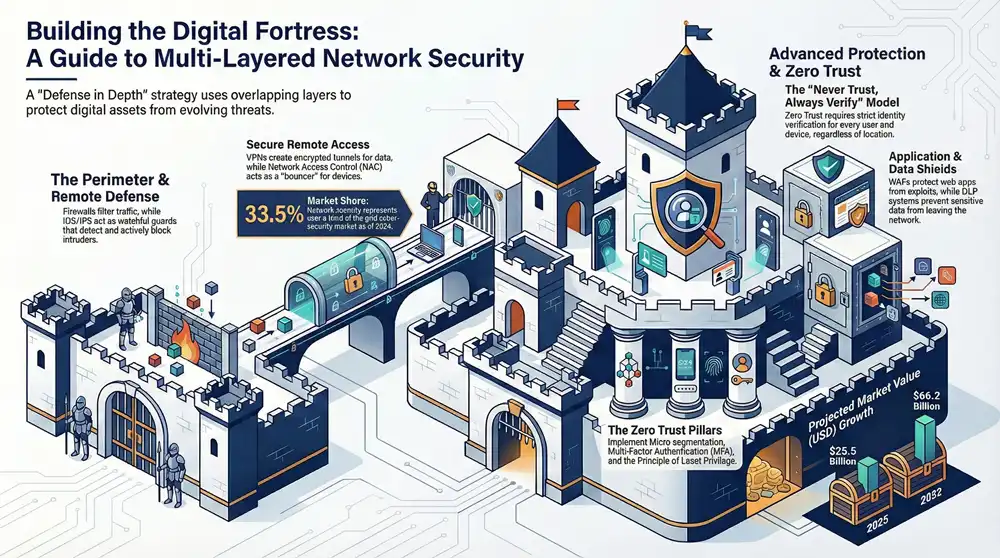
Protecting your digital assets starts with securing the network they reside on. An effective strategy uses several network security types to build a multi-layered defense against evolving cyber threats. This guide explains the essential security controls designed to shield your data, applications, and infrastructure from unauthorized access.
A single security tool is no longer sufficient. True resilience comes from a strategic combination of defenses that work together to protect your entire operation.
Why a Layered Network Security Strategy Is Non-Negotiable

A single unlocked door is all a thief needs to bypass a fortress. The same principle applies to your network—relying on one security measure leaves your business exposed to countless threats. That is why a layered security strategy, known in the industry as “defense in depth,” is the modern standard. It ensures that if one defense fails, another is in place to stop an attack.
Think of it like building a castle. You have outer walls, a moat, guards at the gate, and a reinforced vault. Each layer plays a critical role in protecting the assets inside. This approach provides a practical roadmap for building genuine, robust security.
As cyberattacks grow in complexity and frequency, this multi-layered mindset has become essential. Investing in robust network security is no longer just an IT expense—it is a fundamental requirement for business continuity.
The Financial and Operational Stakes
Market trends tell a clear story. The global network security market is projected to reach US$25.5 billion in 2025 and is expected to grow to US$66.2 billion by 2032. This explosive growth is driven by escalating threats and increasing regulatory pressure on businesses to protect their data.
This is not just about spending; it is about avoiding catastrophic losses. The cost of a security breach almost always dwarfs the investment in preventing one. A successful attack can lead to:
- Significant Financial Loss from downtime, regulatory fines, and extensive remediation costs.
- Reputational Damage that erodes customer trust and can take years to rebuild.
- Data Breaches that expose sensitive customer or company information, resulting in legal and compliance challenges.
Building a Resilient Defense System
A layered defense strategy integrates multiple network security types, each with a specific function. This guide will break down the essential components needed to construct a comprehensive security framework. By understanding how technologies like firewalls, VPNs, and Zero Trust models work together, you can make informed decisions to protect your organization.
The core idea is simple: create overlapping fields of protection. That way, a failure in one area doesn’t lead to a total system compromise. This proactive stance is the secret to building a truly resilient business.
While this guide provides foundational knowledge, you can also learn more about why secure networking matters for modern businesses in our detailed article. In the following sections, we will explore each specific security type and its role in your digital fortress.
Building Your First Line of Defense at the Perimeter

Your network’s perimeter is the digital frontier where your private, internal network meets the public internet. It is the first battleground against external threats, and building a strong defense here is the initial step in any effective security strategy. These defenses act as digital gatekeepers, inspecting all incoming and outgoing traffic to stop threats before they can reach your internal systems.
Consider your network as a medieval castle. You would not leave the main gate open for anyone to enter. Instead, you would have guards controlling access, watchtowers to spot approaching enemies, and soldiers ready to act. In the digital world, these critical roles are filled by core network security types that collaborate to protect your perimeter.
The three primary technologies for this task are Firewalls, Intrusion Detection Systems (IDS), and Intrusion Prevention Systems (IPS). Each plays a unique but complementary role in securing your network’s entry points.
Firewalls: The Primary Gatekeeper
A firewall is the most fundamental perimeter security control. It serves as the main gate and high stone walls of your digital castle. Its primary job is to filter network traffic based on a predefined set of security rules, creating an essential barrier between your trusted internal network and untrusted external networks like the internet.
Firewalls inspect data packets and decide whether to allow or block them based on criteria like source and destination IP addresses, port numbers, and protocols. For example, a firewall can be configured to block all traffic from a known malicious IP address or to only allow web traffic through specific, designated ports.
The importance of this first line of defense cannot be overstated, particularly for critical infrastructure. Network security holds a commanding position in the grid cybersecurity market, where it is essential for protecting the digital backbone of utilities and smart grids. As of 2024, network security constituted 33.5% of the entire grid cybersecurity market, with firewalls and intrusion prevention systems forming the core of that resilience. You can explore more data on the grid cybersecurity market to understand its significance.
Intrusion Detection Systems: The Watchful Guards
While a firewall is excellent at enforcing rules, it cannot always spot sophisticated attacks hidden within seemingly legitimate traffic. This is where an Intrusion Detection System (IDS) comes in. Think of an IDS as the vigilant guards patrolling your castle walls. Their job is not to fight but to spot suspicious activity and raise an alarm.
An IDS continuously monitors network traffic, looking for patterns that match known cyberattack signatures or for unusual behavior that deviates from the norm. When it detects a potential threat—such as a port scan or malware infiltration—it generates an alert for your security team to investigate immediately.
An IDS is a passive monitoring tool. It observes, detects, and reports, but it does not take direct action to stop the threat. Its value lies in providing the critical visibility needed for a swift human response.
Intrusion Prevention Systems: The Active Defenders
If an IDS is the watch guard that shouts, “Intruder!”, then an Intrusion Prevention System (IPS) is the guard that also draws their sword to stop them. An IPS combines the detection capabilities of an IDS with an automated, active response. It does not just watch—it acts to block malicious activity in real-time.
Because an IPS sits directly in the flow of network traffic, it can take immediate action upon detecting a threat. These actions may include:
- Blocking malicious traffic from the offending IP address.
- Terminating the network session to cut off the attacker’s connection.
- Resetting the connection to disrupt the attack as it happens.
- Reconfiguring the firewall to prevent similar attacks.
By acting automatically, an IPS offers a more proactive defense than a standalone IDS. However, this introduces the risk of “false positives,” where the IPS might mistakenly block legitimate traffic, potentially disrupting business operations if not configured carefully.
Comparison of Perimeter Defense Technologies
| Technology | Primary Function | Action Taken | Best Use Case |
|---|---|---|---|
| Firewall | Filters traffic based on predefined rules (IPs, ports). | Allows or blocks traffic packets. | Establishing a basic, rule-based boundary between networks. |
| IDS | Monitors network traffic for suspicious patterns and known threats. | Generates alerts for security personnel. | Gaining visibility into potential threats without impacting traffic flow. |
| IPS | Detects and actively blocks malicious traffic in real-time. | Blocks, terminates, or resets connections. | Proactively stopping known attacks at the perimeter before they cause harm. |
These technologies are not mutually exclusive. A firewall sets the foundation, an IDS provides visibility, and an IPS adds automated response capabilities. A truly layered perimeter defense often uses all three in concert to create a formidable barrier against intruders.
Securing Your Workforce and Data in Motion
The traditional network perimeter confined to an office building is a relic of the past. Today’s teams work from home, coffee shops, and airports, with critical data constantly flowing over public networks and residing in the cloud. This new reality requires a modern approach to data protection.
Two crucial security tools address this challenge: Virtual Private Networks (VPNs) and Network Access Control (NAC).
These tools work together to ensure that only trusted users on secure, compliant devices can access company resources, regardless of their location. This is how you defend your information when it is most vulnerable—in transit.
Virtual Private Networks (VPNs): Your Private Data Convoy
A Virtual Private Network (VPN) creates a secure, encrypted connection over an untrusted network, such as the public internet. You can picture it as a private, armored highway for your data.
When a remote employee connects to your company’s network through a VPN, it builds an encrypted tunnel around their internet traffic. This tunnel shields the data from unauthorized observation, ensuring that everything sent between the user’s device and your network remains confidential and unaltered.
Even if an attacker intercepts the data packets, the strong encryption renders the information unreadable and useless. For any business with a mobile or remote workforce, a VPN is a foundational security tool. To learn more, read our guide on what a VPN is and how it works.
A VPN essentially extends your private corporate network across a public one. It allows users to send and receive data as if their devices were directly connected to the office network, with the added protection of military-grade encryption.
Network Access Control (NAC): The Digital Bouncer
While a VPN secures the connection, Network Access Control (NAC) determines who and what is allowed to connect in the first place. Think of NAC as a strict bouncer at the door of your company’s exclusive digital club. Before anyone enters, the bouncer checks their ID and ensures they meet the entry requirements.
A NAC solution performs the same function for every device attempting to connect. It verifies them against your organization’s security policies to ensure they are compliant and trustworthy, whether it is a company laptop, a personal smartphone, or an IoT sensor.
This pre-entry security screening is vital. It prevents compromised, unpatched, or misconfigured devices from accessing your network, where they could spread malware or cause other disruptions.
How NAC Enforces Security Policies
At its core, NAC enforces security rules by performing a “health check” on devices before granting them network access. This is a detailed inspection that verifies:
- Antivirus Status: Is the antivirus software installed, running, and updated with the latest threat definitions?
- Operating System Patches: Does the device have all the latest security patches for its operating system?
- Firewall Configuration: Is the device’s local firewall enabled and configured according to company policies?
- User Authentication: Can the user verify their identity, typically with multi-factor authentication (MFA)?
If a device fails any part of this check, the NAC system can automatically intervene to mitigate the threat.
Deployment and Automated Fixes
NAC systems offer flexible deployment options, but their primary goal is always automated enforcement. The two main approaches are:
- Pre-admission Control: This is the strictest method. Devices are checked before they are granted any network access.
- Post-admission Control: In this model, devices may receive limited access and are then monitored continuously. If a device becomes non-compliant, its access can be immediately restricted or revoked.
When a device is flagged as non-compliant, the NAC system can automatically quarantine it in an isolated network segment, preventing it from reaching sensitive data. From there, the system can provide resources for remediation, such as links to software updates or patch servers.
This automated remediation significantly reduces the burden on your IT team and ensures that security policies are applied consistently to every device. Together, VPNs and NAC create a powerful defensive strategy for any modern, mobile business.
Protecting Applications and Sensitive Data
Your business runs on applications and data. While perimeter defenses like firewalls are effective at keeping obvious threats out, a determined attacker will always search for an alternative entry point. Once past the initial defenses, their primary targets are your most valuable assets: the applications your teams use daily and the sensitive data they contain.
This requires a deeper layer of security designed specifically to protect these core components. Specialized tools are needed that go beyond inspecting traffic origins and instead analyze the content and context of communications.
Web Application Firewalls: The App’s Personal Bodyguard
A Web Application Firewall (WAF) acts as a dedicated bodyguard for your web applications. While a standard network firewall functions like a bouncer checking IDs at the front door, a WAF is like a security detail inspecting everything that enters and leaves a VIP’s room.
A WAF analyzes the HTTP traffic between a user and your application. It is designed to identify and block common web-based attacks, such as SQL injection and cross-site scripting, before they can reach your server.
A WAF acts as a shield, filtering and blocking malicious traffic aimed directly at your applications. It’s an absolutely critical defense against attacks trying to exploit weaknesses in your software’s code.
This application-focused approach is becoming the new standard. The market is shifting toward cloud-based security centered on protecting applications and users. Technologies like WAFs and Security Service Edge (SSE) are at the forefront of this movement. SSE, which bundles multiple security services into a single cloud-native platform, is experiencing nearly 20% year-over-year growth as companies adopt more sophisticated, user-centric security models. For more details, review the latest network security market research from Dell’Oro Group.
Data Loss Prevention: Plugging Leaks at the Source
While a WAF protects your applications from incoming threats, a Data Loss Prevention (DLP) system prevents sensitive data from leaving your network without authorization. A DLP solution functions as a combination of a digital watermark and an outbound security checkpoint. It identifies, monitors, and protects your confidential information, whether it is at rest on a server, in use within an application, or in transit across the network.
DLP systems operate based on policies that classify sensitive data, such as customer records, intellectual property, or financial details. The system then monitors all network traffic, emails, and cloud uploads for content matching these classifications.
If an unauthorized attempt to move sensitive data is detected, the DLP system can take immediate action:
- Block the transfer, preventing a risky email from being sent.
- Encrypt the data on the fly to ensure only authorized individuals can read it.
- Send an alert to an administrator to flag the suspicious activity for review.
This technology serves as a last line of defense against both malicious insiders attempting to steal information and well-intentioned employees who make accidental mistakes.
Email Security Gateways: Guarding the Most Common Entry Point
Email remains the number one attack vector for most businesses. Email Security Gateways are designed to neutralize this threat by filtering all incoming and outgoing emails before they can cause harm.
These gateways sit between the public internet and your internal email server, acting as a powerful filter against a wide range of threats. They use sophisticated techniques to scan emails for malicious content, including:
- Anti-phishing engines that detect fraudulent emails designed to steal credentials.
- Anti-malware scanners that identify and block viruses, ransomware, and other malicious attachments.
- Spam filters that reduce clutter and minimize the risk of employees clicking on dangerous links.
By cleansing your email stream, these gateways dramatically reduce the risk of a major security breach initiated by a single click. They are an essential tool for protecting your most vulnerable asset: your people.
Adopting a Modern Zero Trust Security Model
The traditional “castle-and-moat” security model is obsolete. This approach relied on a strong perimeter to protect a trusted internal network. However, once an attacker breached the perimeter, they could move freely inside. This model is no longer effective when your users, data, and applications are distributed everywhere.
Enter Zero Trust, a modern security framework that inverts the traditional model. It operates on a simple but powerful principle: never trust, always verify. This approach assumes that threats can exist both inside and outside the network. Consequently, it demands strict identity verification for every user and device attempting to access any resource, regardless of their location.
Imagine a high-security government facility where an agent must present their credentials at every interior door, not just the front gate. Zero Trust applies the same principle to your network—every access request is a new checkpoint. For a deeper look at this strategy, read this guide on What is Zero Trust Security.
Core Pillars of a Zero Trust Architecture
Implementing Zero Trust is not about purchasing a single product; it is a fundamental shift in your security mindset built on several key pillars. When combined, these pillars create a resilient defense that significantly reduces your attack surface. A Zero Trust strategy is also a key component of advanced frameworks like Secure Access Service Edge (SASE).
Three of the most critical pillars are:
- Micro-segmentation: This involves dividing your network into small, isolated zones to contain breaches and prevent lateral movement.
- Multi-Factor Authentication (MFA): MFA requires users to provide two or more verification factors to prove their identity, rendering stolen passwords far less effective for attackers.
- Principle of Least Privilege: This pillar ensures that users and devices are granted only the minimum level of access required to perform their duties.
Making Zero Trust Practical for Your Business
Adopting a Zero Trust model can be achieved through practical, incremental steps. The goal is to move away from providing broad network access and instead grant secure, direct connections to specific resources only after verification.
The core concept is shifting from “trust but verify” to “never trust, always verify.” This change in perspective is the foundation for a security architecture capable of withstanding modern cyber threats.
A practical starting point is to identify your most critical data and applications. You can then begin applying Zero Trust principles to these high-value assets first. For example, you could implement stricter access controls and MFA for your financial systems or customer databases before addressing less sensitive areas.
By continuously verifying every user, device, and connection, you build a more resilient security posture. This modern framework acknowledges that the network perimeter is no longer a physical location but a dynamic web of access points that must be secured individually and repeatedly.
Building Your Integrated Network Security Plan
Understanding individual security tools—firewalls, VPNs, and IDS/IPS—is the first step. The key to effective security is making them work together as a cohesive team. A layered security approach involves integrating these tools so they can communicate and create a defense that is stronger than the sum of its parts. This strategy must be tailored to your specific business needs, company size, and industry.
A small business might build a solid foundation with a firewall, VPNs for remote staff, and email security filters. In contrast, a larger enterprise will require a more complex strategy, likely incorporating Network Access Control (NAC), advanced threat detection, and a comprehensive Zero Trust architecture.
Creating a Cohesive Defense
The objective is to eliminate security gaps by ensuring all tools share threat intelligence. For instance, if your Intrusion Prevention System (IPS) detects a new threat, it should immediately communicate this information to your firewalls, which can then automatically update their rules to block the attacker across the entire network. This synergy transforms separate products into an intelligent, responsive security ecosystem.
To ensure your plan is robust and comprehensive, it is beneficial to align with global information security standards like ISO 27001. These frameworks provide a proven roadmap for managing information security, helping you build a plan that is both powerful and compliant.
The Zero Trust model is an excellent framework for achieving this integration. It replaces the outdated “trust but verify” mindset with the more secure “never trust, always verify” principle.
As illustrated, core concepts like micro-segmentation, multi-factor authentication (MFA), and least privilege access all support the central mission: continuously verify every connection, every time.
Simplifying Complexity with Managed Services
Managing a dozen different security tools can quickly become overwhelming, leading to a constant flood of alerts and the risk of missing a genuine threat. This is where a Managed Security Service Provider (MSSP) can provide significant value. An MSSP consolidates all your network security tools under the management of experts.
An MSSP essentially becomes your outsourced security operations team, providing 24/7 monitoring, expert management, and rapid incident response. This partnership cuts through the complexity of cybersecurity, letting you get back to focusing on your actual business.
Working with a managed service provider offers several key advantages:
- Unified Monitoring: Instead of juggling alerts from multiple systems, you get a single, consolidated view of your security posture.
- Expert Management: Their team ensures your security tools are configured correctly, updated, and optimized for peak performance.
- Incident Response: When a threat is detected, you have immediate access to cybersecurity professionals who can contain the threat and remediate the issue before significant damage occurs.
By partnering with a provider, you gain access to enterprise-grade security expertise and technology without the high cost and complexity of building it in-house.
Frequently Asked Questions About Network Security
Navigating the various network security types can be complex, but it often comes down to a few key questions. Here are clear answers to the most common inquiries from business leaders and IT managers.
What Is the Most Important Type of Network security?
There is no single "most important" tool, as effective security relies on a layered approach. However, a firewall is the non-negotiable foundation. It serves as the first line of defense, creating a basic boundary between your internal network and the public internet.
Today, with remote work and cloud applications being standard, a Zero Trust mindset is equally critical. Supported by tools like VPNs and Network Access Control (NAC), this approach ensures every access request is verified, protecting your data regardless of its location.
How Do I Choose the Right Security for My Business?
The ideal security solutions depend on your unique risk profile, industry regulations, and operational model. The best starting point is a thorough risk assessment to identify your most valuable digital assets and your greatest vulnerabilities.
Consider the following factors to tailor your security strategy:
Workforce Model: Do you have a remote, in-office, or hybrid team? This will influence your need for tools like VPNs and NAC.
Data Sensitivity: Are you handling sensitive data subject to regulations like HIPAA or GDPR? This makes solutions like DLP and encryption essential.
Cloud Usage: How heavily do you rely on cloud services? The more you use the cloud, the more critical a Web Application Firewall (WAF) becomes.
Consulting with a security expert can help you design a plan that is both effective and aligned with your budget.
Can I Mix Security Tools from Different Vendors?
Yes, and most companies do. Creating a "best-of-breed" security architecture by selecting top solutions from different vendors is a common and effective strategy. The key is to ensure these tools can integrate and share threat intelligence.
If your security tools are not integrated, you're not building a fortress; you're building a collection of disconnected walls. This creates security gaps, blind spots, and an avalanche of alerts that will overwhelm your IT team.
This is where a Security Information and Event Management (SIEM) platform or a managed security service proves invaluable. These solutions aggregate data from all your tools, correlating alerts and enabling your security components to function as a single, intelligent defense system.
Building and managing an integrated security strategy is a complex, full-time job, but you do not have to do it alone. 1-800 Office Solutions provides comprehensive managed cybersecurity services, bringing together all the necessary network security types under one expert team. Get a quote today to secure your business with professional, 24/7 protection.