
AI Overview:
Managed Detection and Response (MDR) services provide 24/7, expert-led cybersecurity monitoring, threat detection, and rapid incident response by combining advanced security technologies with human threat hunters. Unlike traditional security tools that only generate alerts, MDR actively investigates, contains, and remediates threats—often outside business hours when most attacks occur. By reducing risk, accelerating response times, lowering cyber insurance costs, and closing the global cybersecurity skills gap, MDR enables organizations of all sizes to achieve enterprise-grade security without the cost or complexity of running an in-house SOC.
Why Managed Detection Response Services Are Essential for Modern Business Security
Managed detection response services combine cutting-edge technology with expert human analysis to provide 24/7 cybersecurity monitoring, threat detection, and incident response for businesses of all sizes.
Quick Answer for Decision Makers:
- What it is: Outsourced cybersecurity service that monitors, detects, and responds to threats around the clock
- Who provides it: Expert security analysts and threat hunters working from Security Operations Centers (SOCs)
- Key benefits: Faster threat response, reduced cyber insurance costs, and access to elite cybersecurity expertise
- Best for: Companies lacking internal security teams or needing to augment existing capabilities
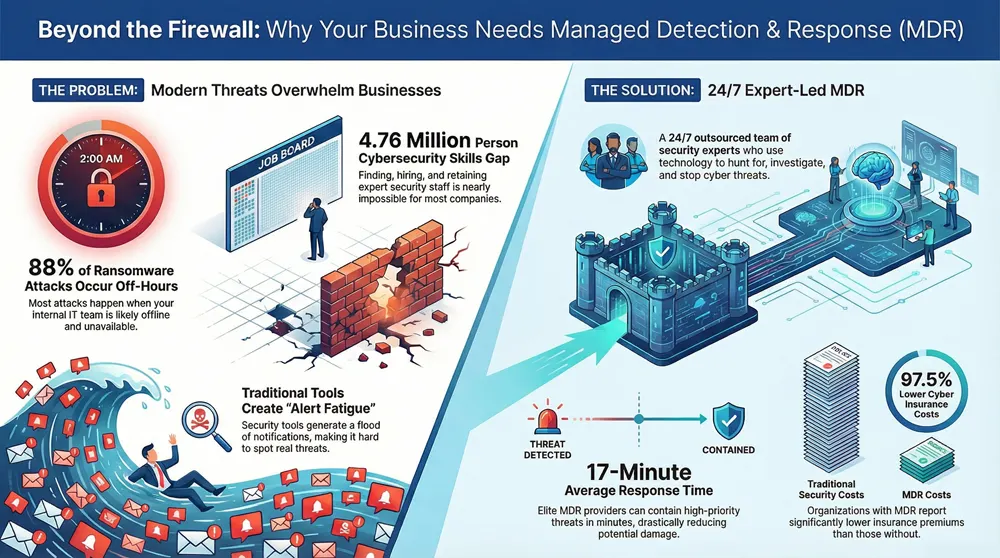
The cybersecurity landscape has never been more challenging. Over half of global CISOs have managed multiple major cyber incidents in the last five years, resulting in significant data loss and operational disruption. With 88% of ransomware attacks occurring outside normal business hours and a staggering 4.76 million cybersecurity expert shortage worldwide, traditional security approaches simply aren’t enough.
This is where managed detection response services shine. Unlike basic security tools that simply generate alerts, MDR provides a complete solution with human experts who actively hunt for threats, investigate suspicious activity, and take immediate action to protect your business.
The results speak for themselves: organizations using MDR services report 97.5% lower cyber insurance costs compared to those relying solely on basic endpoint protection. As one CISO from Ansys explained, their MDR provider acts “as a filter that bubbles up the most pressing things to the top,” making collaboration seamless and ensuring critical threats get immediate attention.

Managed detection response services helpful reading:
What is Managed Detection and Response (MDR)?
Picture this: You’ve got an incredibly important vault, holding all your business’s most precious digital treasures. Now, imagine having a dedicated, highly trained security team watching that vault 24/7, not just waiting for an alarm but actively looking for sneaky intruders. That’s essentially what Managed Detection and Response (MDR) is all about!
At its core, MDR is an outsourced cybersecurity service designed to protect your data and digital assets around the clock. It goes way beyond just putting up a fence (prevention); it actively monitors your computers, networks, and cloud spaces 24/7. This helps catch and neutralize threats that might somehow slip past traditional security tools. Think of it as having an elite team of cybersecurity experts on standby, ready to spring into action at any moment.
MDR cleverly combines the power of cutting-edge technology, like smart analytics and up-to-the-minute threat information, with the irreplaceable knowledge and experience of human experts. This powerful blend ensures that even the most sophisticated cyber threats are not only spotted, but also fully investigated and quickly dealt with. For many businesses, especially small and mid-sized ones, building and running an in-house security team (a SOC) with 24/7 staff just isn’t realistic. MDR neatly fills this gap, giving you top-tier security without the huge costs.
Want to learn more about how we can support your business’s technology needs? More info about our IT services
The Core Components of Managed Detection Response Services
So, what makes managed detection response services so effective? It’s like building a super-strong security fortress for your business, brick by brick. Each component plays a vital role in keeping you safe:
First, there’s Threat Intelligence. This is the bedrock, giving MDR providers the latest scoop on new threats, how attackers operate, and what nasty tricks they’re using. They use this global information, often adding their own findings, to predict and spot harmful activities before they cause real trouble.
Next comes Proactive Threat Hunting. Unlike old-school security that just waits for an alarm, MDR includes human experts who actively search for hidden dangers inside your systems. They’re like digital detectives, looking for anything out of place, suspicious patterns, or clues that an attacker might already be lurking.
Then, there’s Alert Triage and Prioritization. You know how your email inbox can get swamped? Security tools can do the same, sending a flood of alerts that cause “alert fatigue.” MDR services use smart tech and human brains to sort through these, filtering out the false alarms and making sure your team only sees the truly important, actionable threats.
When a threat is confirmed, Guided Response and Remediation kicks in. MDR providers move fast! They’ll help your team take the right steps to contain the problem and get rid of it. Some even offer “hands-on-keyboard” help, meaning they can directly jump in to neutralize the threat for you, like isolating affected computers or removing harmful software.
All of this relies on strong Security Analytics. MDR platforms gather and analyze huge amounts of security data from everywhere in your IT setup – logs, network traffic, activity on your devices. This data is then put through advanced analysis to spot unusual behaviors.
Finally, there are the key technologies that power the insights: Endpoint Detection and Response (EDR) gives a deep look into what’s happening on individual devices like laptops and servers. Security Information and Event Management (SIEM) brings together all your security logs and events from across your network, giving analysts a full picture. And Network Detection and Response (NDR) keeps an eye on your network traffic, catching threats that might hide elsewhere.
How MDR Differs from Traditional Security
To truly appreciate the value of managed detection response services, it helps to see how they stack up against more traditional cybersecurity options, like simple Managed Security Service Providers (MSSPs) or even dedicated Endpoint Detection and Response (EDR) tools. It’s like comparing a full-service mechanic to just having a fancy set of tools.
Here’s a quick look at the differences:
| Feature | Managed Detection and Response (MDR) | Managed Security Service Provider (MSSP) | Endpoint Detection and Response (EDR) |
|---|---|---|---|
| Scope | Comprehensive (Endpoints, Network, Cloud, Identity, SaaS applications) | Often narrower (Firewall, VPN, basic monitoring, vulnerability scans) | Primarily focused on endpoints (laptops, servers, mobile devices) |
| Primary Goal | Proactive threat hunting, rapid incident response, threat neutralization | Alerting, compliance reporting, basic security management | Deep visibility, detection, and response capabilities on endpoints |
| Alerting vs. Response | Active investigation and response (containment, remediation) | Primarily alerts; response is often left to the client | Provides data and tools for detection and response; requires skilled analysts to operate effectively |
| Human Involvement | High (24/7 expert analysts, threat hunters, incident responders) | Moderate (monitoring, basic management, reporting) | Low (technology platform); requires internal security team for full value |
| Focus | Outcomes: stopping threats, reducing dwell time, improving security posture | Compliance, uptime, basic security hygiene | Data collection and analysis from endpoints |
Traditional MSSPs often focus on managing your security devices and sending you alerts. While that’s helpful, they usually leave the tough job of investigating incidents and actually responding to threats up to your own team. This can lead to something called “alert fatigue,” where your staff gets totally overwhelmed by the sheer number of notifications. It makes it super hard to spot and act on the truly dangerous stuff.
EDR, on the other hand, is a powerful piece of technology. But here’s the thing: it’s just technology. It gives you all the data and cool tools, but you need skilled human analysts to really understand that data, investigate what’s going on, and start fixing things. Without that human touch, an EDR solution can be like having a super-fast race car but no one to drive it!
MDR stands out because it offers a human-led service that expertly manages all those cybersecurity tools and the mountain of data they produce. It’s about changing from a reactive approach (just waiting for alarms) to a proactive, outcome-focused one. Our goal isn’t just to tell you about a threat; it’s to help you stop it in its tracks, often before it can cause any real damage to your business.
The Primary Benefits of Implementing MDR
Implementing managed detection response services can truly change the game for your business’s cybersecurity. It’s not just about adding another layer of defense; it’s about gaining a powerful, proactive partner in keeping your digital world safe. Think of it as upgrading your security from a guard dog to a full-blown, 24/7 security team, constantly watching and ready to act.

Here’s how managed detection response services deliver real value and peace of mind:
First, you’ll see a significant reduction in risk and much faster response times. With 24/7 monitoring and proactive threat hunting, MDR dramatically cuts down the time it takes to spot and shut down cyber threats. This is incredibly important when you consider that a whopping 88% of ransomware attacks happen outside of normal business hours – when your team might be sleeping! Quick action minimizes the damage an attacker can do. For example, some leading MDR providers boast an incredible 17-minute average response time for high-priority incidents, showing just how fast and effective this approach can be.
Next, it’s incredibly cost-effective. Building and maintaining your own in-house Security Operations Center (SOC) with round-the-clock staffing, advanced tools, and highly skilled experts is a huge financial commitment. MDR gives you access to this top-tier security at a fraction of the cost, often reducing your operational expenses by as much as 30% compared to trying to do it all internally. Plus, here’s a big win: organizations using MDR services often report 97.5% lower cyber insurance costs than those who only rely on basic endpoint protection. That’s a tangible saving!
You also gain immediate access to elite experts. The cybersecurity talent shortage is a real problem globally. With MDR, you don’t have to worry about finding, hiring, or retaining these rare professionals. You instantly get a dedicated team of highly skilled security analysts, threat hunters, and incident responders. These experts bring years of experience and cutting-edge knowledge to your defense, helping to catch sophisticated threats that automated tools might miss.
Finally, MDR helps you achieve an improved compliance posture. Many managed detection response services are designed to help businesses meet industry-specific compliance rules, like HIPAA for healthcare or PCI-DSS for processing credit card payments. By offering continuous monitoring, detailed reports, and rapid incident response, MDR can simplify your compliance efforts and show auditors that you’re serious about security.
For a deeper dive into how we can protect your digital assets, explore our cybersecurity solutions.
Addressing the Cybersecurity Skills Gap
The cybersecurity world faces a big challenge: there simply aren’t enough skilled professionals to go around. The 2024 ISC2 Cybersecurity Workforce Study points to a staggering 4.76 million cybersecurity experts needed to fill the global workforce gap. This means many businesses struggle to find and keep the talented people required to manage complex security operations 24/7. It’s a tough spot to be in!
Managed detection response services directly tackle this staffing shortage head-on. By outsourcing your detection and response capabilities, you immediately gain a full-time, dedicated team of experts without the headaches and costs of recruitment, training, and retention. This allows your business to:
- Augment your in-house teams: MDR acts like an extra arm for your existing IT or security team, bringing specialized knowledge and round-the-clock coverage that might otherwise be impossible to achieve. Your internal staff can then focus on important strategic projects instead of getting bogged down by endless alerts and incident responses.
- Reduce IT burden: With MDR taking on the heavy lifting of threat detection and response, your IT team is freed up from constant security monitoring. This allows them to focus on core business functions and innovation, helping your company grow.
- Eliminate security tool sprawl: MDR providers often work seamlessly with and optimize your current security tools. This reduces complexity and ensures you get the most value from the investments you’ve already made, helping to tidy up your security setup and avoid unnecessary spending.
Common Use Cases for MDR
Managed detection response services are incredibly versatile and can be used in many different situations to boost your organization’s security. Here are some common ways MDR proves to be especially effective:
- Protecting Remote Workforces: With more people working from home or hybrid setups, securing devices and data outside the traditional office walls is a must. MDR extends vigilant monitoring to remote computers and devices, catching threats no matter where your team is located.
- Securing Cloud Environments: As businesses move more of their operations to the cloud, cloud security becomes more complex. MDR offers continuous visibility and threat detection across your cloud infrastructure, finding misconfigurations, unauthorized access, and attacks specifically targeting cloud systems.
- Meeting Regulatory Compliance: Businesses in regulated industries (like healthcare or finance) must follow strict data protection rules such as HIPAA or PCI-DSS. MDR helps by providing the necessary monitoring, incident response, and detailed reporting required to show you’re compliant. It can also assist with standards like NIST SP 800-171 and GLBA.
- Detecting Advanced Threats: Tricky threats like zero-day exploits, fileless malware, and advanced persistent threats (APTs) can often slip past regular antivirus programs. MDR’s blend of advanced technology and human threat hunters is specifically designed to uncover these hard-to-find attacks.
- Incident Containment and Response: When a security incident happens, stopping it quickly is key to minimizing damage. MDR providers rapidly identify affected systems, isolate them, and guide your team through the steps needed to clean up and recover, significantly reducing how long an attacker can stay hidden in your systems.
- Post-Breach Investigation: Even after a breach is contained, understanding its full scope and what caused it is vital to prevent future problems. MDR services often include forensic capabilities and detailed reports after an incident to help you learn from the attack and make your defenses even stronger.
Core Processes and Use Cases of Managed Detection Response Services
The effectiveness of managed detection response services lies in their structured yet dynamic approach to cybersecurity. It’s a continuous cycle of monitoring, detection, investigation, and response, constantly adapting to the evolving threat landscape.
This process is often mapped against frameworks like the MITRE ATT&CK framework, which details adversary tactics and techniques, allowing MDR providers to understand and counter threats more effectively. It creates a continuous improvement loop, where insights from past incidents feed into stronger future defenses. Think of it as a security system that learns and evolves with every threat it encounters.
The MDR Process: From Detection to Neutralization
Understanding how managed detection response services work behind the scenes can help you appreciate their value. The MDR process is like a well-orchestrated emergency response team, where every step is designed to minimize damage and restore security as quickly as possible.
The journey begins with prioritization, where the massive amount of security data flowing through your systems gets filtered and analyzed. MDR solutions use sophisticated automation combined with expert human analysis to separate genuine threats from false alarms. This prevents the dreaded “alert fatigue” that can overwhelm internal IT teams and ensures that real dangers get immediate attention.
Next comes proactive threat hunting, where skilled analysts actively search for hidden threats within your environment. Unlike passive monitoring systems that wait for obvious signs of trouble, threat hunters use their expertise and the latest threat intelligence to uncover subtle indicators that something isn’t right. They’re like digital detectives, looking for clues that automated tools might miss entirely.
When a potential threat surfaces, the investigation phase kicks into high gear. MDR analysts dive deep, gathering context from multiple sources across your endpoints, network, and cloud infrastructure. They work to understand not just what happened, but how it happened, who might be responsible, and what the attacker’s ultimate goal might be. This root cause analysis is crucial for preventing similar attacks in the future.
Speed becomes critical during containment. The primary goal is stopping the attack in its tracks before it can spread further through your systems. This might involve isolating affected computers, blocking suspicious network traffic, or immediately revoking compromised user credentials. Every minute counts, as attackers can cause exponentially more damage the longer they remain undetected.
The eradication phase focuses on completely removing the threat from your environment. This thorough cleanup process might involve removing malware, patching security vulnerabilities, or completely rebuilding compromised systems. It’s not enough to just stop an attack – every trace must be eliminated to prevent it from resurging later.
Recovery brings everything back to normal operations while ensuring business continuity. Systems are carefully restored, data is verified for integrity, and normal operations resume. Throughout this process, MDR providers work closely with your team to minimize downtime and ensure a smooth transition back to full functionality.
Finally, comprehensive post-incident reporting documents everything that happened, how it was handled, and what lessons were learned. This detailed analysis becomes invaluable intelligence for strengthening your defenses against future attacks, creating that continuous improvement loop that makes your security posture stronger over time.
Key Considerations When Choosing an MDR Provider
Selecting the right managed detection response services provider is one of the most important cybersecurity decisions your organization will make. The provider you choose becomes your trusted partner in defending against increasingly sophisticated threats, so it’s worth taking time to evaluate your options carefully.
Service Level Agreements (SLAs) should be your first consideration. These aren’t just numbers on paper – they represent how quickly help will arrive when you’re under attack. Some providers offer standard 2-hour response times, which works well for many businesses, while premium services might guarantee response within 30 minutes. The choice often comes down to your risk tolerance, budget, and how critical immediate response is to your operations.
Your provider’s technology stack forms the foundation of your defense. You’ll want to understand what tools they use – whether it’s advanced EDR platforms, sophisticated SIEM systems, next-generation XDR solutions, or cutting-edge AI and machine learning platforms. More importantly, ensure their technology can effectively monitor your specific environment, whether that’s traditional on-premise infrastructure, cloud-based systems, or a hybrid mix of both.
Industry expertise can make a significant difference in how well your MDR service protects you. While cyber threats target everyone, different industries face unique challenges. Healthcare organizations must steer HIPAA compliance while defending against ransomware, while financial services companies deal with different regulatory requirements and threat actors. A provider with deep experience in your sector will better understand these nuances.
The response capabilities of your MDR provider determine what happens when threats are finded. Some providers excel at guided remediation, walking your team through the necessary steps to contain and eliminate threats. Others offer “hands-on-keyboard” services, where their experts take direct action on your systems to neutralize threats immediately. Understanding what level of response you need – and what you’re comfortable with – is crucial.
A smooth onboarding process sets the stage for everything that follows. The best MDR providers make deployment as painless as possible, with clear timelines, minimal disruption to your operations, and dedicated support to ensure everything integrates properly with your existing infrastructure. Ask potential providers about their typical onboarding timeline and what resources you’ll need to commit from your team.
Reporting and visibility keep you informed about your security posture and any incidents that occur. Look for providers who offer clear, actionable reporting through intuitive dashboards and regular communication. You should never be left wondering what’s happening with your security or whether the service is working effectively.
Finally, consider scalability for your future needs. Your business will grow, your technology environment will evolve, and your security requirements will change. The right MDR provider should be able to grow with you, easily adding new endpoints, expanding into new cloud environments, or adjusting coverage as your organization develops. This flexibility ensures your investment continues to pay dividends as your business expands.
Measuring Success and the Future of MDR
When it comes to cybersecurity, what you measure really does matter! For managed detection response services, success isn’t just about avoiding a nasty cyberattack (though that’s certainly a huge win!). It’s also about showing real, tangible improvements in your security and proving that your investment is paying off. Thinking about security with data and clear numbers helps you keep getting better and lets you show everyone involved just how valuable your security strategy truly is.
The world of cyber threats is always changing, and super fast too! With things like AI-powered attacks and clever new tricks from cybercriminals, the future of MDR is just as exciting and dynamic. It’s a field that’s always pushing the limits of how we can proactively defend businesses like yours.
And speaking of optimizing your business, did you know we also help make your document management smoother? You can find More info about our managed print services right here!
How to Measure the Effectiveness of Your Managed Detection Response Services
To really understand how well your managed detection response services are working, we like to look at some key numbers, or KPIs. These show us both how efficient the service is and what kind of impact it’s having on your business’s safety.
First up is Mean Time to Detect (MTTD). This is basically how quickly a threat gets spotted once it enters your system. The faster your MDR team can detect something, the better! For example, some top MDR providers are twice as fast at detecting threats as the average. Next, we have Mean Time to Respond (MTTR). This measures how long it takes to actually stop and clean up a detected threat. A low MTTR means attacks are squashed quickly, reducing any potential damage. Imagine, some MDR services boast an incredible 17-minute response time for serious incidents!
Another big one is Dwell Time Reduction. “Dwell time” is just a fancy way of saying how long an attacker hangs around undetected in your network. A main goal of MDR is to cut this time way down, stopping bad actors from doing more harm or stealing your valuable data. Then there’s the False Positive Rate. You know how some security alerts turn out to be nothing? Those are false positives. While some are unavoidable, a good MDR service works hard to minimize them. This means your team gets fewer annoying, false alarms and more high-quality alerts that actually need your attention.
Of course, we also look at the Number of Incidents Remediated. This is a straightforward way to see how many security problems the MDR service has successfully found and fixed. Finally, don’t forget about Security ROI (Return on Investment). Beyond just these techy numbers, think about the bigger picture. This includes saving money on cyber insurance (MDR users can pay 97.5% less!), avoiding the huge costs of a potential breach, and being able to let your internal IT team focus on what they do best, instead of constant security monitoring.
Emerging Trends in the MDR Space
The world of cybersecurity is like a fast-moving river, and managed detection response services are constantly evolving to keep up with the flow. Here are some exciting new trends shaping the future of MDR:
First off, AI and Machine Learning (AI/ML) are becoming super important. They help MDR providers spot threats even faster by sifting through huge amounts of data to find tiny, unusual patterns that signal danger. Even fancy Generative AI (GenAI) is now helping reduce detection times and speed up responses by automating the first steps of analysis.
Then there’s Automation (SOAR). Think of SOAR platforms as smart helpers that automate routine security tasks. This frees up human analysts to focus on the really tough stuff, making the whole process much more efficient.
You’ll also hear a lot about Extended Detection and Response (XDR). This is a rapidly growing trend that gives a much wider view of your security. Instead of just looking at your computers, XDR checks your networks, cloud setups, user identities, and even common software you use. MDR services are increasingly built on these XDR platforms, giving you a more complete picture and leading to quicker, more accurate threat detection across everything your business uses.
Threat Intelligence Sharing and Collaboration is another big trend. MDR providers are working together and sharing what they learn about new threats. It’s like building a collective shield against sophisticated attackers, using shared knowledge to stay ahead. We’re also seeing more Predictive Analytics. This moves beyond just reacting to threats. It’s about using past data and threat patterns to predict where the next attack might come from, letting businesses set up defenses even more proactively.
Lastly, there’s a big Focus on Business Outcomes. It’s not just about cool tech anymore. MDR providers are now really honing in on how their services directly reduce risks for your business, make your operations more resilient, and actually help you grow, rather than just talking about technical specs.
Frequently Asked Questions about MDR Services
When considering managed detection response services, business leaders often have practical questions about implementation, costs, and compatibility with their existing systems. These are the most common concerns we hear from organizations evaluating MDR solutions.
What is the main difference between MDR and a Security Operations Center (SOC)?
Think of it this way: a Security Operations Center (SOC) is like having your own in-house fire department, while MDR is like subscribing to a premium fire protection service that gives you access to expert firefighters without the overhead of maintaining your own fire station.
A SOC is the centralized security function or team itself - the people, processes, and technology working together to monitor and protect your organization. You can build an internal SOC with your own staff and equipment, but this requires significant investment in hiring skilled analysts, purchasing expensive security tools, and maintaining 24/7 operations.
Managed detection response services provide you with access to a professionally staffed SOC and its expert team without the massive overhead. You get all the benefits of enterprise-grade security operations - the advanced technology, the skilled analysts, the round-the-clock monitoring - delivered as a service. For most small and mid-sized businesses, this approach makes much more financial and operational sense than trying to build their own internal SOC.
Can MDR services work with my existing security tools?
Absolutely, and this is one of the biggest advantages of modern managed detection response services. The best MDR providers are designed to maximize the return on your current security investments rather than replace everything you've already purchased.
Leading MDR providers can integrate with hundreds of existing security technologies, including your current firewalls, endpoint detection tools, cloud security platforms, and network monitoring systems. This integration capability means you won't have to rip and replace your existing infrastructure - instead, your MDR provider will help you get more value from the tools you already own.
The integration works by connecting your existing security tools to the MDR provider's monitoring and analysis platform. This creates a unified view of your security posture while leveraging the specialized capabilities of each tool. Your firewall logs, endpoint alerts, and cloud security events all feed into the MDR platform, where expert analysts can correlate this information to identify and respond to threats more effectively.
Is MDR only for large enterprises?
This is one of the biggest misconceptions about managed detection response services. In reality, MDR is often more valuable for small and mid-sized businesses than for large enterprises, precisely because smaller organizations typically lack the internal resources to build comprehensive security operations.
Consider the challenge: building an effective 24/7 security operation requires hiring multiple skilled cybersecurity analysts (with average salaries often exceeding $100,000), purchasing and maintaining expensive security tools, and ensuring continuous coverage across all shifts. For most SMBs, this represents a significant financial burden that's often impossible to justify.
MDR changes this equation completely. It provides enterprise-grade security at a manageable cost, allowing smaller businesses to access the same level of protection and expertise typically available only to large corporations with massive security budgets. You get immediate access to a full team of experts, advanced security technologies, and 24/7 monitoring without the overhead of hiring, training, and retaining specialized staff.
Many of our clients are small and mid-sized businesses who found that MDR was the most practical way to achieve robust cybersecurity without breaking their budget or overwhelming their existing IT teams.
Conclusion
New cyber threats pop up daily, having managed detection response services isn’t just a nice-to-have – it’s truly essential for businesses of every size. Think of it as your business’s personal guardian angel, working tirelessly behind the scenes to keep you safe.
These services bring together the best of both worlds: cutting-edge technology that can spot even the sneakiest threats, and incredible human experts who know exactly how to hunt down and stop them. This powerful combination means your business gets 24/7 monitoring, proactive threat hunting (meaning they look for trouble before it finds you!), and super-fast responses when an incident occurs.
Choosing MDR is more than just buying a service; it’s like forming a strategic partnership. It helps you tackle big challenges like the shortage of cybersecurity experts, significantly reduces your risk of a costly breach, and truly strengthens your overall security. It’s a key ingredient for making your business cyber resilient, meaning you can bounce back quickly from any digital bumps in the road.
At 1-800 Office Solutions, we understand how important it is to keep your digital assets safe while making sure your business runs smoothly. We’re dedicated to offering comprehensive managed IT and security services that are custom just for your needs. We’re here to help you confidently steer the complex world of cyber threats.
Ready to give your business the expert-driven cybersecurity it deserves? We’re here to help you secure your future.
Secure your business with our Managed Detection and Response services today.