
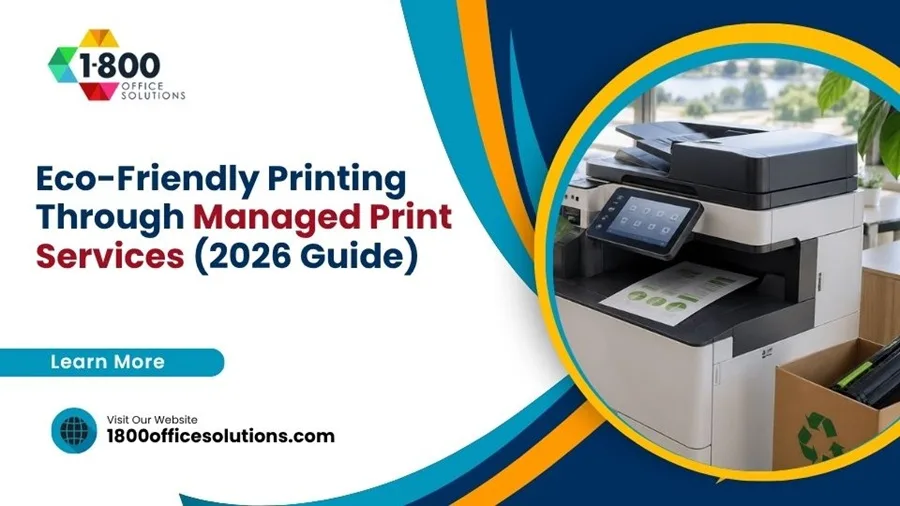
Eco-friendly printing through Managed Print Services (MPS) can shrink office paper use by up to 50%, trim total print spend 20 to 40%, and cut carbon emissions tied to your fleet. The fix is rarely about printing less; it is about printing smarter with right-sized devices, default duplex settings, secure pull-printing, toner recycling, and ongoing usage analytics. 1800 Office Solutions has been helping Miami offices do exactly this.
The Hidden Cost of Office Print
Why Office Printing Is a Bigger Climate Problem Than You Think
Most offices treat printing like background noise. The toner shows up. Paper stacks refill on autopilot. Nobody really tracks what gets printed, who printed it, or where the page actually ended up. Quiet inattention adds up fast.
US offices push out roughly 12.1 trillion sheets of paper every year, and almost half of those printed pages get tossed within 24 hours. This single fact reframes the whole conversation. We are not printing too little; we are printing the wrong things, then throwing them straight in the bin.
Paper alone makes up about a quarter of landfill waste globally, and as it decomposes it releases methane, a greenhouse gas roughly 25 times more potent than carbon dioxide. And virgin office paper uses around 17 trees per ton, so the office printer suddenly looks less innocent.
of total office waste comes from paper, and nearly half of printed pages are discarded within a day
So how does a busy Miami office change this pattern without disrupting the work? This is exactly where Managed Print Services come in. MPS is not a single product. It is a partnership where a provider audits your fleet, optimizes how it runs, and keeps tuning it month after month. Done well, it pays for itself and improves your sustainability story at the same time.
For a deeper look at the cost side, our breakdown of how managed print services reduce printing waste and costs walks through the savings math step by step.
What MPS Actually Does
Managed Print Services, Explained Without the Jargon
Think of Managed Print Services as having a fleet manager for every printer, copier, and multifunction device in your building. Instead of buying ad-hoc devices and toner from whoever calls first, you get one partner watching usage, supplies, security, and uptime. The provider tracks every page, every cartridge, and every alert.
And this matters environmentally because the most polluting page is the one never needed in the first place. MPS finds those pages and quietly stops them. Default duplex. Pull-print release. Smarter routing. Quotas. Analytics. None of it is glamorous. All of it works.
The Five Pillars of a Sustainable MPS Program
- Fleet right-sizing. Most offices have too many small desktop printers and not enough efficient shared devices. Right-sizing alone often removes a quarter of your fleet on day one.
- Default duplex and grayscale. Setting two-sided printing as the standard can cut paper use by up to 50% with zero training required.
- Secure pull-printing. Print jobs sit in a queue until you tap a badge or PIN at the device. Forgotten print jobs simply expire and never waste paper.
- Toner and cartridge recycling. Branded recycling programs from Ricoh, HP, Canon, Xerox, Konica Minolta, and Kyocera return spent supplies for refurbishment or material reclaim.
- Usage analytics. Monthly dashboards show who prints what, where, and how often. Companies using analytics tools have reported a 35% drop in unnecessary printing.
By the Numbers
What Sustainable Print Programs Actually Save
The skeptical CFO question is fair. Does any of this move the needle, or is it greenwashing dressed up as procurement? The data is encouraging. Properly designed MPS programs deliver meaningful savings on cost, paper, energy, and emissions all at once.
typical cost reduction on print and copy spend after a managed print engagement
Here is the rough impact you can expect, drawn from industry research and our own client engagements across South Florida.
| Metric | Before MPS (typical) | After MPS (typical) | Source / Driver |
|---|---|---|---|
| Total print spend | Baseline | 20% to 40% lower | Allied Market Research, Quocirca |
| Paper consumption | Baseline | Up to 50% lower | Default duplex policy |
| Unnecessary print jobs | Baseline | ~35% reduction | Pull-print plus analytics |
| Energy use per device | Older fleet | 30% to 50% lower | ENERGY STAR-rated MFPs |
| Toner cartridge waste | Landfill | Closed-loop recycle | OEM reclaim programs |
| Help-desk print tickets | Baseline | 50% to 70% fewer | Proactive monitoring |
And the carbon math follows the paper math. With roughly 1.5 tons of CO2 emissions per ton of paper produced, every ream you do not print is roughly 2.5 kilograms of CO2 you do not emit. Multiply across a Miami office of 100 people for a year and the savings are real.
For a related angle on cost, our piece on photocopier servicing costs shows how proactive maintenance, the same approach MPS uses, prevents the most expensive failures.
Sustainable Hardware
The Greenest Printer Is the One You Already Have, Until It Is Not
One myth worth busting early. Replacing every printer with a brand-new ENERGY STAR model is not automatically the greenest move. The embedded carbon in manufacturing a new device is significant, and tossing a working machine to chase a small efficiency gain can be a net loss.
So a smart MPS audit asks three questions about each device. Is the device healthy? Does it fit the workload? And is the energy delta from replacement large enough to justify the embodied carbon of a new unit? Often the answer is to keep the device, change the settings, and replace only the worst offenders.
What to Look For in a Sustainable Multifunction Device
- ENERGY STAR certification, with a Typical Electricity Consumption (TEC) rating fitting your duty cycle.
- EPEAT Gold or Silver registration, which scores recyclability, packaging, and end-of-life takeback.
- Default sleep mode under one minute and instant-on warm-up to avoid wasted standby power.
- Low-melt toner fusing at lower temperatures, cutting both energy and ozone emissions.
- Refurbished or remanufactured chassis options, which use up to 80% less material than a new build.
- Vendor takeback program with verified recycling chain of custody.
Many of our clients run hybrid fleets pairing newer Ricoh IM C and Konica Minolta bizhub i-Series flagships in high-volume areas with older but well-maintained desktop units in low-volume zones. The result is lower total emissions than a wholesale fleet refresh would deliver.
If you are weighing brands and models, our Ricoh copier maintenance guide covers maintenance steps to extend useful life and keep older devices running clean.
Paper, Toner, and Supply Chain
Eco-Friendly Supplies Are the Easiest Win Most Offices Skip
Hardware gets all the attention, but the supplies you feed those machines often have a bigger lifecycle footprint than the machines themselves. The good news: switching is cheap, fast, and rarely affects quality.
Paper Choices With Real Impact
Look for paper with Forest Stewardship Council (FSC) or Sustainable Forestry Initiative (SFI) certification. Both confirm the fiber came from responsibly managed forests. Even better, choose 30% to 100% post-consumer recycled paper. A ton of recycled paper saves about 17 trees, 7,000 gallons of water, and 4,000 kilowatt-hours of electricity compared to virgin stock.
Lighter weights matter too. Moving from 24-pound to 20-pound bond reduces fiber use without affecting most office workflows. And brightness ratings above 96 require more chlorine bleaching, so dropping to 92 brightness for internal documents is a quick environmental win nobody will notice.
Toner and Ink: Closing the Loop
OEM closed-loop toner programs (Ricoh, HP Planet Partners, Canon Generation Green, Xerox Green World Alliance) take spent cartridges, sort them, and either refurbish or reclaim raw materials. Roughly 65% of office paper gets recycled in the US today, but toner recycling rates lag behind, so this is a real gap most offices can close immediately.
are saved per ton of recycled paper used in place of virgin office stock
For organizations chasing CDP or ISO 14001 reporting, your MPS partner should provide quarterly recycling certificates documenting how many cartridges were diverted from landfill and what materials were recovered.
Behavior Change
The Soft Stuff Matters: User Habits and Print Culture
You can install the greenest fleet in Miami and still hemorrhage paper if your team prints habitually. So the most successful MPS programs pair hardware and supply changes with quiet behavioral nudges.
Nudges Without the Friction
- Print preview defaults. A two-second preview screen catches the accidental 200-page web archive before it hits the queue.
- Color quotas. Most internal documents do not need color. Soft quotas (with override for client work) cut color volume sharply.
- Department-level dashboards. Friendly competition between teams reliably reduces print volume more than top-down policy.
- Follow-me print expiry. Jobs sitting in the queue longer than 24 hours auto-delete, so forgotten prints never reach paper.
- Onboarding scripts. New hires learn the print culture during their first week, not three months later.
Security & Compliance
Sustainable Printing Has to Be Secure Printing Too
Eco-friendly print policy and information security live closer together than most people assume. Both depend on knowing where every page goes, who printed it, and whether it ever needed to exist on paper at all.
Pull-print release, the same feature preventing wasted output, also stops sensitive documents from sitting in an unattended output tray where anyone walking past could grab them. So the same MPS dashboard helping your sustainability committee report on diverted carbon also helps your IT team report on HIPAA, FERPA, GLBA, or PCI compliance.
If you handle protected data, our team can pair MPS with broader cybersecurity protections. Our cybersecurity practice works alongside print to harden the whole document workflow.
Compliance Touchpoints to Discuss With Your MPS Partner
- Hard drive encryption and data overwrite for every multifunction printer.
- End-of-lease device wipe with a certificate of destruction.
- Audit logs of who released which print job, retained per your data policy.
- Network segmentation so printers cannot reach sensitive systems unnecessarily.
- Firmware update cadence to close known printer vulnerabilities, which the Cybersecurity and Infrastructure Security Agency regularly flags.
South Florida Reality Check
What Eco-Friendly Print Looks Like for a Miami Business
South Florida offices have a few quirks worth naming. Heat, humidity, and salt air all stress copier components and shorten the useful life of fusers and rollers if maintenance lapses. So sustainability planning has to factor in our climate.
Strong HVAC discipline keeps device temperatures stable, which improves energy efficiency and reduces the failure rate sending machines to early end-of-life. Coastal offices in Brickell, Coral Gables, Aventura, and Fort Lauderdale also benefit from quarterly cleaning passes not needed to happen at the same frequency in drier climates.
Power resiliency matters too. Hurricane season brings outages, and unprotected fleets can suffer firmware corruption forcing premature replacement. Surge protection, UPS backup for higher-end MFPs, and seasonal preparation are part of any responsible MPS engagement here.
Local Compliance Notes
Florida businesses serving regulated industries (legal, healthcare, financial services) have to align print workflows with both federal frameworks and Florida-specific privacy law. Your MPS partner should be able to map device controls to those requirements during the audit phase, not as an afterthought. The NIST Cybersecurity Framework remains a useful reference point for this mapping.
How 1800 Office Solutions Helps
What an Engagement With Us Actually Looks Like
We have been serving Miami offices. Over those years we have refined an MPS approach designed around three things our clients actually care about. Predictable cost. Real environmental impact. Zero drama from the help desk.
1. Free Print Audit
We map every device, plug volumes into our model, and show you the savings range before you sign anything.
2. Right-Sized Fleet Plan
We propose a leaner, more efficient device mix from Ricoh, Canon, HP, Konica Minolta, and Kyocera based on workload, not vendor quotas.
3. Sustainable Setup
Default duplex, grayscale, secure release, and follow-me printing get configured before the first user logs in.
4. Closed-Loop Supplies
Toner ships with a prepaid return label so cartridges are recycled, not landfilled.
5. Proactive Service
Devices self-report errors and supply levels. We dispatch before your team knows there is a problem.
6. Quarterly Reviews
Cost, paper, carbon, and exception reports show progress and where to tune next.
If you want to see how we approach modernization beyond print, our copier malfunction prevention guide shows the same maintenance philosophy in action.
Decision Framework
Is MPS the Right Move for Your Office Right Now?
Not every office is ready for a full MPS engagement. Some are too small for the operational lift to be worthwhile. Others run such tight workflows already where the savings opportunity is small. So a candid self-assessment helps before you even pick up the phone.
| Signal | Strong Fit for MPS | Maybe Wait |
|---|---|---|
| Number of devices | 10 or more across one or more sites | Fewer than 5 devices total |
| Monthly print volume | 20,000+ pages | Under 5,000 pages |
| Print cost visibility | You cannot answer “what did we spend on print last quarter?” | Already tracked precisely |
| Sustainability reporting | You publish ESG, CDP, or ISO 14001 data | No external reporting needs yet |
| Help desk load | Print issues hit the queue weekly | Print issues are rare |
| Fleet age | Mixed ages, varied vendors, no service contract | Recently refreshed, single vendor, under warranty |
If three or more of those rows put you in the “Strong Fit” column, an MPS audit will almost certainly find meaningful savings. If you are in the “Maybe Wait” column on most rows, a lighter consultative conversation may be a better fit.
Frequently Asked Questions
Eco-Friendly Managed Print: Your Questions Answered
How much can Managed Print Services actually reduce my paper use?
Most MPS engagements cut paper use 30% to 50% within the first year. Default duplex printing alone delivers up to half of those gains. Adding pull-print release, color quotas, and analytics reporting captures the rest. Your starting baseline matters, so an audit gives the most accurate forecast.
Will my staff notice or resist the changes?
Most users adapt within a week. The biggest visible change is tapping a badge or entering a PIN at the printer to release jobs, which most people accept once they understand it also protects sensitive documents. Quotas and color restrictions need a brief change-management push, but they rarely cause friction.
Do I have to replace all my printers to go green?
No. A good MPS audit often keeps 60% to 80% of your existing fleet. The greenest print device is frequently the one you already own, especially when its remaining service life is healthy. Replacement should target only the worst energy offenders or units no longer fitting the workflow.
What is the difference between MPS and just buying a service contract?
A service contract covers parts, labor, and supplies. MPS adds usage analytics, fleet optimization, secure print, sustainability reporting, and continuous improvement. So MPS is a strategic engagement, while a service contract is purely reactive.
How does MPS support compliance frameworks like HIPAA or PCI?
MPS centralizes user authentication, encrypts device storage, logs every print and scan event, and applies firmware updates on a managed cadence. Those controls map directly to HIPAA, PCI DSS, GLBA, and FERPA requirements. Your provider should produce mapping documentation as part of onboarding.
What happens to my old toner cartridges and printers?
OEM closed-loop programs from Ricoh, HP, Canon, Xerox, Konica Minolta, and Kyocera reclaim cartridges for refurbishment or material recovery. End-of-life devices are wiped, harvested for parts, and routed to certified e-waste recyclers. You receive recycling certificates each quarter.
How long does an MPS engagement typically last?
Most contracts run 36 to 60 months and align with hardware lease terms. Pricing usually scales with click volume rather than headcount, so growth or contraction adjusts the bill automatically. Quarterly reviews keep the agreement honest as your needs change.
Can MPS work for a hybrid or remote workforce?
Yes, and it has become essential. Cloud print platforms route jobs to home or office devices securely, apply the same default duplex and grayscale rules, and report usage centrally. So sustainability metrics travel with the worker.
What does an MPS contract cost in South Florida?
Pricing varies by volume, fleet age, and feature set, but most Miami clients pay 1.0 to 4.5 cents per black page and 4 to 12 cents per color page, supplies and service included. The savings versus a la carte purchasing typically reach 20% to 40%.
How do I prove the environmental impact of MPS to my board or ESG committee?
Your provider should deliver a quarterly sustainability report with paper saved, carbon avoided, cartridges recycled, and energy reduction figures. We benchmark against your pre-engagement baseline so the numbers are credible and audit-ready.
Is recycled paper noticeably worse quality than virgin?
Modern 30% post-consumer recycled paper performs identically to virgin in any office workflow. Higher recycled content (50% to 100%) may show a slightly warmer tone, but for internal documents this is rarely an issue. For client-facing pieces, your provider can keep a virgin stock available.
How fast does an MPS rollout actually happen?
A typical Miami engagement runs 30 to 60 days from signed agreement to fully configured fleet. Audit and proposal take two to three weeks. Hardware swaps, software deployment, and user training fill the remaining time. We coordinate around your business calendar to minimize disruption.
Ready to Print Smarter and Greener?
1800 Office Solutions is your one source for everything office. We will audit your current fleet, show you the exact paper, cost, and carbon savings available, and design an MPS program built around your goals. No pressure. No jargon. Just numbers you can take to your CFO and your sustainability committee.
Call (888) 574-5120 or click below.
1800 Office Solutions · Your One Source For Everything Office · Serving Miami