


7 Essential Business Continuity Planning Steps for 2026

Unexpected disruptions—from cyberattacks and supply chain failures to natural disasters—can halt operations and threaten your organization’s survival. A reactive approach is no longer sufficient; a proactive, structured business continuity plan is the key to navigating uncertainty and ensuring operational stability. This guide breaks down the essential business continuity planning steps into a clear, actionable roadmap, transforming abstract risks into a manageable and effective strategy.
Following this detailed checklist will empower your organization to not only withstand unforeseen events but also to strengthen day-to-day operational efficiency. By systematically addressing each phase, from initial risk assessment to ongoing plan maintenance, you can protect critical assets, safeguard revenue streams, and maintain the trust of customers and stakeholders when it matters most.
The process involves significant data gathering, documentation, and coordination across multiple departments. To aid in establishing and maintaining your robust framework, exploring dedicated business continuity planning software can streamline workflows, centralize information, and automate critical notifications. This article will guide you through the seven core components of a successful plan, providing the structure needed to build an enterprise that is prepared, responsive, and ultimately, resilient.
1. Risk Assessment and Business Impact Analysis (BIA)

The foundational step in any robust business continuity plan is to understand what you are protecting and what you are protecting it from. This is accomplished through a comprehensive Risk Assessment and Business Impact Analysis (BIA). This dual process serves as the bedrock for all subsequent business continuity planning steps, ensuring that your efforts are focused, efficient, and aligned with your organization’s most critical needs.
A Risk Assessment identifies potential threats and vulnerabilities, both internal and external. These can range from natural disasters like floods and earthquakes to technological failures such as server crashes and cyberattacks, or even human-centric risks like key personnel loss. A crucial first step in business continuity planning is conducting a thorough risk assessment and business impact analysis, which benefits greatly from understanding effective risk management strategies.
The Role of the Business Impact Analysis (BIA)
While the risk assessment identifies what could happen, the BIA quantifies the operational and financial consequences if it does happen. The BIA systematically evaluates business processes to determine which are most critical to your organization’s survival.
Key outputs of a BIA include:
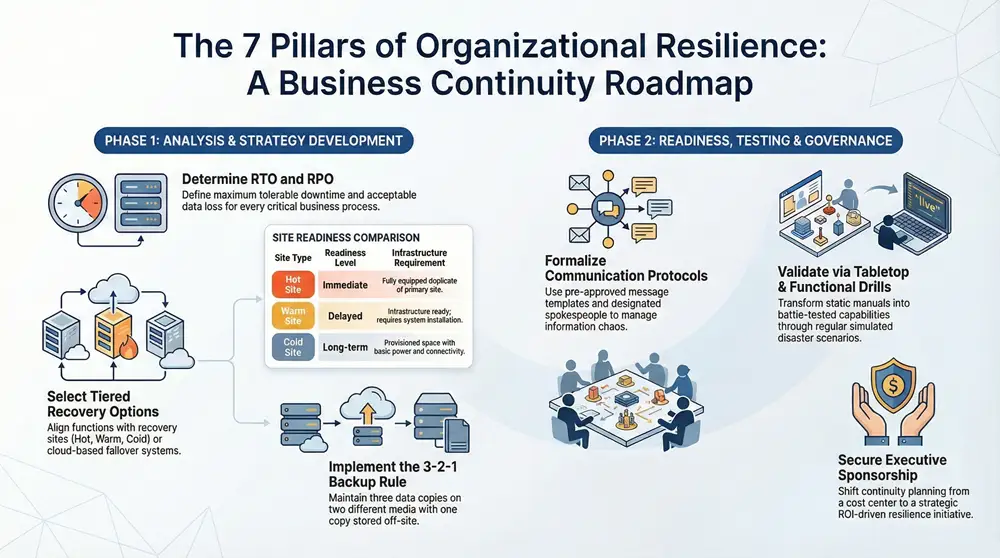
- Recovery Time Objective (RTO): The maximum tolerable downtime for a specific process before the business suffers significant harm.
- Recovery Point Objective (RPO): The maximum amount of data loss that can be tolerated, measured in time (e.g., 15 minutes of data).
- Interdependencies: Identifying how the failure of one process or system impacts others, both upstream and downstream.
For example, a healthcare provider’s BIA would likely assign the highest priority (and shortest RTO/RPO) to its patient record system and emergency services communication network. In contrast, an e-commerce company would prioritize its transaction processing platform, especially during peak sales periods like Black Friday.
Practical Steps for Implementation
To execute an effective BIA, involve stakeholders from every corner of the organization. Systematically interview department heads from operations, IT, finance, and human resources using standardized questionnaires to ensure consistent data collection. Quantify impacts in financial terms wherever possible, such as lost revenue per hour of downtime. Documenting all your assumptions is critical, as this analysis should be treated as a living document, updated at least annually or whenever significant organizational changes occur.
Understanding your organization’s unique vulnerabilities is essential for protecting it. For a deeper dive into the methodologies behind a thorough assessment, explore this detailed guide to a cybersecurity risk assessment. This analysis establishes the priorities that will guide your entire continuity strategy.
2. Business Continuity Strategy Development
With a clear understanding of your critical functions and potential threats from the BIA, the next step is to formulate targeted recovery strategies. This is where you move from analysis to action, creating the specific response mechanisms that will enable your organization to resume operations within the defined Recovery Time Objectives (RTOs). A well-defined strategy ensures that recovery efforts are not improvised during a crisis but are instead deliberate, pre-approved, and aligned with your budget and operational needs.
Business Continuity Strategy Development involves selecting the most appropriate and cost-effective methods for each critical business function identified in your analysis. This process translates the “what if” scenarios from the risk assessment into a concrete “how to” plan for recovery, serving as a blueprint for resilience.
The Role of Recovery Options
While the BIA dictates how fast you need to recover, your strategy defines how you will achieve it. This involves evaluating various recovery options and aligning them with the specific requirements of each business unit. The goal is to build a layered defense that provides a practical path back to normalcy.
Key recovery strategy options include:
- Hot, Warm, and Cold Sites: These are alternate physical locations. A hot site is a fully equipped duplicate of your primary site, ready for immediate failover. A warm site has infrastructure but requires systems to be installed, while a cold site is merely a provisioned space with power and connectivity.
- Cloud-Based Failover: Leveraging cloud services for Infrastructure-as-a-Service (IaaS) or Disaster-Recovery-as-a-Service (DRaaS) allows for rapid system recovery without maintaining physical hardware.
- Manual Workarounds: For less critical processes with a longer RTO, documented manual procedures can serve as a temporary bridge until automated systems are restored.
For example, a regional bank might invest in a hot site with real-time data replication for its core banking system to ensure zero transaction loss. A software development company, however, might opt for a more flexible cloud-based failover system, allowing its globally distributed teams to reconnect and resume work from any location.
Practical Steps for Implementation
To develop an effective strategy, perform a detailed cost-benefit analysis for each potential recovery option. Engage department leaders and financial stakeholders to weigh the cost of implementation against the potential losses from downtime identified in the BIA. It is crucial to document all assumptions made during this decision-making process, such as vendor capabilities or required lead times for equipment.
Consider hybrid approaches that blend different methods. For instance, you could use a cloud failover for critical IT systems while relying on a cold site and manual workarounds for administrative functions. This balanced approach, a core part of modern business continuity planning steps, optimizes cost and effectiveness. Regular reviews, at least annually, ensure your strategy remains aligned with evolving business needs and technological advancements.
3. Backup and Data Protection Planning

After identifying your most critical business functions and their recovery objectives, the next essential step is to ensure the data supporting them is protected and recoverable. This is achieved through a comprehensive Backup and Data Protection Plan. This plan serves as your organization’s digital life raft, providing the technical means to restore information and resume operations after a disruptive event, from a ransomware attack to a server failure.
A robust data protection strategy is a non-negotiable component of any modern business continuity plan. It involves defining and implementing procedures for creating redundant copies of critical data, storing them securely, and having a tested process to restore them quickly. Without a reliable backup system, even the best-laid recovery strategies will fail at the most crucial moment.
The Role of the 3-2-1 Backup Strategy
While there are many approaches to data protection, the industry-standard 3-2-1 rule provides a simple yet powerful framework. This strategy dictates that you should have at least three copies of your data, stored on two different types of media, with one of those copies located off-site.
Key elements of a data protection plan include:
- Backup Frequency: How often data is backed up, which should align with your RPO. Transactional databases may require continuous or near-continuous backups.
- Retention Policies: Rules defining how long backups are kept. Regulatory requirements, like HIPAA for healthcare, often dictate minimum retention periods.
- Storage Locations: A mix of on-premises devices (like a NAS) and off-site storage (such as cloud services like AWS or Azure) to protect against localized disasters.
For example, a financial institution will use the 3-2-1 rule to maintain a local backup on a separate server (copy 1 on media 1), a secondary backup on tape storage (media 2), and a third, encrypted copy in a secure cloud environment (copy 2, off-site). This redundancy ensures data is recoverable even if the primary data center is compromised.
Practical Steps for Implementation
To implement an effective backup plan, start by inventorying all critical data sources identified in your BIA. Classify this data based on its importance and assign corresponding backup policies. Automate the backup process wherever possible using modern software solutions to eliminate human error and ensure consistency. Critically, schedule and perform regular restoration tests, at least quarterly, to validate that your backups are viable and that your team can execute the recovery procedures within the established RTO.
Document every aspect of your backup and recovery process, including who is responsible, where backups are stored, and the step-by-step instructions for a full restore. For organizations seeking to fortify their data protection, exploring managed backup and disaster recovery solutions can provide the expertise and infrastructure needed to build a resilient system. This proactive planning is fundamental to data integrity and operational resilience.
4. Communication and Notification Planning
A meticulously crafted business continuity plan is ineffective if no one knows it has been activated. The fourth crucial step, Communication and Notification Planning, ensures that information flows quickly and accurately to all relevant stakeholders during a disruption. This plan is the nervous system of your response, coordinating actions and maintaining trust with employees, customers, vendors, and the public when it matters most.
Effective communication planning involves creating structured protocols, escalation procedures, and notification systems to manage the information chaos that often accompanies a crisis. A clear plan dictates who says what, to whom, and through which channels. This systematic approach is a vital component of successful business continuity planning steps, as it prevents misinformation, manages expectations, and demonstrates organizational control.
The Role of a Communication Plan
While the recovery strategy focuses on restoring operations, the communication plan focuses on managing perceptions and coordinating human responses. It ensures that every stakeholder group receives timely, relevant, and consistent information tailored to their specific needs.
Key outputs of a communication plan include:
- Stakeholder Contact Lists: Maintained and regularly updated contact information for all key internal and external groups, including employees, customers, suppliers, and regulatory bodies.
- Pre-Approved Message Templates: Drafted and approved messages for various potential scenarios (e.g., system outage, office closure, data breach) to enable rapid, consistent communication.
- Designated Spokespeople and Channels: A clear hierarchy defining who is authorized to speak on behalf of the company and which platforms (e.g., mass notification system, status page, social media) will be used.
For example, a tech company experiencing a service outage would use its status page and social media channels to provide real-time updates to customers, while simultaneously using an internal emergency notification system to instruct employees on their roles in the recovery effort. An airline facing widespread flight cancellations uses a mass notification system to alert passengers via text and email, while coordinating with airport staff and media through separate, dedicated channels.
Practical Steps for Implementation
Begin by mapping all stakeholder groups and identifying their unique communication needs during a crisis. Create a communication matrix that assigns responsibility for contacting each group and specifies the primary and secondary channels to be used. Developing pre-scripted templates is critical; these should be reviewed by legal and PR teams ahead of time to ensure they are accurate and align with brand voice. Ensure your contact lists are updated quarterly to remain accurate, paying special attention to different time zones if you operate globally. Finally, integrate communication drills into your tabletop exercises and broader BCP tests to practice and refine your protocols under simulated pressure.
5. Plan Documentation and Maintenance
A business continuity plan is only effective if it can be executed flawlessly under pressure. The fifth of our business continuity planning steps, Plan Documentation and Maintenance, ensures that your well-developed strategies are captured in a clear, accessible, and up-to-date format. This process transforms abstract plans into a practical, actionable guide that your team can rely on during a real-world disruption.
Without comprehensive and current documentation, even the most brilliant continuity strategy will fail. This step involves creating detailed written procedures, contact lists, system diagrams, and recovery checklists. Crucially, it also establishes a formal process for regularly reviewing and updating these documents to reflect changes in technology, personnel, and business processes, ensuring the plan remains a living, relevant tool rather than an obsolete binder on a shelf.
The Role of Comprehensive Documentation
Clear documentation acts as the central source of truth during a crisis, eliminating guesswork and minimizing response time. It provides step-by-step instructions that guide teams through complex recovery procedures, ensuring consistency and accuracy when stress levels are high and key decision-makers may be unavailable.
Key components of effective BCP documentation include:
- Activation Criteria: Clearly defined triggers for when the business continuity plan should be activated.
- Roles and Responsibilities: A detailed breakdown of who is responsible for what, including primary and alternate contacts.
- Step-by-Step Procedures: Granular, sequential instructions for recovering critical systems and business functions.
- Resource Inventories: Lists of essential equipment, software, data backups, and vendor contact information needed for recovery.
For example, a hospital’s disaster plan will contain meticulously documented procedures for patient evacuation, backup power activation, and transitioning to manual record-keeping. Similarly, a technology company might maintain version-controlled recovery playbooks in a system like GitHub, detailing the exact commands and scripts needed to restore a production database.
Practical Steps for Implementation
To create usable documentation, prioritize clarity and simplicity. Use plain language, avoiding jargon wherever possible, and break down complex tasks into numbered steps. Incorporate visual aids like flowcharts and network diagrams to help users quickly understand interdependencies. Establish a single “documentation owner” or a small committee responsible for scheduling and executing regular reviews, such as quarterly or biannually.
Ensure the plan is stored in multiple secure yet accessible locations. Maintain digital copies on a cloud platform and local servers, but also keep printed hard copies in off-site locations. After every test, exercise, or actual incident, perform a post-mortem and immediately update the documentation with lessons learned. This iterative process of documentation and maintenance is fundamental to a resilient business continuity program.
6. Testing, Training, and Exercise Programs
A business continuity plan is only as good as its last test. Without rigorous validation, even the most detailed plan is merely a theoretical document. Implementing a structured program of testing, training, and exercises transforms your plan from a static manual into a dynamic, reliable, and battle-tested operational capability. This is one of the most critical business continuity planning steps, ensuring your team can execute the plan effectively when a real disruption occurs.
A comprehensive testing and training program validates the plan’s effectiveness, identifies weaknesses, and builds muscle memory within your team. These activities confirm that recovery strategies work as designed, technical systems perform as expected, and personnel understand their specific roles and responsibilities under pressure. This proactive approach ensures readiness and significantly reduces the chaos and confusion that often accompany a crisis.
The Role of Exercises and Drills
While testing focuses on systems and procedures, exercises and drills focus on people. They are designed to prepare your team to respond to an incident confidently and efficiently. Exercises can range in complexity, but all serve to ingrain the plan’s procedures into your organizational culture.
Key types of exercises include:
- Tabletop Exercises: A discussion-based session where team members walk through a simulated disaster scenario, describing their roles and responses based on the BCP.
- Functional Drills: Hands-on exercises that test a specific function, such as activating the emergency notification system or failing over a critical server to a secondary site.
- Full-Scale Simulations: A comprehensive, real-time simulation of a disaster, involving multiple teams, off-site locations, and often third-party partners to test the plan in its entirety.
For instance, a financial institution might conduct quarterly failover tests for its core banking platform, while a healthcare system performs annual disaster drills simulating a mass-casualty event. These exercises reveal gaps in communication, resource allocation, and procedural understanding that can only be found through practical application.
Practical Steps for Implementation
A successful program requires a consistent schedule and a commitment to continuous improvement. Start by creating an annual exercise calendar that incorporates a variety of test types and scenarios. Involve different departments and personnel in each exercise to ensure broad organizational competence and to avoid relying on just a few key individuals. Always document the results, including what went well and where improvements are needed, and assign action items to address any identified gaps. Finally, conduct a post-exercise debriefing session with all participants to capture lessons learned and refine the BCP.
Building a resilient organization involves more than just writing a plan; it requires a culture of preparedness cultivated through practice. For more strategies to keep your operations running smoothly during a disruption, you can explore these detailed BCP tactics to keep your business running. This ongoing cycle of testing and refinement is what truly builds organizational resilience.
7. Executive Leadership Engagement and Resource Allocation
A business continuity plan, no matter how meticulously crafted, is destined to fail without active support from the top. Securing sustained commitment and funding from senior management is not just a preliminary step; it is an ongoing necessity. Executive leadership engagement and resource allocation ensure that business continuity planning is treated as a core strategic function rather than an isolated IT or operational project. This top-down validation is critical for overcoming organizational resistance and securing the budget required for effective implementation.
This crucial phase in the business continuity planning steps involves translating risk into business terms that resonate with the C-suite. It’s about demonstrating the clear return on investment (ROI) of resilience. When leaders understand their roles and the direct financial and reputational consequences of inaction, continuity planning shifts from a cost center to a vital component of enterprise risk management and corporate governance.
The Role of Executive Sponsorship
While a BCP team handles the day-to-day tasks, executive sponsors champion the initiative. Their role is to provide strategic direction, remove roadblocks, approve budgets, and hold the organization accountable for its state of readiness. Without this sponsorship, continuity efforts often stall due to competing priorities, departmental silos, and insufficient funding.
Key functions of executive leadership include:
- Budget Approval: Allocating the necessary capital for tools, technologies, training, and personnel.
- Policy Endorsement: Formally sanctioning the business continuity policy, giving it authority across the entire organization.
- Governance and Oversight: Establishing a governance structure, such as a steering committee, to oversee the BCP lifecycle and review progress.
For example, major financial institutions like JPMorgan Chase maintain executive-level continuity committees that meet regularly to review threats, test results, and strategic resilience initiatives. Similarly, many hospital systems have disaster recovery subcommittees at the board level, ensuring that patient safety and operational continuity are governed with the highest level of scrutiny.
Practical Steps for Implementation
To secure and maintain leadership buy-in, the business case must be compelling and data-driven. Frame the conversation around protecting revenue streams, maintaining customer trust, and ensuring regulatory compliance. Use the outputs from your Risk Assessment and BIA to quantify potential losses from disruptions, comparing them directly against the cost of mitigation strategies.
Present a clear, phased roadmap with defined milestones and report progress using executive dashboards that focus on key performance indicators (KPIs). Schedule regular, concise briefings to keep leadership informed and engaged. By demonstrating early wins, such as a successful tabletop exercise or the implementation of a new backup system, you build momentum and reinforce the value of their continued investment in the organization’s resilience.
Build a Resilient Future for Your Business
By systematically progressing through these essential business continuity planning steps, you transform a theoretical safety net into a practical, powerful tool for organizational resilience. This journey is not just about surviving a crisis; it is about emerging stronger, with your operations, reputation, and customer trust fully intact.
The path begins with a deep, honest look at your vulnerabilities through the Risk Assessment and Business Impact Analysis (BIA). From there, you build a robust Business Continuity Strategy, craft a non-negotiable Backup and Data Protection Plan, and establish clear Communication Planning to keep stakeholders informed. A plan that only exists on paper, however, is destined to fail. That is why rigorous Plan Documentation, Testing and Training, and steadfast Executive Leadership Engagement are so crucial.
Key Takeaway: An untested business continuity plan is not a plan at all; it’s a hypothesis. Consistent training and realistic testing scenarios are the only ways to validate your strategies, identify gaps, and ensure your team is prepared to execute flawlessly when it matters most.
The journey through these business continuity planning steps is a continuous cycle of assessment, implementation, testing, and refinement. It is a strategic investment that pays dividends not just during a disaster, but every day, by creating a more robust, efficient, and secure organization. You now have the blueprint to build that resilience. The next step is to take action.
Ready to turn your business continuity plan into a fully protected operational reality? The experts at 1-800 Office Solutions provide the comprehensive managed IT, cybersecurity, and backup and disaster recovery services needed to fortify your defenses. Let our 40 years of experience help you implement a world-class continuity strategy that secures your business for tomorrow and beyond. Contact us today to learn how we can help.