


What is BANT?

What Is BANT? A Comprehensive Overview for Sales Teams
Are you struggling to identify qualified leads for your business? This article explains BANT, a proven method to evaluate potential customers for office equipment sales. It outlines the core elements of BANT and describes how sales teams can apply this approach to improve decision-making. Business owners and sales experts will learn how to address common sales challenges while increasing operational efficiency. By reading this piece, teams gain actionable insights to refine their sales strategies for office equipment solutions, ensuring a clear path to better customer evaluation through BANT.
Key Takeaways
- BANT provides a structured approach to sales qualification
- It streamlines the process for clear decision-making
- Sales teams use it to verify budgets and decision authority
- Digital tools and timely interactions boost engagement
- Clear communication improves stakeholder alignment and outcomes
What Is BANT?

BANT is a sales methodology that assists teams in gauging customer potential and readiness. It streamlines the process of qualification and integrates practical strategies to ensure efficient decision-making.
The framework emphasizes clear understanding, ensuring that sales teams grasp each element of the qualification process. It provides a structured approach that supports consistent evaluations.
Sales teams in Poland have applied BANT to improve their overall performance, incorporating regional insights to complement global best practices. This adaptation has refined how prospects are engaged and assessed.
The method has influenced sectors including those represented by planar technologies and companies similar to wizards of the coast. Experts in the field rely on the framework to maintain a focused and effective sales strategy.
Understanding the Importance of BANT in Sales
BANT offers clear structure to sales teams by streamlining qualification questions and accelerating the decision-making process. This systematic approach provides a solid reason for assessing prospects and organizing efforts with easy integration into platforms like salesforce.
Experienced professionals value BANT for its impact on project management tasks, ensuring that each project has a defined purpose and measurable outcomes. The method supports clear dialogue as teams communicate in both technical and dutch language settings.
The framework helps align sales efforts by embedding qualification questions into every interaction, providing a reason to verify customer needs accurately. This alignment assists in managing high-value projects, especially when using salesforce tools for data tracking and analysis.
Sales teams benefit from BANT by incorporating it into everyday project management routines that include salesforce integration and dutch language precision. The method ensures every qualification question asked delivers a clear reason for further engagement in a professional sales environment.
The Elements of BANT Explained
This section covers key BANT elements: budget considerations and constraints, decision-making authority, identifying the need for solutions, and the importance of timing. Topics will detail budget origins, explain decision authority, clarify solution needs, and discuss timeline relevance, including practical insights from Italy and clear examples using the noun approach. These insights support informed sales strategies.
Budget Considerations and Constraints
The company evaluates the bant criteria with careful attention to budget constraints, ensuring each element acts as a verb driving effective planning. This approach helps sales teams understand how budget considerations align with overall project needs and provides a clear structure that does not leave room for ambiguity, even if terms need to rhyme for clarity.
Budget considerations represent a crucial part of the bant criteria, with each decision reflecting the company’s commitment to cost-efficient solutions. The process relies on clear language, ensuring each statement serves as a verb directing actions that capture attention and streamline budget verification.
Authority in the Decision-Making Process
The sales team assesses the decision-making power within potential clients using a tool that pinpoints who holds the final say during a campaign; this method draws on insights from ibm case studies and respects the origin of clear communication, including the precise pronunciation of roles during negotiations:
The evaluation process emphasizes proper role identification by integrating practical insights from various campaigns, including feedback from ibm and historical data that stresses the origin of effective authority checks. This focus allows the sales team to overcome pain points while ensuring every negotiation reflects a clear understanding of decision-making terms, including the accurate pronunciation of titles and responsibilities.
Identifying the Need for Solutions
The process of identifying the need for solutions clarifies revenue expectations, price adjustments, and overall goal alignment within the organization. This step uses clear criteria to ensure that every evaluation targets specific issues and opportunities that matter to business owners.
Practical efforts involve gathering detailed insights from organizations to verify if the challenges align with strategic objectives and criteria for success:
Timing and Its Relevance in Sales
The timing element in the sales process plays a crucial role in client engagement and decision milestones. By adhering to well-defined management schedules and incorporating dutch standards, teams can streamline their evaluation efforts, ensuring that progress remains on track and media activities align with campaign timelines.
Sales teams benefit from synchronizing their outreach with market trends and internal management assessments. In practice, this approach improves evaluation accuracy and enhances media coordination, providing actionable insights that lead to informed decision-making during critical stages of the sales process.
Implementing BANT Effectively in Sales Strategies

Techniques for assessing budget and needs, engaging stakeholders, setting follow-up timelines, and leveraging technology are essential for efficient qualification. This section covers how bant questions integrate with customer relationship management, exemplifying practices from the united kingdom and relevant advertisement strategies, offering practical insights to optimize sales processes.
Techniques for Assessing Budget and Needs
The process of assessing budget and needs involves a practical approach to qualify sales, ensuring that every financial estimation aligns with actual project requirements. Experts recommend careful consideration when selecting budget allocations, similar to evaluating a medicine dosage, to prevent overspending and maintain fiscal discipline.
Industry professionals have observed that a german precision in financial analysis is akin to performing a medical examination that identifies critical budget adjustments. This method helps sales teams to select appropriate budget levels, guaranteeing that every financial decision directly contributes to improved sales outcomes.
Engaging Stakeholders in the BANT Process
The engagement of key stakeholders is central to a successful bant sales process. Business experts emphasize using smart bant strategies to clarify the truth behind customer needs and expectations, ensuring each decision receives careful attention while managing money wisely during every interaction.
Industry professionals stress that involving stakeholders in the sales conversation leads to better customer understanding and improved outcomes. They note that smart bant implementation makes it easier to align stakeholder perspectives, allowing the efficient handling of money matters and reinforcing the truth in communications.
Setting a Timeline for Follow-Ups
Setting a timeline for follow-ups is essential for ensuring efficient sales qualification and managing investment in opportunities. The approach, enhanced by reliable software like Hubspot, assists teams in planning timely interactions while also aligning their advertising campaigns with critical decision points.
Timely follow-up scheduling improves the overall sales process and strengthens stakeholder engagement. The structured timeline allows professionals to track progress and adjust strategies quickly, using Hubspot and software integration to optimize advertising and sales qualification efforts.
Leveraging Technology to Enhance BANT Usage
The integration of modern technology with the bant methodology offers sales teams a streamlined approach to managing prospects while monitoring the health of each engagement. Sales professionals have observed that using digital tools can serve as a card to quickly assess key decision elements within the bant framework:
Advanced software and dedicated applications assist sales teams in leveraging technology to refine their qualification processes, ensuring that insights gleaned through the bant methodology are applied effectively. Practical examples reveal that digital integration into the bant framework simplifies the evaluation of prospects while preserving clarity in every interaction.
Common Pitfalls When Utilizing BANT
Utilizing BANT without proper attention may lead to misinterpretation of qualifying questions that affect the sales network. Sales teams risk missing vital indicators from a valuable prospect due to unclear inquiries.
Common errors include skipping key steps in qualification, improper timing of follow-ups, and inefficient use of digital tools that improve return on investment. Consider these pitfalls for improvement:
- Inadequate synchronization of timing with sales milestones
- Miscommunication regarding the decision maker within the network
- Overlooking the specific question that gauges the prospect’s needs
- Failure to monitor return on investment during each phase
Improper timing of interactions may lower the impact of the qualification process, thereby reducing the overall return on investment. Sales professionals observe that delayed responses can confuse a firm’s network and distort a prospect’s interest.
Failure to refine the key question may lead to a less engaged prospect and affect project outcomes. A strong alignment between timely follow-up and a clear network strategy supports consistent improvements in return on investment.
Case Studies Demonstrating BANT Success
The firm evaluated how the methodology improved productivity and authority in sales strategies, resulting in strong case studies. The implementation in areas like therapy and marketing shows measurable impact.
The case studies demonstrate clear benefits by streamlining key sales functions and building authority with prospects. Productivity gains were evident through faster follow-ups and effective qualification methods.
The success stories highlight a structured approach that increased marketing efficiency and refined authority checks for potential clients. The tested methodology contributed to gains in both team productivity and client engagement:
- Enhanced tracking of budget constraints and role clarification
- Improved assessment of customer therapy needs and solution alignment
- Faster decision making that boosted marketing and overall productivity
The documented cases confirm that a disciplined methodology leads to higher productivity and established authority in sales processes. Sales teams now use proven techniques to drive better marketing outcomes and reliable qualification steps.
The Future of BANT in Evolving Sales Environments
Modern sales teams rely on impeccable grammar to ensure clear communication while enhancing lead qualification techniques. The methodology streamlines the process and refines strategies for optimal results.
Technology integration drives efficiency in lead qualification and business operations. Digital tools running on ios platforms and updated grammar checks improve the accuracy and speed of evaluations:
- Enhanced clarity in client correspondence
- Efficient follow-up scheduling
- Accurate lead tracking methods
Business operations benefit from technological upgrades that support lead qualification processes and robust grammar standards. The dynamic approach enables teams to track progress on ios devices effectively.
Experienced reps adapt to changing business needs by utilizing structured lead qualification practices. The approach keeps reps focused, ensuring each step is accurate and meets the required grammar standards.
Additional Resources for Mastering BANT in Sales
Businesses in the netherlands can access practical guides and resource materials that provide a clear framework for utilizing BANT in sales. These tools offer straightforward examples to help teams understand essential concepts.
Industry stakeholders obtain valuable insights through updated resources that focus on refining sales strategies. The content helps stakeholders and teams align their efforts with proven qualification methods.
Resources for sales reps include modules that simplify the BANT process and improve engagement practices:
- Detailed articles on budget evaluation and decision-making
- Workshops on managing stakeholder interactions
- Guides with case studies for sales reps
Online materials feature advanced search options and clear language, ensuring that every aspect of BANT is accessible and practical. This support aids teams in maintaining precision and efficiency across all sales activities.
Frequently Asked Questions
What does BANT signify in sales?
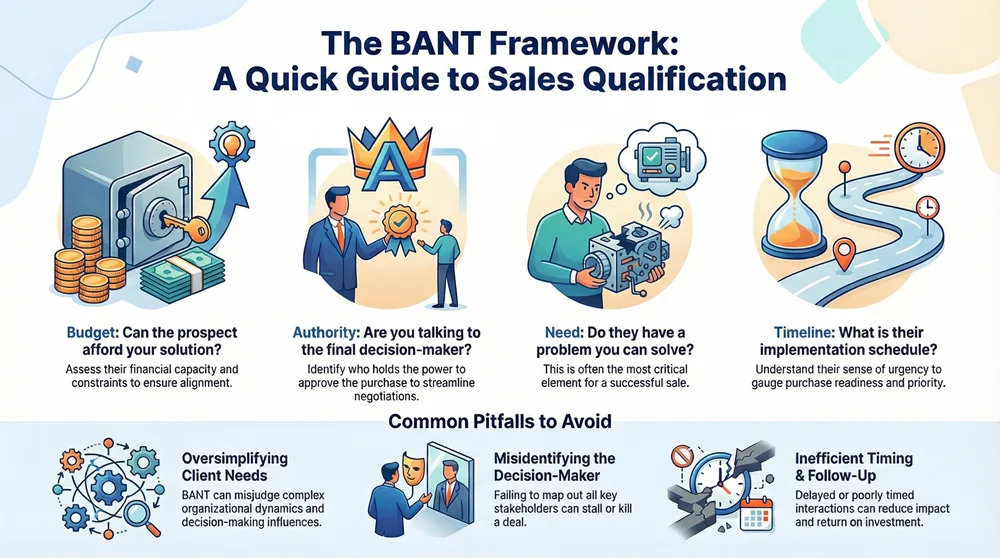
BANT represents Budget, Authority, Need, and Timeline—a framework sales experts use to assess a prospect’s financial capacity, decision-making level, specific requirements, and sense of urgency to tailor office equipment solutions effectively.
Why is bant crucial for sales teams?
BANT helps sales teams qualify potential leads by evaluating budget, authority, needs, and timeline. This method drives higher conversion rates, allowing teams to allocate resources effectively while meeting business demands in copier, printer, IT services, and cybersecurity solutions.
Which element is key in BANT analysis?
Among the BANT criteria, need is often regarded as the most critical element. Without clear demand, even significant budget and established authority may not lead to a successful purchase decision by business owners.
How does Bant boost sales strategies?
Bant refines sales initiatives by employing actionable insights to adjust client outreach, improve lead assessment, and streamline communications. Its data-backed approach complements office equipment leasing and managed IT services, optimizing precise targeting and increasing overall business growth strategies.
What pitfalls arise using BANT in sales?
BANT may limit sales effectiveness by oversimplifying client needs, potentially misjudging decision-making influences and organizational dynamics, which can hinder accurate qualification and long-term relationship building.
Conclusion
BANT provides a clear framework that aids sales teams in evaluating prospects effectively. It streamlines decision-making by focusing on budget, authority, need, and timing. Sales professionals gain practical insights that help refine qualification processes and strengthen stakeholder engagement. This methodology empowers teams to manage their efforts with precision and achieve measurable improvements in sales productivity.