

Your security team is drowning. Thousands of alerts pour in daily. Some matter. Most don’t. Your analysts scramble to triage, investigate, and respond — but by the time they act on a critical threat, hours have already passed.
SOAR — Security Orchestration, Automation and Response — is changing how organizations defend themselves. Instead of security teams manually responding to each alert, SOAR platforms orchestrate and automate those responses across your entire security infrastructure. Think of it as giving your SOC team superpowers.
The market reflects that shift. The global SOAR market is projected to grow from $1.87 billion in 2025 to $2.22 billion in 2026, expanding at an 18.5% compound annual growth rate, according to Market Research Future. By 2030, analysts expect the market to reach $4.42 billion.
Breaking Down SOAR: The Three Pillars

SOAR isn’t a single technology. It’s three capabilities working together. Understanding each one explains why SOAR has become essential for modern security teams.
1. Orchestration
Orchestration connects your tools. Your organization likely uses a firewall, endpoint detection and response (EDR), a SIEM, threat intelligence feeds, and maybe a dozen other security products. Each operates somewhat independently. Orchestration brings them into a unified workflow.
When a SOAR platform orchestrates your tools, it can pull information from your SIEM, correlate it with threat intelligence, check your EDR for related activity, and present analysts with a complete picture. Instead of logging into five different dashboards, your team sees everything in one place.
2. Automation
This is where SOAR delivers massive efficiency gains. Once a threat pattern is identified, SOAR executes predetermined actions without waiting for human approval. These automated workflows are called playbooks.
Say your SIEM detects suspicious login activity from an unusual location. A SOAR playbook might automatically query your identity platform for additional context, block the account temporarily, message the user, and escalate to your security team. All of this happens in seconds — before an analyst even sees the alert.
Research shows that organizations using automation in security operations reduce incident response time by 20% compared to manual processes. Some organizations report reductions in mean time to respond (MTTR) of 60% or more after deploying SOAR.
3. Response
Response is about acting decisively. SOAR enables your security team to take action directly through integrations with your other tools. Need to isolate a compromised endpoint? Done. Block a malicious domain? Done. Revoke compromised credentials? Already handled.
SOAR doesn’t just notify analysts — it acts. The difference between “we detected a breach” and “we detected and contained a breach” is time. SOAR collapses that gap.
How SOAR Works in Practice: Playbooks and Workflows
The real power of SOAR lives in playbooks. A playbook is an intelligent workflow that defines how your organization responds to specific security events.
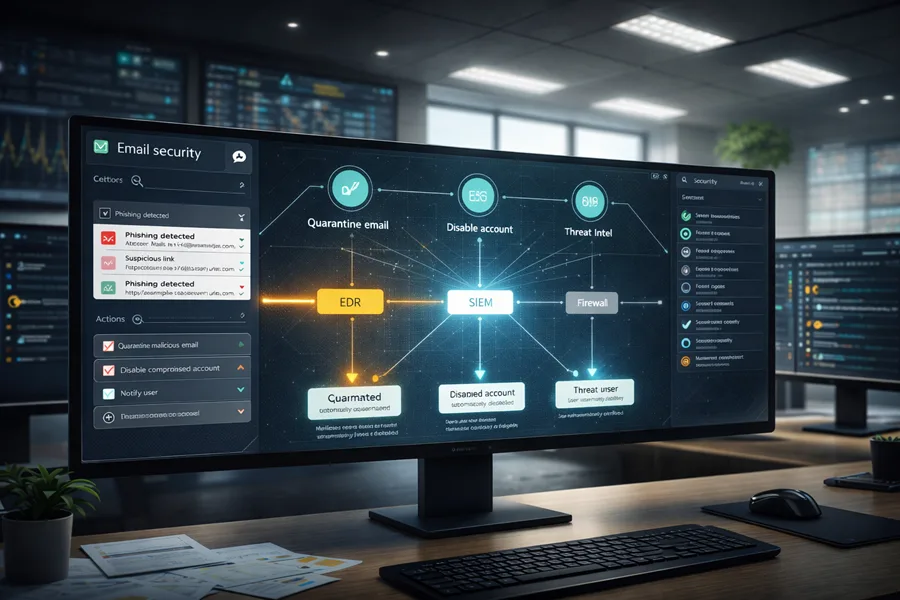
Here’s a concrete example. Your email security gateway flags a phishing email. Normally, an analyst would manually review the email, check if it matches known phishing patterns, search your threat intelligence, check if users already clicked the link, quarantine the email, and notify affected users.
With a SOAR playbook, that entire sequence happens automatically in minutes, not hours. The playbook enriches the alert with context, checks threat intelligence against the sender domain, queries your email system for other instances of the same message, quarantines all copies, and notifies targeted users. Your analyst receives a detailed summary only if something unusual requires their attention.
Playbooks aren’t static. They evolve as your threat landscape changes. You can build them for phishing, malware, suspicious network activity, compliance violations, and dozens of other scenarios. And many SOAR platforms ship with pre-built playbooks that security teams customize for their own environments.
SOAR vs. SIEM: Complementary, Not Competing
A common misconception is that SOAR replaces SIEM. It doesn’t. They solve different problems, and they work best together.
SIEM focuses on detection. It collects security event data from across your environment, correlates that data to spot suspicious patterns, and alerts your team to potential threats. SIEM is your detection engine.
SOAR focuses on response. It takes those alerts from your SIEM and automates what happens next. Where SIEM tells you what’s happening, SOAR decides and acts on what needs to be done.
| Aspect | SIEM | SOAR |
|---|---|---|
| Primary Focus | Detection and correlation | Automated response |
| Data Sources | Raw security logs and events | Alerts from SIEM and other tools |
| Key Output | Alerts and dashboards | Automated actions and insights |
| Analyst Role | Review alerts and investigate | Oversee automation and escalations |
The most effective security operations centers use both. Your SIEM detects suspicious account activity. That alert triggers a SOAR playbook, which investigates the activity, checks threat intelligence, and can automatically disable the account and force a password reset. The analyst then reviews what happened and takes additional action if needed. Detection and response, working in harmony.
Key Benefits: Why Organizations Are Adopting SOAR
1. Faster Response Times
This is the headline benefit. Mean time to detect (MTTD) and mean time to respond (MTTR) are critical metrics for any security operation. SOAR slashes both. When playbooks execute automatically, you’re responding to threats in seconds rather than hours. For high-severity incidents, that difference separates containment from catastrophe.
2. Reduced Alert Fatigue
Security analysts receive thousands of alerts daily. Most are false positives. That creates fatigue — and when analysts are exhausted from chasing phantom threats, they miss real ones. SOAR filters and enriches alerts automatically, surfacing only high-priority events that warrant human attention. Your analysts focus on what matters.
3. Improved Consistency
Manual processes are inconsistent. Analyst A might respond differently than Analyst B to the same threat. Playbooks enforce consistent incident response procedures across your organization. Every similar threat gets handled the same way, reducing risk from human error or oversight.
4. Better Use of Limited Resources
Skilled security analysts are expensive and hard to find. SOAR lets your existing team handle exponentially more incidents because routine tasks are automated. You’re not replacing analysts — you’re amplifying their effectiveness.
5. Scalability
As your organization grows, threat volume grows too. Manual incident response doesn’t scale. SOAR does. Your playbooks work as hard for 10,000 users as they do for 1,000.
The SOAR Market: Who’s Leading?
Several vendors dominate the SOAR space. Understanding the major players helps if you’re evaluating solutions.
Palo Alto XSOAR is one of the most powerful and flexible platforms. It offers extensive automation capabilities and strong integration with Palo Alto’s security suite, though it can be complex for smaller organizations.
Splunk SOAR integrates tightly with Splunk’s SIEM. If you’re already on Splunk, this is a natural choice — strong out-of-the-box capabilities with less customization required.
IBM Resilient is enterprise-focused and particularly strong in compliance-heavy industries like banking and healthcare. Sophisticated orchestration capabilities, but at a higher price point.
Swimlane is known for ease of use, while Demisto (now part of Palo Alto) appeals to teams looking for lower total cost of ownership.
The SOAR market is competitive and still maturing. The best solution for your organization depends on your specific threat landscape, existing tools, and budget.
Who Actually Needs SOAR?
SOAR isn’t just for enterprise Fortune 500 companies. Here’s who should consider it.
Enterprise Organizations
Large organizations with mature security operations are SOAR’s primary users. They handle high alert volumes, run complex security stacks, and can justify the investment. Large enterprises accounted for 78% of SOAR market revenue in 2024.
Mid-Market Companies
This is where the growth is. Mid-sized organizations are discovering that SOAR lets them punch above their weight — operating like much larger security teams without proportional headcount growth. Cloud-based SOAR deployments have lowered the entry barrier. Cloud deployments now capture 71% of the SOAR market and are growing at 21.4% annually.
Small and Medium Enterprises (SMEs)
Here’s a surprise: SMEs are the fastest-growing segment, posting a 19.6% compound annual growth rate through 2030. SMEs can’t afford large security teams, but they face the same threats as enterprise companies. SOAR lets them automate responses with a lean team.
Highly Regulated Industries
Banking, healthcare, and insurance were early SOAR adopters. These industries face stringent compliance requirements and need demonstrable incident response procedures. SOAR delivers both. Financial services and healthcare have seen a 35% increase in SOAR adoption as compliance requirements tighten.
The real question isn’t who needs SOAR — it’s whether your organization can afford not to have it. If you’re managing security at any scale, alert volume is probably your biggest headache. SOAR solves that problem.
Implementation Challenges: What to Expect
SOAR isn’t plug-and-play. Successful deployments require real work, and it helps to understand the challenges going in.
Integration Complexity
SOAR’s value comes from integrating with your existing tools. If you have a fragmented security stack with non-standard products, those integrations can be painful. Before implementing SOAR, audit your security tools and assess how well they communicate via APIs.
Playbook Development
Out-of-the-box playbooks are helpful but rarely perfect for your specific environment. Your team needs to customize and build new playbooks — which requires either hiring specialists or allocating significant time from your existing staff.
Change Management
SOAR changes how your team works. Analysts accustomed to manual investigation may feel like they’re losing control when actions happen automatically. Getting buy-in requires education and patience.
Cost
SOAR solutions aren’t cheap. Licensing costs, implementation services, and ongoing training add up. Budget accordingly and plan for a multi-year deployment if you’re a large organization.
How 1800 Office Solutions Integrates SOAR into Managed Security
At 1800 Office Solutions, we know that security excellence requires more than deploying tools. It requires orchestrating those tools into a cohesive defense strategy.
We integrate SOAR capabilities into our managed security services to deliver faster threat detection and response for our clients. Here’s how we approach it.
Assessment First. We don’t recommend SOAR because it’s trendy. We assess your current security operations, alert volume, and team capacity to determine if SOAR is the right fit. Sometimes it’s the perfect solution. Sometimes you need to mature your SIEM first. We’re honest about what you actually need.
Strategic Implementation. We handle SOAR deployment, customization, and integration with your existing stack. Your team doesn’t need to become SOAR experts overnight. We guide the process and make sure playbooks align with your threat landscape.
Ongoing Tuning. SOAR isn’t set-it-and-forget-it. As threats evolve and your organization changes, playbooks need adjustment. We continuously monitor and refine automation rules to keep your security operation running at peak efficiency.
Human + Automation. We balance automation with human expertise. Not everything should be automated. We help identify which incident types benefit most from automation and which require human judgment. The goal is a security operation where your team focuses on high-value analysis and strategy, not routine triage.
The Future of Security Operations
SOAR is no longer emerging technology. It’s table stakes for modern security operations. Organizations that haven’t automated their incident response are falling further behind every day.
The next frontier is AI-enhanced SOAR — platforms adding machine learning to make playbooks smarter, learning from your environment and suggesting optimizations automatically. We’re also seeing SOAR evolve to handle more complex response workflows, particularly in cloud environments where security teams face unprecedented complexity.
Your organization’s ability to respond to threats will increasingly define your security posture. Detection technology is commoditizing — every vendor can deploy a SIEM or EDR platform. What separates secure organizations from vulnerable ones is response speed and consistency. That’s where SOAR delivers real value.
The Bottom Line: SOAR bridges the gap between detection and remediation. It orchestrates your security tools, automates your response procedures, and enables your team to respond to threats faster than attackers can act. In a threat landscape that moves at digital speed, that’s not just an advantage — it’s essential.
Ready to Explore SOAR for Your Security Operations?
Contact 1800 Office Solutions to discuss a security assessment tailored to your organization’s needs.
Sources and References
- Research and Markets: Security Orchestration, Automation and Response (SOAR) Market Report 2026
- Mordor Intelligence: SOAR Market Size, Share & 2030 Growth Trends Report
- Future Market Insights: Security Orchestration, Automation and Response (SOAR) Market
- Palo Alto Networks: What is SOAR / SOAR vs. SIEM
- Swimlane: SOAR vs. SIEM — What’s the Difference?
- Check Point Software: SOAR vs. SIEM Key Differences
- Cyware: Improving Incident Response through SOAR
- Radiant Security: SOAR Tools — Key Capabilities and 10 Solutions to Know in 2026
Published by 1800 Office Solutions | Security Operations