

10 Proven IT Cost Optimization Strategies for 2025

AI Overview:
This blog outlines 10 practical IT cost optimization strategies that help organizations reduce waste, improve efficiency, and maximize ROI without sacrificing performance or innovation. It covers actionable approaches across cloud and hybrid infrastructure, virtualization, software licensing, automation, DevOps, storage optimization, energy efficiency, managed services, and capacity planning. The guide emphasizes shifting from reactive cost cutting to strategic spending, showing how smarter technology investments can lower operational costs, improve agility, and turn IT into a driver of long-term business value.
Rising technology expenses can strain any budget, forcing difficult choices between innovation and financial stability. Uncontrolled IT spending on cloud services, software licensing, and infrastructure maintenance often leads to significant waste, directly impacting your bottom line. Effectively managing these costs is not about cutting back; it’s about making smarter, strategic investments that enhance performance and drive business value. The primary challenge lies in identifying where inefficiencies exist and implementing the right changes without disrupting operations.
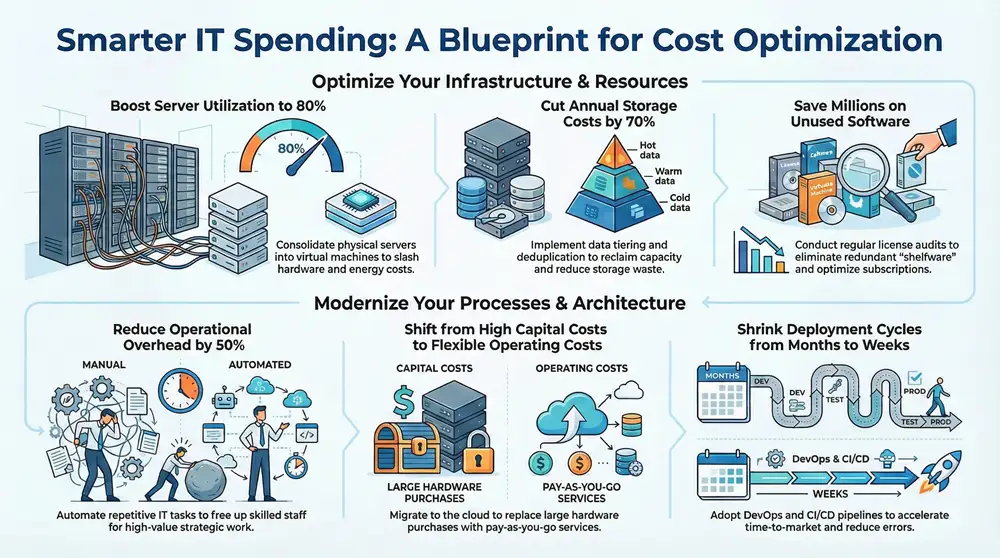
This article provides 10 actionable it cost optimization strategies to help you reduce expenses, maximize resource efficiency, and achieve a stronger return on your technology investments. We will deliver practical, step-by-step guidance you can implement immediately, covering everything from vendor contracts and cloud infrastructure to software licenses and daily operational workflows. Many of these strategies focus on maximizing the value of existing assets, particularly within your cloud environment. For a deeper dive into that specific area, consider reviewing these 10 Cloud Cost Optimization Strategies You Should Know.
By implementing these proven tactics, from vendor management to strategic automation, your organization can build a more resilient and cost-effective IT framework. Each section includes practical steps and real-world examples to guide your efforts, ensuring your technology budget actively supports your strategic goals.
1. Master Cloud & Hybrid Infrastructure for Peak Efficiency
One of the most impactful IT cost optimization strategies involves rethinking where your digital assets reside. Migrating on-premises infrastructure to a cloud platform like AWS, Azure, or Google Cloud transforms spending from large capital expenditures (CapEx) on physical hardware to predictable operational expenditures (OpEx). This pay-as-you-go approach eliminates the need for expensive servers, data centers, and the associated maintenance overhead.
A hybrid cloud model offers an even more nuanced level of control. It allows you to keep sensitive data or high-performance workloads on-premises while leveraging the public cloud’s scalability and cost-efficiency for less critical applications. This dual strategy ensures you aren’t forced into a one-size-fits-all solution, optimizing costs directly based on workload requirements and security protocols.

How to Implement Cloud & Hybrid Strategies
Successfully transitioning requires a methodical approach to maximize ROI and minimize disruption. Follow these steps for a structured implementation:
- Conduct a Thorough Cost-Benefit Analysis: Before migrating, perform a detailed analysis. For a deeper understanding, you can explore a complete breakdown of the cost of cloud computing to accurately model potential savings against migration expenses.
- Utilize Cloud Assessment Tools: Use tools provided by cloud vendors or third parties to analyze your current environment. These tools help identify which workloads are best suited for the cloud and estimate resource requirements.
- Implement FinOps Practices: Financial Operations (FinOps) is a cultural practice that brings financial accountability to the variable spending model of the cloud. Implement budget alerts, tagging strategies, and regular cost reviews to maintain control.
- Start with Non-Critical Applications: Begin your migration with lower-risk applications. This “crawl, walk, run” approach allows your team to build expertise and refine processes before moving business-critical systems.
By strategically adopting cloud and hybrid models, businesses like GE Digital, which cut its IT costs by 30%, demonstrate the significant financial benefits of moving away from traditional infrastructure.
2. Embrace Virtualization and Server Consolidation
Another powerful IT cost optimization strategy is to reduce physical server sprawl through virtualization. This process involves consolidating multiple, often underutilized, physical servers onto fewer, more powerful host machines. Each original server becomes a “virtual machine” (VM), running its own operating system and applications but sharing the host’s hardware resources. This dramatically increases hardware utilization rates, often from a mere 5-15% to as high as 80%.
The immediate financial impact comes from a steep reduction in capital expenditures. You purchase and maintain far fewer physical servers. This, in turn, lowers operational costs related to power, cooling, and the physical space required for your data center. Leading platforms like VMware’s vSphere and Microsoft’s Hyper-V have made this technology accessible and reliable for businesses of all sizes, enabling significant efficiency gains.
How to Implement Virtualization Strategies
A successful server consolidation project hinges on careful planning and execution to maximize returns and ensure stable performance. Follow these key steps for a structured approach:
- Assess Your Current Environment: Use assessment tools to analyze the performance and resource usage of your existing physical servers. This data is critical for identifying which servers are good candidates for virtualization and for correctly sizing the host hardware. For a complete guide, you can explore the benefits and process of server virtualization.
- Right-Size Virtual Machines: Avoid the common mistake of allocating the same resources to a VM as its physical predecessor had. Instead, allocate CPU, memory, and storage based on actual workload needs, which prevents resource waste on the host machine.
- Implement Robust Monitoring and Management: Use virtualization management tools to monitor the health and performance of your virtual environment. This allows for proactive capacity planning and helps you use features like automated load balancing to distribute workloads evenly across hosts.
- Consider Containerization as the Next Step: For even greater density and efficiency, explore containerization technologies like Docker and Kubernetes. Containers are more lightweight than VMs and allow you to run more applications on a single host.
By consolidating servers, organizations can achieve impressive results. For instance, Bank of America transformed 3,600 physical servers into 1,400 virtual machines, significantly reducing its data center footprint and operational overhead.
3. Software License Optimization and Management
Unchecked software spending is a common drain on IT budgets, often hidden in plain sight. Optimizing your software licenses moves beyond simple procurement to an active management strategy, ensuring you only pay for what you actually use. This involves auditing current licenses, eliminating redundant applications, and right-sizing subscriptions to match employee needs, directly converting waste into savings.
This strategic approach prevents over-provisioning, a frequent issue where more licenses are purchased than are necessary. By actively managing contracts and understanding usage patterns, you can avoid costly compliance penalties for under-licensing and stop hemorrhaging money on “shelfware”—software that sits unused. For a deeper dive into managing software expenses effectively, exploring strategies for optimizing software licenses provides valuable insights into tracking and reducing these costs.
How to Implement License Management
Putting a robust software asset management (SAM) plan in place is a key IT cost optimization strategy that yields immediate returns. Follow these steps to gain control over your software portfolio:
- Conduct Quarterly License Audits: Regularly review and reconcile your purchased licenses against actual deployment and usage. This process identifies unused licenses that can be reharvested or retired.
- Implement a Software Asset Management (SAM) Tool: Deploy specialized tools from providers like Flexera or Snow Software to automate the tracking of installations, usage, and compliance across your entire organization.
- Consolidate Vendors and Negotiate Agreements: Reduce management overhead by consolidating similar software products to a single vendor. Use your total license count to negotiate volume discounts and more favorable multi-year agreements.
- Leverage Open-Source Alternatives: Where appropriate, substitute expensive commercial software with viable open-source options. Be sure to consider the hidden costs of open-source software like support and maintenance in your analysis.
Organizations that master this discipline see significant results. One Fortune 500 company saved over $8 million annually through meticulous license audits, demonstrating the powerful impact of active software management.
4. Energy Efficiency and Green IT
A significant, yet often overlooked, component of IT cost optimization strategies lies in reducing energy consumption. Green IT initiatives focus on minimizing the environmental impact of technology, which directly translates into lower operational costs through reduced electricity bills. This strategy involves deploying energy-efficient hardware, optimizing data center cooling, and adopting power management practices across the entire IT infrastructure.
Adopting green IT is not just an ethical choice; it is a sound financial decision. By systematically addressing power usage, from individual workstations to the entire data center, businesses can unlock substantial savings. This approach transforms a major operational expense into a controllable variable, improving the bottom line while enhancing corporate sustainability credentials.
How to Implement Green IT Strategies
Putting energy efficiency into practice requires a multi-faceted approach that addresses both hardware and operational habits. Follow these steps for a structured implementation:
- Audit Your Power Consumption: Use power monitoring tools and conduct an energy audit to identify your biggest consumption culprits. This data provides a baseline and highlights areas with the highest potential for savings, from servers to networking gear.
- Decommission Inefficient Hardware: Modern servers and computers are significantly more power-efficient than older models. Create a lifecycle management plan to systematically replace aging, power-hungry equipment with newer, Energy Star-rated devices.
- Optimize Data Center Cooling: For on-premises infrastructure, review and optimize your HVAC systems and airflow management. Simple changes like using hot/cold aisle containment or adjusting thermostat setpoints can dramatically reduce cooling costs, which often account for a large portion of a data center’s energy bill.
- Implement Power Management Policies: Configure servers and workstations to enter low-power or sleep modes during periods of inactivity. Centralized management tools can enforce these policies across your entire organization, ensuring consistent energy savings.
Tech giants have proven the financial upside of this model. Google famously reduced its data center energy usage by 50% using AI-driven cooling optimization, demonstrating that sustainable practices are a powerful tool for cost reduction.
5. Automate and Orchestrate IT Operations for Radical Efficiency
One of the most powerful IT cost optimization strategies is to eliminate the hidden expense of manual labor. Automating repetitive IT tasks and orchestrating complex workflows frees up highly skilled personnel from mundane activities like server provisioning, software patching, and system monitoring. This shift allows your team to focus on strategic initiatives that drive business value instead of just keeping the lights on.
By leveraging tools for Infrastructure as Code (IaC), workflow automation, and AIOps, you can build a more resilient, consistent, and cost-effective IT environment. Automation minimizes the risk of human error, which can lead to costly downtime and security vulnerabilities. Orchestration ensures that disparate systems and automated processes work together seamlessly, accelerating service delivery and reducing operational overhead from start to finish.
How to Implement Automation and Orchestration
A successful automation strategy requires a deliberate, phased approach to ensure it aligns with business goals and delivers measurable returns. Follow these steps for a structured implementation:
- Target High-Volume, Repetitive Tasks: Begin by identifying and automating tasks that are performed frequently and follow a predictable pattern, such as user account creation or routine system checks. This delivers quick wins and demonstrates the value of automation early on.
- Implement Infrastructure as Code (IaC): Use tools like Terraform or Ansible to define and manage your infrastructure through code. This standardizes deployments, eliminates configuration drift, and drastically cuts down the time required to provision new environments.
- Embrace Containerization: Utilize platforms like Docker and orchestrators like Kubernetes to package applications and their dependencies into portable containers. This simplifies management, improves resource utilization, and makes scaling applications far more efficient.
- Invest in Training and Change Management: Equip your team with the skills needed to build and manage automated systems. Foster a culture that embraces automation as a tool for empowerment, not a threat, to ensure smooth adoption across the organization.
Companies that fully embrace this approach see dramatic results. For instance, Deloitte achieved a 50% reduction in operational overhead by implementing robotic process automation (RPA), proving the immense financial impact of a well-executed automation strategy.
6. Embrace Containerization and Microservices Architecture
Another powerful IT cost optimization strategy is to modernize how applications are built and deployed. Shifting from monolithic applications to a microservices architecture, packaged in containers like Docker, dramatically improves resource efficiency and agility. This approach breaks down large, complex applications into smaller, independent services, each running in its own lightweight container. This eliminates the “works on my machine” problem and significantly reduces infrastructure overhead, as multiple containers can run on a single host without conflicting with each other.
This architectural shift allows teams to develop, deploy, and scale individual services independently, accelerating innovation and reducing waste. Instead of provisioning oversized virtual machines for an entire application, you can allocate precise resources to each microservice, paying only for what you truly need. This granular control over resources directly translates into lower cloud bills and a more resilient, scalable IT environment.
How to Implement Containerization and Microservices
Adopting this modern architecture requires careful planning and a phased approach to ensure a smooth transition and maximize cost savings. Follow these steps for a structured implementation:
- Start with a Pilot Project: Begin by containerizing a single, non-critical application or a new project. This allows your team to gain hands-on experience with tools like Docker and orchestration platforms like Kubernetes without risking core business operations.
- Implement Container Orchestration: Use a platform like Kubernetes or a managed service (e.g., Amazon EKS, Azure Kubernetes Service) to automate the deployment, scaling, and management of your containers. This is crucial for managing complexity as you scale.
- Establish Strong Governance: Create clear security policies, governance rules, and best practices for container image creation and management. Use private container registries to store and secure your custom images, ensuring consistency and control.
- Monitor and Optimize Resources: Continuously monitor container performance and resource consumption. Set resource requests and limits for each container to prevent any single service from monopolizing host resources, ensuring fair distribution and optimal performance.
By adopting this model, companies like Airbnb have reportedly cut infrastructure costs by up to 30%, demonstrating how architectural modernization is a key driver for significant financial efficiency.
7. Leverage IT Staff Augmentation and Managed Services
One of the most effective IT cost optimization strategies is to strategically outsource specific functions instead of hiring full-time, in-house staff for every role. Engaging with a Managed Service Provider (MSP) or utilizing staff augmentation shifts spending from fixed payroll costs, benefits, and training (CapEx) to a flexible, predictable operational expense (OpEx). This model allows you to access specialized expertise on demand, from cybersecurity to cloud management, without the long-term financial commitment of a full-time hire.
This approach is not about replacing your entire IT team but rather enhancing its capabilities. By outsourcing routine tasks like helpdesk support, network monitoring, or infrastructure maintenance, your core team can focus on high-value strategic initiatives that drive business growth. This blended model ensures you maintain internal control over critical projects while leveraging external experts for efficiency and cost savings in other areas.
How to Implement Outsourcing and Managed Services
A successful partnership with an external provider requires clear goals, strong governance, and a focus on measurable outcomes. Follow these steps to implement this strategy effectively:
- Define Scope and Service Levels (SLAs): Clearly document which IT functions you are outsourcing and establish specific, measurable Service Level Agreements. These SLAs should cover response times, system uptime, and key performance indicators to ensure the provider meets your business requirements.
- Audit for Security and Compliance: Before signing any contract, conduct a thorough security audit of the potential MSP. Verify their compliance certifications (like SOC 2 or ISO 27001) and ensure their security practices align with your company’s standards and regulatory needs.
- Maintain Core Capabilities In-House: Identify your company’s core IT competencies, such as strategic planning or proprietary application development. Keep these critical functions in-house to retain your competitive advantage and institutional knowledge.
- Establish Strong Contracts with Exit Clauses: Work with legal counsel to draft a comprehensive contract that includes a clear statement of work, pricing models, and well-defined exit clauses. This protects your business and ensures a smooth transition if you need to change providers.
Global financial institutions have reduced IT operational costs by up to 40% through strategic MSP partnerships, demonstrating the immense potential of this approach to optimize budgets while gaining access to world-class talent and technology.
8. Storage Optimization and Data Management
Unchecked data growth can lead to spiraling storage costs, consuming a significant portion of your IT budget. An effective IT cost optimization strategy directly addresses this challenge by implementing intelligent data management. This involves using techniques like deduplication, compression, and tiered storage to ensure you only pay for the capacity you truly need, maximizing the efficiency of every gigabyte.
By applying data lifecycle management, you can automate the process of moving data to the most cost-effective storage tier based on its age and access frequency. This prevents expensive, high-performance storage from being wasted on archival data that is rarely accessed. This strategic approach not only cuts direct storage hardware and cloud service costs but also reduces backup times and associated data protection expenses, creating a leaner, more efficient data environment.
How to Implement Storage Optimization
A proactive approach to data management yields immediate and long-term financial benefits. Follow these steps to reclaim capacity and control costs:
- Implement Data Classification and Retention Policies: Start by defining what data you have, who owns it, and how long it must be kept. A clear policy is the foundation for all other optimization efforts, ensuring compliance while enabling the deletion of redundant, obsolete, and trivial (ROT) data.
- Utilize Deduplication and Compression: Enable these features on your primary storage systems, backup appliances, and cloud storage tiers. A financial services firm, for example, recovered 60% of its primary storage capacity simply by implementing deduplication, drastically delaying the need for new hardware purchases.
- Establish a Tiered Storage Model: Automatically move infrequently accessed data from expensive Tier 1 storage to lower-cost options like nearline disk or object storage in the cloud. Archival data can be sent to ultra-low-cost cold storage solutions like Amazon S3 Glacier.
- Monitor and Analyze Utilization: Regularly use storage analysis tools to identify orphaned data, oversized virtual machine disks, and unused volumes. Consistent monitoring reveals hidden pockets of waste and ensures your policies are working effectively.
A leading healthcare provider, for instance, reduced its annual storage expenditure from $2 million to just $600,000 by combining these data management techniques.
9. Infrastructure Right-Sizing and Capacity Planning
One of the most persistent drains on an IT budget is over-provisioning: paying for infrastructure capacity you don’t actually use. Infrastructure right-sizing directly confronts this issue by analyzing actual resource utilization and precisely matching your server, storage, and cloud instance capacity to real workload requirements. This data-driven approach shifts your organization from guessing at future needs to making informed decisions based on historical and current performance metrics.
Effective capacity planning builds on this foundation, forecasting future needs to prevent performance bottlenecks while avoiding premature, costly upgrades. By aligning infrastructure spend directly with operational demand, you eliminate waste and ensure every dollar invested in hardware or cloud services delivers maximum value. This is a critical component of any successful IT cost optimization strategy, turning your infrastructure from a fixed cost center into a flexible, efficient asset.
How to Implement Right-Sizing and Capacity Planning
A systematic approach is essential to capture savings without compromising application performance. Follow these steps to align your resources with actual demand:
- Monitor Resource Utilization Continuously: Deploy monitoring tools like AppDynamics or Dynatrace to gather real-time and historical data on CPU, memory, storage, and network usage across all your environments.
- Establish Realistic Utilization Targets: Aiming for 100% utilization is a recipe for performance issues. Instead, set healthy targets, typically between 60-75%, to allow for unexpected spikes in demand.
- Analyze Historical Trends and Patterns: Use the data you’ve collected to identify daily, weekly, and seasonal patterns. This insight allows you to schedule scaling activities proactively, such as adding capacity before a known busy period like Black Friday.
- Implement Chargeback or Showback Models: Assign infrastructure costs back to the business units or departments that use them. This practice fosters a culture of accountability and encourages teams to be more mindful of their resource consumption.
By implementing these practices, one global enterprise famously reduced its infrastructure costs by $30 million, while another technology firm cut its cloud spending by 35% through meticulous capacity planning.
10. Embrace DevOps and CI/CD for Faster, Cheaper Deployments
Adopting DevOps and Continuous Integration/Continuous Deployment (CI/CD) pipelines is a powerful IT cost optimization strategy that streamlines your entire software development lifecycle. By breaking down silos between development (Dev) and operations (Ops) teams and automating the build, test, and deployment process, you dramatically reduce manual effort and the high costs associated with human error. This integrated approach accelerates time-to-market, improves code quality, and lowers operational overhead.
The core principle is to create a culture of collaboration supported by automated workflows. CI/CD pipelines automatically build and test code every time a change is committed, catching bugs earlier when they are less expensive to fix. This continuous feedback loop ensures that your software is always in a deployable state, allowing for smaller, more frequent releases. This operational agility not only boosts productivity but also reduces the financial risk tied to large, monolithic deployments that often lead to costly rollbacks and extended downtime.
How to Implement DevOps and CI/CD
Transitioning to a DevOps model is as much a cultural shift as it is a technical one. A successful implementation requires a clear roadmap to foster collaboration and build efficient automation.
- Foster a Collaborative Culture: Start by aligning development and operations teams around shared goals and responsibilities. Encourage open communication and use tools that provide visibility across the entire development pipeline.
- Implement Robust Version Control: Use a system like Git as the single source of truth for all code. Enforce code review processes to maintain high standards and catch issues before they enter the main branch.
- Automate Everything Possible: Automate the entire pipeline from code commit to production deployment. This includes automated testing at multiple levels (unit, integration, end-to-end) and using Infrastructure as Code (IaC) tools like Terraform or Ansible to create reproducible environments.
- Establish Comprehensive Monitoring: Implement monitoring and observability practices to gain real-time insights into application performance and infrastructure health. This allows teams to proactively identify and resolve issues before they impact users.
By following this path, companies like Amazon, which deploys new code thousands of times a day, showcase how effective DevOps can be. One major financial firm even reduced its software deployment cycle from six months to just two weeks, demonstrating a massive return on its investment in CI/CD.
Embarking on a journey of IT cost optimization is far more than a simple budget-slashing exercise. It’s a strategic initiative that transforms your technology department from a reactive cost center into a proactive engine for business growth and innovation. The ten it cost optimization strategies detailed in this article provide a comprehensive roadmap for achieving this transformation, guiding you through every layer of your technology stack.
From the foundational efficiency gains of server virtualization and storage optimization to the modern agility offered by containerization and DevOps, each strategy represents a powerful lever for change. The goal is not just to spend less, but to spend smarter. By eliminating waste and reallocating resources toward innovation, you create a more resilient, secure, and competitive organization.
From Tactical Savings to Strategic Value
The most crucial takeaway is that these strategies are interconnected. True, sustainable savings are realized when these initiatives work in concert. For example, a well-planned hybrid cloud strategy becomes exponentially more powerful when combined with automation, while leveraging managed services frees your internal teams to focus on high-value projects like building out CI/CD pipelines.
Mastering IT cost optimization is not a one-time project; it is a continuous discipline. Start by identifying low-hanging fruit, such as auditing SaaS subscriptions or eliminating unused cloud instances. Use these initial wins to build momentum for more significant, long-term initiatives. By fostering this mindset of perpetual improvement, you ensure that your organization remains agile and financially healthy.
Ultimately, effective it cost optimization strategies do more than just improve your bottom line. They enhance security, boost operational performance, and unlock capital that can be reinvested into an innovation that gives you a definitive competitive edge.
Ready to build a more cost-effective and powerful IT foundation for your business? The experts at 1-800 Office Solutions provide comprehensive managed IT, cybersecurity, and print services tailored to your specific needs, helping you implement many of the strategies discussed. Contact us today for a free consultation to identify your potential savings and streamline your operations.