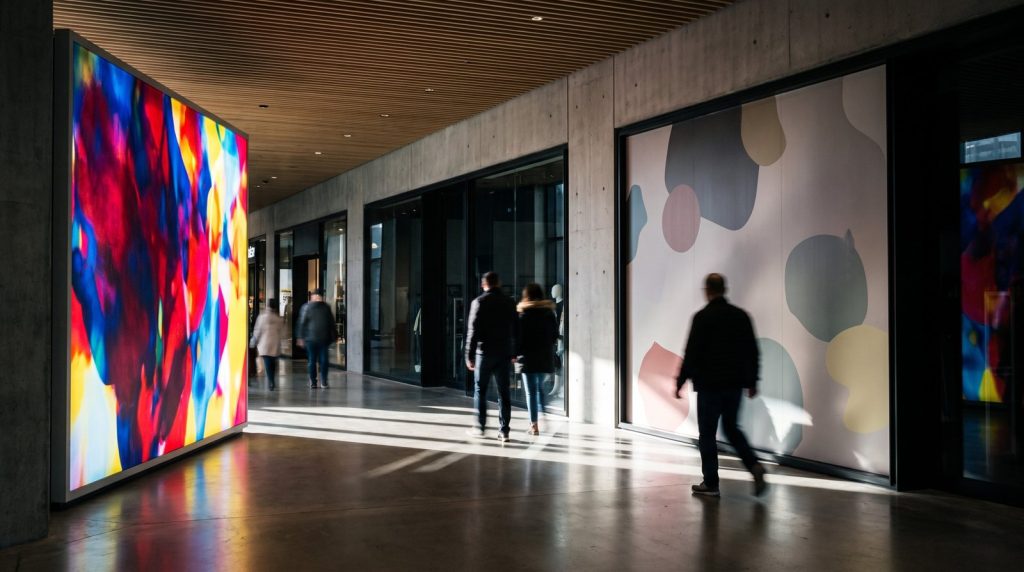
Imagine it's 6 pm on a Friday evening in a shopping mall. Forty shop fronts are visible and hundreds of people pass by and most signs blur into a gray line. Then a wall goes on, and heads turn. Was it the size? The brand? Often it’s just the light. However, there are a variety of costs involved with a glowing sign compared to a printed sign, so it's not a simple decision. This guide contrasts both types in terms of appearance, expense, maintenance and rules, so that you can select the right sign before you spend a cent.
What Each Sign Type Is
The aluminum frame, the fabric graphic (which has a silicone edge that fits into a groove in the frame), and the LED panels or strips behind the fabric make up a SEG modular lightbox. The print is lit from behind, making it glow. It is modular, so you can build it from parts and expand or shrink it later.
Printed Signs are a large category of vinyl on board, acrylic, foam board, metal, banners and paper posters. Most of them don't produce any light. They only reflect the light that falls on them, so how they look depends on the room.
Some printed signs are front-lit with spotlights, and others sit in a simple lightbox. Still, the two types work differently.
What a Shop or Mall Needs From a Sign
There are four jobs to be done with a sign. It has to be viewed from a distance, communicate the brand story quickly, fit the space, and match the price level of what's for sale.
First, distance. Mall walkways are long, and shoppers typically see a sign from 20 meters (66 feet) away. Only color, shape and light are visible at that distance. Second, speed. Most shoppers give a sign only a few seconds, so use one logo, one short line and one image.
Third, fit. Before selecting, consider the wall size, ceiling height, room light and glass glare. For instance, a sego modular lightbox display can be constructed to fit the wall, and a printed board will only have set dimensions unless cut.
Fourth, brand level. A fine jewelry store cannot have a sales flyer type sign. Shoppers read the sign as a promise, and what's on the shelf has to keep it.
Look and Light
Light is the main gap between the two types, so start there. On a SEG lightbox, LEDs shine through the fabric, and the glow stays even when the frame is deep enough and the LEDs are spaced well. A printed sign only reflects the light in the room. In a dim corner of a mall, it can look flat, while a lit fabric wall stays bright.
Color needs care. Backlight makes colors look brighter and thinner than they do on paper, so a dark blue can turn into sky blue. Ask your printer for a proof on the real fabric, lit from behind, and ask for a file set up for lit fabric. Printed boards don’t shift this way, so what you see on the proof is close to the final result.
Finish matters too. Fabric stretches tight in the frame, so there are no creases, and large walls can often be made with no visible joint. Boards can show seams where panels meet, and vinyl can bubble.
Day and night change the picture. In a shop window, bright sun can wash out a lit sign, and glass can cause glare on a printed one. View both from the aisle at different hours.
Finally, check distance:
- 1 m: fine detail and fabric feel
- 5 m: logo and one short line
- 20 m: color and glow
Cost Over Time
The price on the quote is only the start. A SEG lightbox costs more on day one, because you pay for the frame, LEDs, fabric print, power parts, delivery and install. A printed sign has a lower entry price, since it needs only the print, the board and a few screws.
Now look at the changes. When a shop updates its look, a SEG lightbox needs only new fabric. The frame and LEDs stay on the wall. A printed sign usually needs a new board, and that means new cost and new waste.
Power and care add small sums. LEDs use little power, and cleaning is simple, but a dead LED panel must be swapped. Printed boards need no power, yet vinyl can fade, bubble or yellow, and paper tears.
So compare over three to five years, not one day. Add the first cost to each reprint, then divide by years in use. A brand that changes its graphic twice a year often saves money with fabric. A shop with one sign that never changes may not.
Set Up, Change and Care
How long does it take to put the sign up? A SEG frame goes together from light aluminum parts, then the fabric is pushed into the groove and the LEDs are wired. Most small and medium walls need two people and a few hours. Large walls take a longer crew. A printed board is faster to hang, but big boards are heavy, and they can be hard to carry through narrow mall halls.
Weight and shipping matter, too. Fabric folds into a small box, while rigid boards need flat, strong crates. Before you order, ask the mall about delivery hours and lift size.
Changing the graphic is where SEG shines. You pull the old fabric from the groove and press the new one in, often with no tools. A printed board must be taken down, and the old one thrown away.
Care is simple for both:
- Fabric: wash it as the maker says and store it flat
- LEDs: keep one spare panel in a box
- Boards: wipe them, and watch the edges for lifts and cracks
Rules and Safety in Shops and Malls
Rules are frequently more critical than looks. Many malls have sign restrictions on size, height, and design and nearly all will require permission to install. Show them the drawing first, and file their response.
Fire rules affect the choice of fabric. For example, mall operators may require fire safety certificates. When choosing electrical components, keep to approved LED and power units, don't place electrical cables in the walk path and don't exceed the power limit of the location.
Last, think about people. A tall sign will require a firm foundation or hang points and cables on the floor create a tripping hazard.