
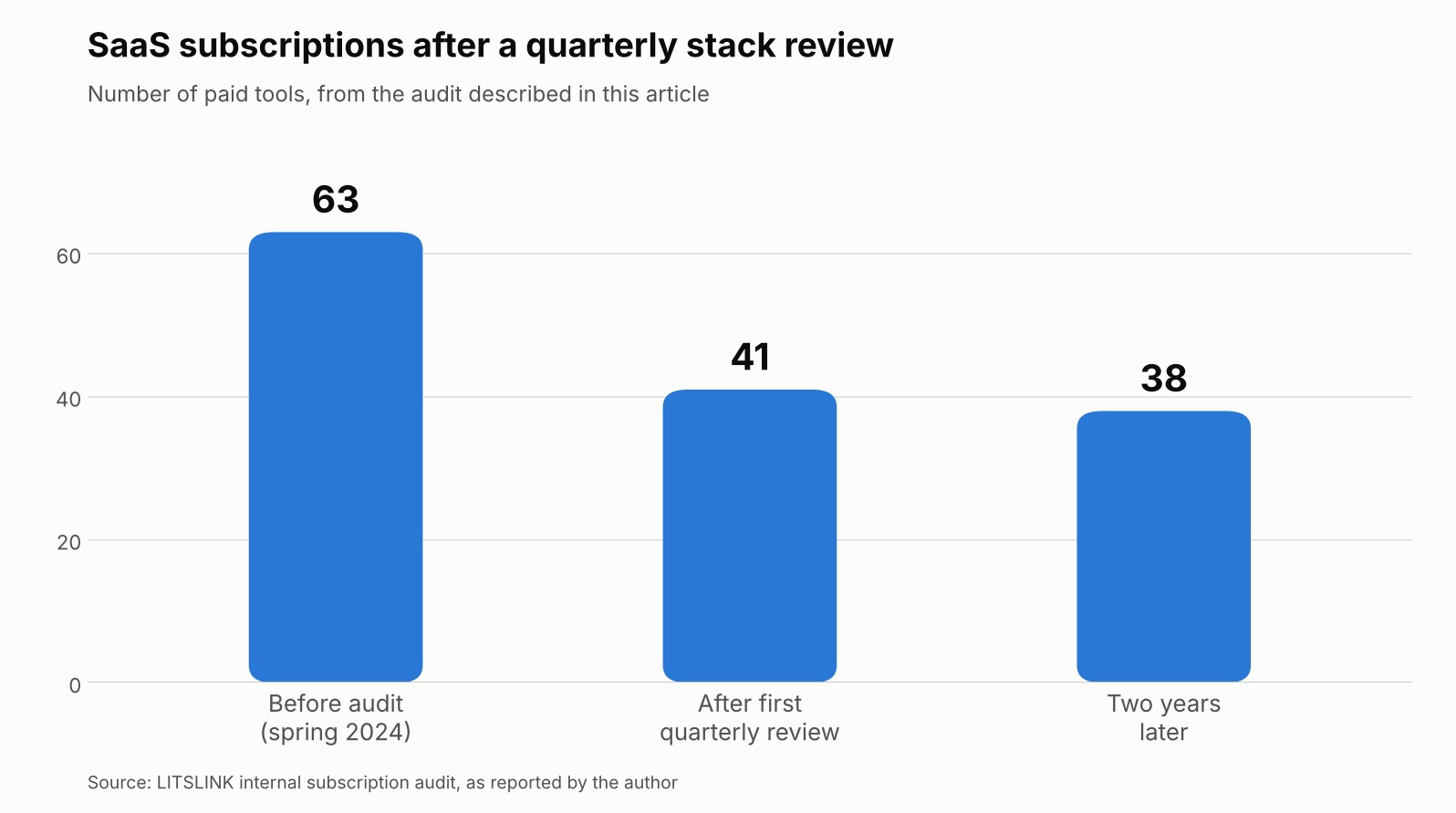
In the spring of 2024, our operations lead at LITSLINK pulled the company card statements and counted the subscriptions. The number was 63. Three of them did the same thing. Two had not been opened in a year. One was a whiteboard app a designer bought, loved, and abandoned when she switched teams.
Here is the thesis, stated plainly: SaaS tools raise productivity when they reduce the number of places a fact can live, and they lower it when they add one more. Every tool we kept after that audit passed one test. Every tool we cut failed it. We run a company of 300 or so people across the US and Europe on software we rent, and we build SaaS products for clients who sell software they own. Both sides of that experience point the same way.
We call the thing we measure the tool-to-truth ratio: the number of applications a team touches in a week, divided by the number of places that hold the authoritative version of a decision. Twelve to one is healthy. Twelve to nine means nine people will give you nine different answers about what shipped on Friday.
1. A SaaS tool earns its place when it becomes the only home for a status
Our biggest productivity gain over the last three years came from a boring decision. Project status lives in one tool. Not in Slack, not in a weekly deck, not in the PM’s head. If a client asks, “Where are we on the payment module?” the answer is a link, and the link is always to the same system.
Before that rule, a status question triggered a scavenger hunt. The engineer checked the ticket. The PM checked the thread. The account manager checked the last email. Then all three met to reconcile. We were paying senior people to act as a human cache for information that was already stored, badly, in four places.
The tool mattered less than the discipline around it. We have watched clients get the same result from Jira, from Linear, from a Notion database an office manager built in an afternoon. What the winning setups share:
- One record per piece of work, with one owner and one due date
- Status changed by the person doing the work, not by a manager after a meeting
- Comments on the record, not in chat, so the history survives the people
- A view a non-technical executive can read in under a minute
- No parallel tracker “just for the leadership team”
That last point is where most companies break the rule. A second tracker for executives looks harmless. Within a quarter it becomes the real one, and the ratio goes back to where it was.
2. Async handoffs beat time-zone overlap, but only if the tools make async honest
Our engineering teams sit mostly in Europe. Our project management and most of our clients sit in US time zones. On a good day the overlap is four hours. On a day with a holiday on either side, it can be zero. For years we treated that as a problem to be solved with earlier mornings in Kyiv and later evenings in Orlando.

It is not a problem. It is a constraint, and SaaS tooling is what turns it into an advantage. A task handed off at 6 pm Eastern with a written spec, a recorded five-minute walkthrough, and a clear definition of done gets picked up at 9 am in Europe and is often finished before the US team logs back in. The work follows the sun. The person who wrote the spec sleeps.
The catch is the word “written.” A Slack message saying “can you look at the login bug” is not a handoff. A ticket with reproduction steps, expected behavior, a screenshot, and a link to the relevant commit is one. Tools that make the second form the default (templates, required fields, linked records) quietly raise the floor on how well people communicate.
One internal rule sounds harsh and has saved more hours than any software purchase. If a handoff needs a meeting to explain, the handoff is not ready. Send it back.
3. The connections between tools recover more hours than any single tool does
Most companies evaluate SaaS tools one at a time. Does the CRM do what we need. Does the help desk. The question nobody asks at purchase time is how the CRM and the help desk will talk to each other, and that is where the productivity hides.
A few patterns from our own operations and from client projects:
A deal closing in the CRM should create the project, not a person. When a contract is signed, a workflow creates the workspace, assigns a PM, posts a kickoff template, and books the first client call. That used to cost an account manager about 45 minutes of clicking and a day of waiting. It now happens within seconds of the signature.
Support tickets that mention a bug should land in the engineering tracker on their own. We built this for a client’s support flow in 2025 with an off-the-shelf automation layer. Their support lead told us her team stopped keeping a private spreadsheet of “things engineering needs to know about,” which she had maintained for two years. Nobody asked her to. She did it because the tools did not talk.
Invoicing should read from time tracking, not from memory. Billing disputes drop sharply when invoice line items come from logged hours rather than being reconstructed at month end.
One caveat. We believe the integration layer is worth more than any individual tool in a mid-sized company’s stack. That is our inference from watching a few hundred projects, not a figure any vendor has published, and we have not run a controlled study on it. The pattern is consistent enough that we act on it anyway.
The data on how fragmented the workday has become is not subtle. Microsoft’s Work Trend Index special report, published in June 2025 from Microsoft 365 telemetry, found that employees are interrupted every two minutes during core hours, receive 117 emails and 153 Teams messages on an average weekday, and that meetings starting after 8 pm are up 16 percent year over year.
Every one of those numbers is a symptom of information people cannot find without asking someone. A status meeting exists because the status is not visible. A “quick sync” exists because two people are working from different versions of a plan. The honest promise of SaaS tooling is that visibility replaces the ask.
We tested this on ourselves. In late 2024 we moved project status, sprint goals, and client-facing risk logs into dashboards anyone in the company could open. Then we did the part most companies skip and deleted the weekly status meeting for every team whose dashboard was current. Not shortened. Deleted. Teams that let the dashboard go stale got the meeting back, a surprisingly effective motivator.
Our internal estimate was about three hours a week returned to each PM and roughly one to each engineer, a reported number rather than a measured one, since we did not run a formal experiment. The meeting count we can verify fell by just over a third for the delivery organization over two quarters.
Dashboards alone do not save time. Dashboards plus the will to cancel things save time. A company that adds the dashboard and keeps the meeting has added one more place to check.
“The more tools your team has, the more productive it becomes. Every new app is a capability you did not have before.”
That is the pitch, and every vendor makes a version of it. The data says the opposite past a fairly low threshold. Okta’s Businesses at Work 2025 report, based on usage across its customer base through October 2024, puts the average company at 101 distinct apps, with US companies at 114. Zylo’s 2025 SaaS Management Index, released in January 2025, found that organizations waste an average of $21 million a year on unused SaaS licenses, that spend per employee hit $4,830 (up 21.9 percent in a year), and that lines of business now control 70 percent of SaaS spend while IT controls 26.1 percent. Those are enterprise-weighted figures, but the direction holds at every size we have seen. A capability nobody adopted is a login, a bill, and one more place a fact can hide.
5. The stack needs an audit on the same calendar as payroll
The 63-subscription count from our own audit is not unusual, and it only captured what ran through the company card. The fix was not a dramatic purge. It was a recurring process that now runs every quarter, owned by operations, and takes half a day.
Each tool gets four questions. Who owns it. What decision or record lives only there. When was it last opened, by how many people. What would break if it disappeared on Monday. A tool with no owner is cancelled by default. A tool that duplicates another goes to a short fight between the two owners, and the loser migrates.
We dropped from 63 to 41 in the first pass. Two years later we are at 38 and holding. The subscription savings were real but not the point. A new hire now learns where things live in a week instead of a month, because there are fewer places for things to be.
Sprawl is not an event. It is what happens to any stack nobody is watching, at a rate of a few apps a quarter, each one bought for a good reason by a person who will not be there to cancel it.
When the off-the-shelf stack stops being enough and a company builds its own
Somewhere past 50 employees, or past the second core process no vendor handles well, a company stops configuring tools and starts wanting one that matches how it works. LITSLINK’s SaaS development services cover SaaS application and platform development on multi-tenant architecture, with API integration into the stack a client already runs, delivered by 300+ engineers on a cycle we put at 30 to 50 percent faster than typical. Projects start with a consultation and a milestone plan, and include data migration off whatever the client ran before.
Willo, a video interviewing platform we built, shows what a purpose-built product does that rented tools cannot. Co-founder and CEO Euan Cameron reported user growth of 150 percent month on month since launch and interviews in more than 40 countries. A livestock management app we built for an agriculture technology client is the less glamorous version of the same idea, a mobile and web product for farmers that uses shared herd data to improve yield. No general-purpose tool was going to do that out of the box.
The trigger for building is almost never “we want our own software.” The process that makes the company money runs in a spreadsheet because no vendor models it. The company pays for six tools to approximate one workflow. Or the data sits with vendors who each own a piece, and getting a single view back costs more than building one.
Here are the options side by side:
| Point SaaS tools | Integrated suite (one vendor) | Custom SaaS layer | |
|---|---|---|---|
| Upfront cost | Low, per-seat monthly | Moderate, bundled contract | High, a build budget |
| Fit to your process | Generic, you adapt to it | Generic but consistent | Built around the process |
| Data ownership | Fragmented across vendors | Centralized but vendor-locked | Yours, in your schema |
| Time to value | Days | Weeks to months | Months, then compounding |
| Who owns the roadmap | The vendor | The vendor | You |
| Best for | Under 30 people, standard work | Growing teams wanting one login | A core process no vendor models |
The custom row is not the default answer and we would be suspicious of anyone who says it is. For a 20-person office, point tools plus one integration layer wins on every line that matters. The custom layer earns its cost when the process it replaces is the one customers pay you for.
What to do now if you run a small or mid-sized business
- Count the subscriptions this week. Pull the card statements and expense reports, and ask department heads what they pay for personally. Expect double your guess.
- Name one system of record for project status and make everything else point to it. If leadership wants a separate view, build it as a filter on the real tracker, never as a second tracker.
- Write down the three handoffs that happen most often (sales to delivery, support to engineering, time tracking to invoicing) and automate the ones that are pure copying. Start with one.
- Delete one recurring meeting whose only purpose is to share status and replace it with a dashboard the attendees can open. Put the meeting back if the dashboard goes stale.
- Put a quarterly stack review on the calendar with an owner. Four questions per tool. No owner means cancelled.
- Only consider building when you can name the process no vendor handles and what it costs you each month. If you cannot name it, you are not there yet, and that is fine.
Where this is heading: fewer tools, more software sitting between them
The next few years will not be about adding another category of SaaS. The categories exist. What is changing is the layer between tools, which is moving from brittle automations to agents that can read a ticket, check a calendar, draft an update, and ask a human only when something is unusual.
Companies with a low tool-to-truth ratio today will get the most out of that shift. An agent that pulls from one source of record is useful. An agent that has to reconcile nine of them will be as confused as the humans were, only faster.
Our best guess, and it is a guess, is that the average company’s app count peaks around now and falls by the end of the decade, not because tools get worse but because a connecting layer makes half of them redundant. The businesses that start the audit this quarter will be ready for that. The ones that keep buying will do the cleanup in 2028 under worse conditions.
If you are weighing whether to configure, consolidate, or build, that is a conversation LITSLINK has every week, and we are happy to tell you when the answer is “do not build.”
Productivity is not the number of tools you own. It is the number of places you have to look.