
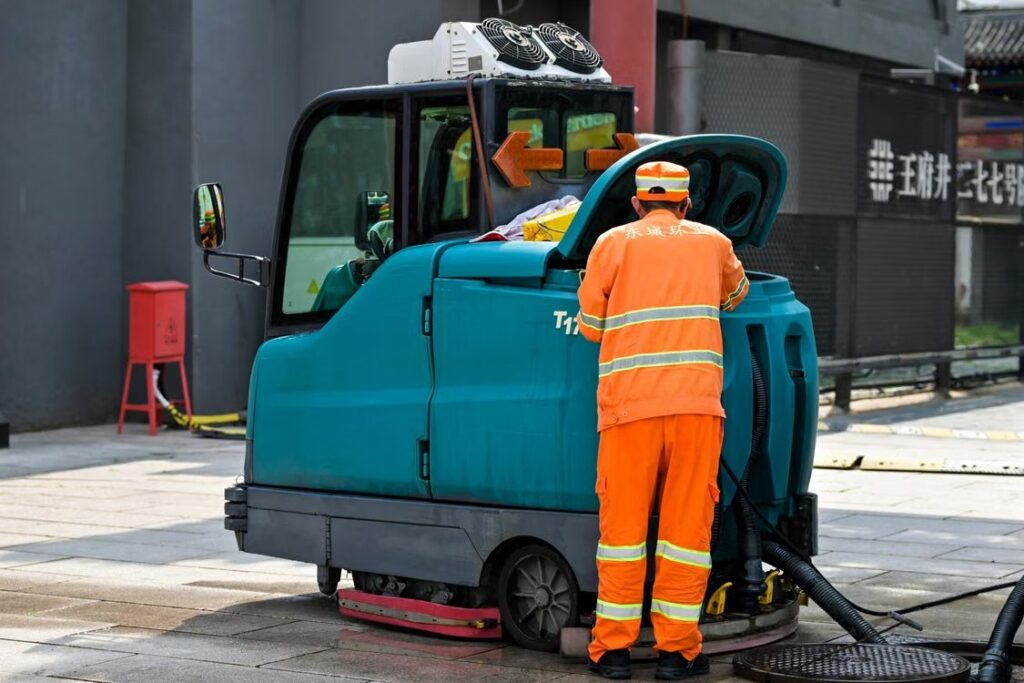
Choosing an auto scrubber for a large commercial space starts with the building, not the machine. A 100,000-square-foot warehouse requires a ride-on scrubber with a wide cleaning path, while a similarly sized office may need a smaller walk-behind model because desks, corridors, elevators, and meeting rooms reduce usable cleaning space.
The U.S. Bureau of Labor Statistics reports 2,432,600 janitors and building cleaners employed in 2025, with a median hourly wage of $17.71. Labor is a large enough part of cleaning operations that equipment productivity deserves to be evaluated as an operating-cost issue, not just an equipment specification.
This updated September 2026 guide explores the main auto scrubber options for large offices and commercial facilities, including how to compare cleaning capacity, machine size, operating costs, power requirements, and technology features before making a purchase.
Measure the Space
Start by separating the building’s hard-floor area from carpeted areas. Auto scrubbers are designed for hard surfaces, while commercial vacuums and extractors may be needed elsewhere.
Next, measure the areas where the scrubber will actually operate. Record the narrowest doorway, corridor, and elevator entrance, along with the width of aisles and the space around fixed furniture. These measurements can eliminate unsuitable machines before price becomes part of the discussion.
Calculate Usable Productivity
Manufacturers generally publish theoretical productivity figures. Those numbers are useful for comparing machines, but they should not be treated as the amount of floor an operator will actually clean during a shift. Use this calculation instead:
Usable productivity = advertised productivity × estimated utilization rate
The exact utilization rate will vary by building, so the best way to establish it is to conduct a timed test. Clean a representative section of the facility and record the actual area covered, including the time spent filling tanks, emptying recovery water, and moving between cleaning zones.
Choose the Machine Type
Walk-Behind
Walk-behind scrubbers are generally easier to maneuver through offices, schools, retail spaces, and healthcare environments where the floor plan is divided into smaller areas. They also tend to require less storage space than large ride-on machines.
Ride-On
Use ride-on scrubbers when large areas can be cleaned without frequent stops. Check the machine’s turning radius and total width before buying. A ride-on unit that cannot comfortably enter storage areas, elevators, or secondary corridors may require a second machine, reducing the expected return on the investment.
Autonomous
Autonomous scrubbers help support automated navigation and fleet management. They can be relevant for repetitive routes in large facilities, but they require a suitable environment and an operating plan that accounts for charging, route mapping, supervision, and maintenance.
Compare the Options
Below are a few examples to choose from:
Betco
Betco manufactures commercial floor-care equipment, including automatic scrubbers, burnishers, and floor machines. Its Stealth DRS32BT, for example, has a 32-inch cleaning path and advertised productivity of up to 55,000 square feet per hour. The broader commercial floor-scrubber market was valued at $4.3 billion in 2025, according to IMARC Group.
Product categories: Auto scrubbers, floor buffers and burnishers, and related floor-care equipment, with commercial vacuums, sweepers, and extractors available across the wider Betco cleaning range.
Pricing: Commercial machines are generally quote-based; buyers should compare purchase costs with rental or leasing and calculate labor and consumable costs per square foot.
Features: The range includes battery-powered machines and different walk-behind configurations; tank capacity, cleaning width, noise, and operator ergonomics vary by model.
Use cases: Suitable for offices, retail locations, schools, healthcare facilities, and other commercial spaces.
Buyer journey: Facilities managers typically prioritize fleet standardization and uptime; contractors may focus on productivity across contracts, while small businesses may favor compact equipment and lower capital costs.
Sustainability: Water and chemical consumption, battery efficiency, and cleaning-product compatibility should be compared when assessing the environmental impact of each machine.
Service and support: Buyers should confirm warranty coverage, replacement-part availability, local technicians, and financing or dealer-support options before purchasing.
Integration: Connected equipment and usage tracking can help larger facilities monitor machine utilization, maintenance, and cleaning schedules.
Pros: Highly advertised productivity; multiple floor-care configurations; low-noise options.
Cons: Larger models need more maneuvering space; pricing is generally quote-based; actual productivity depends on facility layout.
Nassco
Nassco provides commercial janitorial equipment, including robotic, rider, stand-on, and walk-behind scrubbers, burnishers, sweepers, vacuums, and extractors. Its floor equipment range spans multiple machine categories, while its LinkedIn profile lists the company as having 51 to 200 employees. For context, walk-behind scrubbers represented approximately 53.7% of the industrial and commercial scrubber market in 2025.
Product categories: Auto scrubbers, floor buffers and burnishers, commercial vacuums, sweepers and extractors, including robotic, ride-on, stand-on, and walk-behind equipment.
Pricing: Buyers can compare new purchases with rental and pre-owned equipment; cost-per-square-foot calculations help determine whether higher-capacity equipment offsets labor costs.
Features: Options include battery-powered scrubbers, different machine configurations, and varying tank capacities, cleaning widths, noise levels, and ergonomic designs.
Use cases: Equipment can serve office buildings, retail spaces, warehouses, healthcare facilities, schools, and multi-tenant properties, depending on machine specifications.
Buyer journey: Facilities managers may prioritize uptime and fleet consistency; janitorial contractors need equipment that works across contracts, while small businesses may prioritize affordability and maneuverability.
Sustainability: Buyers can compare water and chemical consumption, battery efficiency, and equipment designed for reduced resource use.
Service and support: Nassco provides equipment service and repair; buyers should confirm warranty terms, parts availability, technician coverage, and financing options for specific equipment.
Integration: Fleet-management and equipment-tracking capabilities can help larger operations monitor utilization, maintenance intervals, and equipment availability.
Pros: Broad floor-equipment selection; new, rental, and pre-owned options; equipment service and repair available.
Cons: A large selection can make comparison more complex; pricing varies by machine; service coverage should be confirmed by location.
Diversey
Diversey’s TASKI range combines commercial floor scrubbing with resource-management technology. Its ULTIMAXX system reports up to 40% more autonomy per charge and up to 76% lower water and chemical consumption through IntelliFlow. A 2024 study from the International Sanitary Supply Association found that 67% of cleaning professionals surveyed had sustainability initiatives in place, making resource efficiency an increasingly relevant equipment consideration.
Product categories: Primarily automatic scrubbers and related floor-care equipment, supported by Diversey’s wider commercial cleaning portfolio.
Pricing: Commercial equipment is generally quote-based; buyers should compare purchase, lease, and rental costs against cleaning labor and consumables.
Features: TASKI machines emphasize battery operation, automated controls, tank efficiency, noise management, and ergonomic operation, with specifications varying by model.
Use cases: Particularly relevant to office buildings, healthcare facilities, retail spaces, schools, and other facilities with recurring cleaning requirements.
Buyer journey: Facilities managers may value fleet efficiency and reporting; contractors can prioritize productivity, while smaller operators may prefer simpler machines.
Sustainability: Water and chemical reduction is a major focus, with TASKI’s IntelliFlow technology reporting up to 76% lower consumption.
Service and support: Warranty, parts, technician coverage, and financing depend on the local sales and service network.
Integration: Connected and automated cleaning technologies can support equipment utilization tracking and broader facility-management systems.
Pros: Strong water and chemical efficiency focus; multiple machine configurations; advanced operating technology.
Cons: More technology can increase complexity; commercial pricing is generally quote-based; some facilities may not need advanced features.
Minuteman International
Minuteman International produces commercial floor-care equipment ranging from compact walk-behind machines to ride-on scrubbers. The U.S. Department of Energy notes that commercial buildings account for approximately 18% of total U.S. energy consumption, making energy use an important consideration when evaluating powered cleaning equipment.
Product categories: Auto scrubbers, floor buffers and burnishers, sweepers, commercial vacuums, and other floor-care equipment.
Pricing: Pricing varies by machine and configuration; buyers can compare purchase costs with rental or leasing and calculate the cost per cleaned square foot.
Features: Includes battery-powered ride-on and walk-behind machines with different cleaning widths, tank capacities, and ergonomic requirements.
Use cases: Ride-on machines suit warehouses, retail floors, and other open areas, while smaller models work better in offices, schools, and tighter spaces.
Buyer journey: Facilities managers can prioritize fleet uptime; contractors may focus on productivity, while small businesses may favor compact equipment with lower acquisition costs.
Sustainability: Battery efficiency, water consumption, and chemical usage should be considered alongside cleaning productivity.
Service and support: Buyers should establish warranty terms, parts access, technician availability, and financing before committing to equipment.
Integration: Larger facilities can incorporate equipment-use data into fleet-management and maintenance systems where supported.
Pros: 51,666 sq. ft./hr. advertised productivity; 30-gallon solution and recovery tanks; range of machine sizes.
Cons: Large ride-on machines require substantial space; higher-capacity models are less maneuverable; dealer support varies by location.
Powr-Flite
Powr-Flite offers automatic scrubbers ranging from compact machines to larger commercial models. The U.S. Department of Energy notes that more than 90% of a typical building’s operating costs can be attributed to personnel and energy, reinforcing why equipment productivity should be considered alongside its purchase price.
Product categories: Auto scrubbers, floor buffers and burnishers, commercial vacuums, sweepers, and extractors across its commercial floor-care range.
Pricing: Smaller equipment may be sold through retail channels, while larger commercial machines are often quote-based; cost per square foot should include labor, consumables, and maintenance.
Features: Models vary between battery-powered and other configurations, with differences in cleaning width, tank capacity, noise, maneuverability, and operator ergonomics.
Use cases: Compact machines suit offices, schools, and retail areas; larger scrubbers are better suited to warehouses and expansive commercial floors.
Buyer journey: Facilities managers may focus on fleet reliability; contractors need versatile equipment for multiple sites, while small businesses may favor simpler, lower-cost models.
Sustainability: Battery efficiency, water consumption, chemical usage, and energy requirements should be assessed alongside cleaning output.
Service and support: Warranty coverage, parts availability, technician access, and financing options should be confirmed with the seller before purchase.
Pros: Wide range of machine sizes; compact options for restricted spaces; some models are available through retail channels.
Cons: Specifications vary considerably by model; larger machines may require distributor support; smaller models may lack the capacity for very large facilities.
Summary Comparison Table
| Entity | Pricing | Key feature | Best for | Limitation |
|---|---|---|---|---|
| Betco | Quote-based | Up to 55,000 sq. ft./hr. | Large commercial interiors | A 32-inch footprint may limit maneuverability |
| Nassco | Model and equipment dependent | Broad janitorial equipment range | Multi-equipment facility programs | Current availability and support should be confirmed |
| Diversey | Quote-based | Up to 76% water and chemical reduction | Resource-conscious facilities | More technology can mean more complexity |
| Minuteman International | Quote-based | 51,666 sq. ft./hr. theoretical productivity | Large open floors | A 1,578-lb ride-on configuration requires space |
| Powr-Flite | Model dependent | 31,215 sq. ft./hr. stated productivity | Medium-to-large spaces | Battery runtime requires charging planning |
FAQ
What size auto scrubber is best for a large office?
Measure the actual cleaning routes first. Large offices with open lobbies and long corridors may benefit from a wider machine, while furniture-dense layouts often favor a smaller walk-behind model. Doorway, elevator, and corridor dimensions should be checked before selecting the cleaning width.
Are battery-powered scrubbers better for offices?
Battery power generally makes indoor movement easier because the operator does not have to manage a power cable. The trade-off is charging infrastructure and battery maintenance. Compare the machine’s expected runtime with the length of the cleaning shift before deciding.
Should I buy, lease, or rent an auto scrubber?
Purchase tends to make more sense for predictable, long-term use. Leasing spreads the capital expense, while rental can suit temporary projects or uncertain demand. Compare all three against expected labor, maintenance, consumables, and downtime rather than comparing only the monthly payment.
Endnote
The best auto scrubber will fit the facility’s measurable operating conditions. Start with floor area and access constraints, calculate usable productivity, compare total cost per square foot, and then evaluate service and technology requirements. That process gives facilities managers a defensible purchasing decision instead of relying on the largest capacity figure or the lowest upfront price.