
Are you facing challenges in managing vast amounts of business data? This article breaks down enterprise content management into simple core concepts, benefits, and best practices. Readers will learn how to define ECM systems, evaluate their advantages, and address common hurdles in implementation. By focusing on clear insights, the article targets issues that many business owners encounter while managing office content efficiently.
Define Enterprise Content Management and Its Core Concepts
The content examines components of enterprise content management systems, key functions of content solutions, and the role of digital asset management in ECM. It also investigates how automation streamlines content processes, highlights compliance and security issues, and discusses integration benefits with existing systems. Practical insights include vendor support, accounting practices, strategy refinement, artificial intelligence, and adoption challenges.

Understand the Components of Enterprise Content Management Systems
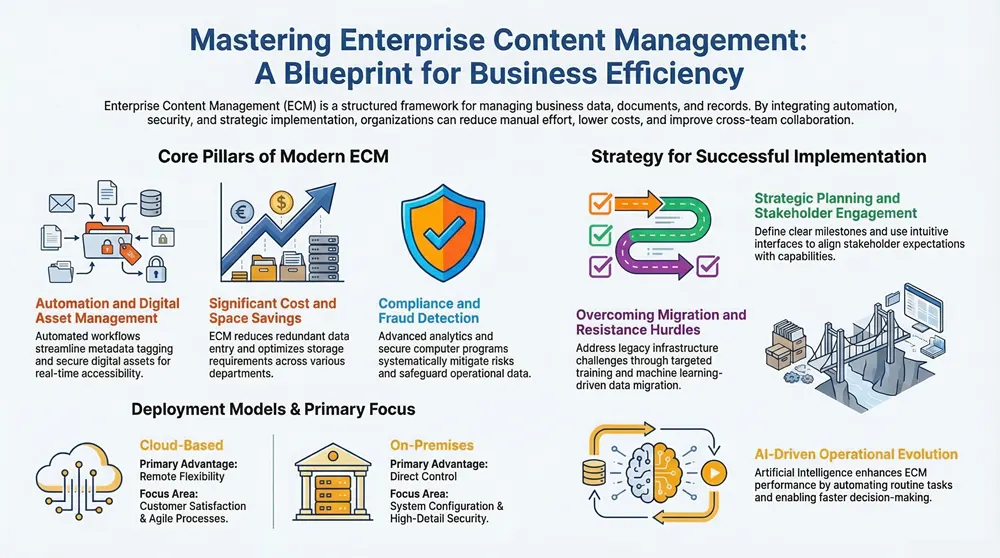
The components of enterprise content management systems offer a structured way to manage data, documents, and records while maintaining expense tracking and monitoring customer service interactions. The integration of automated workflows with core modules enables businesses in manufacturing and related sectors to improve efficiency and optimize processes, such as managing data from furnaces used in industry operations.
Modern content management systems incorporate secure modules that support practical functionalities for customer service teams and production facilities alike. The system’s design ensures that automated workflows reduce manual effort and lower expense, which proves beneficial for organizations that rely on manufacturing processes, including the maintenance of furnaces and other industrial equipment.
Identify the Key Functions of Content Management Solutions
The key functions of content management solutions provide efficient handling of data entry, streamlining workflow processes while balancing cost and space requirements. This approach uses practical examples like integrating salesforce systems to track customer interactions, ensuring that every sensor reading and document update is captured accurately for improved operational efficiency.
These solutions also offer advanced capabilities designed to reduce redundant data entry tasks, thereby lowering cost and better managing space utilization across various departments. With hands-on expertise, businesses can deploy such systems to monitor sensor data in manufacturing environments, aligning content management with overall strategic goals and operational practices.
Explore the Importance of Digital Asset Management in ECM
Digital asset management in ECM plays a significant role by ensuring assets such as pdf files are securely stored and readily available for operational needs. This system integrates backup features to protect essential data and supports accessibility improvements, thereby reducing downtime and ensuring smooth production operations fueled by real-time data.
Incorporating durable metal security measures offers a robust framework that balances physical protection with digital oversight. Such integration fuels operational resilience by aligning backup protocols with accessibility standards that support overall content management strategies effectively.
Investigate the Role of Automation in Content Processes
The role of automation in content processes significantly improves operational efficiency by integrating advanced functionalities within a system that optimizes tasks related to metadata management and tag assignments. Business owners with extensive experience in managing office equipment can observe reduced manual effort and improved precision with automation tools that easily incorporate sap data for real-time updates.
Automation platforms streamline repetitive tasks while ensuring that digital files are accurately processed and securely archived. Experts appreciate how these automated workflows automatically tag new documents with accurate metadata, enabling smoother transitions and more effective management of office processes.
Learn About Compliance and Security in Content Management
Organizations benefit from robust compliance and security measures in enterprise content management when a computer program systematically detects and mitigates risks such as fraud. The integration of web content management capabilities with advanced analytics enhances data protection and maintains process integrity for all departments.
Experts recommend ensuring that content management systems enforce strict compliance protocols to deter fraudulent activities and secure sensitive files. By applying targeted analytics and leveraging the system’s secure computer program, the organization effectively tracks web content management activities and safeguards its operational data.
Examine the Benefits of Integration With Existing Systems
The integration of enterprise content management with existing systems streamlines the process to ship documents and data safely using advanced machine technology. This integration benefits users by combining cloud computing with document management systems, resulting in smoother workflows and reduced operational interruptions.
Combining new and established systems allows organizations to use automated workflows that connect current technology with document management systems. This approach helps synchronize operations, ensuring that each machine component works effectively with cloud computing solutions to improve overall performance.
Analyze the Benefits of Implementing ECM Solutions

This section evaluates how ECM improves team collaboration, boosts information retrieval, and elevates customer service using business software features. It reviews cost savings in invoice processing and optical mark recognition, enhances server performance, reduces greenhouse gas emissions, and supports better decision-making while streamlining operations for a well-organized content management system.
Assess How ECM Improves Collaboration Across Teams
Enterprise content management improves collaboration by streamlining information sharing among teams, making it easier for departments to remain aligned during complex projects like carburizing processes. The system supports real-time updates that ensure each team member receives timely and accurate learning and patient data, ultimately conserving energy by reducing redundant work.
The automated workflows within ECM contribute to smoother communication, enabling teams to access secure information that is critical for operations. This efficiency aids in maintaining consistent patient care standards and supports process improvements in areas such as carburizing, where precise and timely updates drive better overall performance.
Discover Ways ECM Enhances Information Retrieval and Access
Enterprise content management systems significantly improve information retrieval by syncing a document management system with advanced indexing capabilities, ensuring that essential data and paper records are seamlessly accessible. This approach helps companies align with the general data protection regulation while staying competitive in the magic quadrant by offering precise and quick access to critical files.
The integration of a robust document management system minimizes manual handling of paper, streamlining retrieval and archiving practices across departments. With an automated setup, organizations can effectively manage data, driving operational efficiency and compliance while reducing the time spent troubleshooting access issues.
Evaluate Cost Savings Associated With Effective Content Management
Effective content management delivers considerable cost savings through streamlined web content processes. With well-organized ecm records and a dedicated directory for centralizing information, businesses experience improved user experience that reduces the need for manual data processing, as supported by insights found in a detailed white paper.
Cost reduction is also realized by automating repetitive tasks and simplifying archival procedures that directly boost operational efficiency. Expert analysis shows that leveraging accurate ecm records and comprehensive directories not only cuts expenses but also enhances user experience while ensuring faster retrieval of essential web content.
Recognize the Impact of ECM on Operational Efficiency
Enterprise content management provides notable improvements in operational efficiency by streamlining audit processes and easing the pressure associated with data handling. Integrating mobile device capabilities and enterprise information management systems, the implementation of ECM leads to faster processing times and reduced manual intervention.
Organizations experience smoother operations as ECM minimizes downtime during audits and lessens pressure on staff related to data retrieval and document updates. The practical implementation of automated workflows enhances overall efficiency, ensuring that processes remain steady despite demanding operational challenges.
Identify How ECM Supports Better Decision-Making
Enterprise content management supports better decision-making by integrating advanced optical character recognition capabilities that simplify data entry and improve accuracy. The system’s robust access control and real-time internet connectivity allow a client to retrieve essential records efficiently, ensuring clear, actionable insights.
ECM also utilizes a crystal-clear data indexing process to organize information, thereby facilitating smoother analysis and planning. This organized framework assists a client in making informed choices by providing timely updates and improving overall operational transparency.
Understand the Role of ECM in Customer Service Improvement
Enterprise content management systems improve customer service by providing seamless integration with enterprise search technology, streamlining interactions between support teams and customer data. These systems also integrate with enterprise resource planning tools, including solutions provided by ibm, ensuring that governance protocols align with overall service delivery and can be referenced in an ebook for training purposes.
The structured organization of content supports prompt retrieval of critical customer information, reducing response times and minimizing errors. This integration of automated workflows and governance standards reinforces a clear framework for addressing customer inquiries while enhancing efficiency.
Explore Different Types of ECM Systems Available
The discussion covers cloud-based versus on-premises solutions, industry-specific systems for unique needs, open-source versus proprietary options, scalability analysis, and key market players. It also examines technologies behind ECM systems, ensuring a workforce focused on carbonitriding, computer, and knowledge management improvements that elevate customer experience and operational efficiency.
Compare Cloud-Based Versus on-Premises Content Management Solutions
Cloud-based management solutions provide flexibility for remote work, ensuring smooth interactions and boosting customer satisfaction. With robust data security and regular system updates, these systems attract attention from businesses that require agile processes, even in environments where sintering operations play a crucial role.
On-premises content management offers direct control over system configurations to assure data security while meeting precise operational needs. By allowing tailored setups that address specific challenges, such as monitoring sintering and ensuring constant customer satisfaction, these systems cater effectively to organizations seeking high attention to detail and reliability in remote work scenarios.
Review Industry-Specific ECM Solutions for Unique Needs
The review of industry-specific ECM solutions reveals tailored content management systems designed to handle electronic document processing and precise data extraction in sectors such as manufacturing and logistics. European organizations benefit from streamlined workflows that match their unique operational needs, resulting in improved efficiency and accountability in document management.
Specialized solutions address diverse industry challenges by integrating robust functionalities with essential tools for electronic document storage and retrieval. These systems offer companies a reliable way to manage data extraction processes, ensuring that content management systems deliver seamless workflow integration suitable for Europe’s regulated markets.
Highlight Open-Source vs Proprietary Content Management Systems
Open-source content management systems provide flexibility and community-driven improvement, allowing users to modify software based on specific classification needs. Business owners often favor these systems as they offer cost-effective and scalable ECM solutions suitable for various industries, including scenarios like managing electric vehicle data and refining policy details in health insurance sectors.
Proprietary content management systems offer dedicated support and established frameworks for organizations seeking robust security and functionality. These ECM solutions guarantee reliability and robust integration that benefit companies dealing with regulatory policy requirements, electric vehicle information tracking, or streamlined health insurance record management.
Analyze the Scalability of Various ECM Options
The scalability of various ECM options reflects an ecosystem that adapts to changing business demands while maintaining robust software performance. Business owners experience seamless growth under clear regulation frameworks and benefit from the integration of intelligent character recognition to drive data accuracy under a unified umbrella of solutions.
Scalable ECM solutions empower organizations to expand their document management capabilities without disrupting current operations. By incorporating flexible software that aligns with industry regulation and supports intelligent character recognition, enterprises establish a secure ecosystem that nurtures ongoing operational efficiency under one comprehensive umbrella.
Examine Key Players in the ECM Software Market
Industry leaders in ECM software offer robust solutions that streamline electronic data interchange and improve archive management. These key players stand out with a proven brand reputation, making them reliable partners for businesses seeking efficient electronic countermeasure features combined with advanced integration for electronics management.
Experts note that prominent ECM vendors continuously innovate to address modern challenges, ensuring businesses receive practical examples and actionable insights in areas such as digital archive security and seamless electronic data interchange. Their ability to incorporate robust electronic countermeasure protocols and maintain a strong market brand gives organizations confidence in selecting solutions that balance efficiency and security.
Discuss the Technologies Behind Advanced ECM Systems
Advanced ECM systems integrate technologies such as xml for data interchange and robust taxonomy frameworks to organize digital library assets efficiently. This approach supports streamlined inventory management by enabling clear classification and secure storage of essential content.
Modern ECM solutions also utilize automated tools that manage asset indexing and apply preset taxonomy rules across digital libraries. These systems help organizations maintain accurate inventory records while offering reliable access to critical data during regulatory audits.
Implement Best Practices for Successful ECM Deployment
This segment covers a strategic plan for ECM implementation, stakeholder engagement, effective training for end users, performance metric monitoring, user feedback incorporation, and regular system updates. Insights benefit human resources, content management solutions, and search engine optimization, addressing issues from vehicle performance to electromagnetic interference for a practical, efficient ECM process.
Develop a Strategic Plan for ECM Implementation
The strategic ECM plan outlines clear milestones to implement a robust management system that supports scalability and integrates business intelligence tools for efficient data processing. The plan assists organizations to manage critical content streams that enhance customer experiences and improve overall operational performance.
Expert teams design actionable strategies for ECM deployment by focusing on system integrations and aligning processes with operational goals. This approach leverages scalability features and advanced management systems, ensuring that business intelligence insights drive decisions that benefit customer service and streamline content handling procedures.
Engage Stakeholders During the Content Management Process
Engaging stakeholders during the digital content management process requires clear communication of ECM benefits through an intuitive interface and strict control measures like version control. Industry experts often employ robotic process automation to help stakeholders grasp the efficiency improvements achieved with this approach, aligning expectations with operational capabilities.
Effective engagement involves providing actionable insights that relate version control and control safeguards to everyday business needs in digital content management. By incorporating hands-on examples with a robust interface and utilizing robotic process automation, organizations empower stakeholders to participate in the implementation process, directly addressing their challenges and promoting smooth transition.
Create Training Programs for End Users of ECM Systems
Training programs for end users of ECM systems provide clear instructions and hands-on examples, ensuring users understand key components such as renewable energy initiatives and contract management. The process equips business teams with the tools required to streamline business processes and improve the overall image of organizational data handling.
Experts design these programs with actionable tasks that guide users through everyday scenarios, integrating practical examples related to contract management and renewable energy projects. Each session emphasizes the value of precise documentation and efficient workflows to build proficient skills in managing daily business processes.
Monitor Performance Metrics to Assess ECM Success
The performance metrics in an ECM system provide clear indicators of operational efficiency. By tracking usability and database interactions, businesses can tailor their business model to address specific pain points and harness actionable insights that support overall success.
Continuous monitoring of performance metrics enables teams to pinpoint weaknesses and quickly adjust strategies. With firsthand expertise, experts advise leveraging essential data drawn from an ECM system to enhance usability and align the business model with long-term goals.
Incorporate User Feedback to Refine ECM Practices
Stakeholders provide valuable research insights that help refine ECM practices by addressing user needs and challenges during onboarding. Feedback gathered from experience with tools like Microsoft Office and Opentext supports a data-driven approach to tweak systems, ultimately boosting operational efficiency.
Industry experts use user feedback to improve system interfaces and guide process adjustments. Actionable insights derived from research and direct user experience ensure that ECM practices evolve consistently with the demands of onboarding and overall operational efficiency.
Regularly Update Systems to Keep Pace With New Requirements
Regular system updates ensure that an ecm platform remains effective by adapting to evolving customer relationship management techniques and shifting digitization trends. Modern updates provide a single source of truth that aids organizations in monitoring behavior and streamlining document management tasks. These proactive measures help maintain reliable data access and operational integrity in a dynamic business environment.
Frequent system reviews allow businesses to adjust their ecm platform to address emerging requirements and secure an efficient customer relationship management strategy. Timely updates support a single source of truth that reinforces data accuracy and adapts to new digitization initiatives while monitoring user behavior. This approach results in enhanced system performance and a sustainable framework for addressing ongoing industry demands.
Assess Challenges in Enterprise Content Management Implementation
This section identifies common hurdles during ECM adoption. It analyzes organizational resistance, evaluates data migration challenges, and examines integration issues with legacy systems. The discussion also reviews compliance and regulatory standards, while exploring practical solutions to improve information management. A clear view of product lifecycle considerations and investment in document management software prepares stakeholders for a smoother ECM project experience.
Identify Common Hurdles Faced During ECM Adoption
Some organizations encounter difficulty when implementing enterprise content management systems due to challenges in adapting legacy infrastructure to a modern cloud setup. These challenges impact knowledge workers who rely on efficient document imaging tools, and can disrupt workflows similar to issues experienced when a compressor fails in an industrial warehouse setting.
Stakeholders often face obstacles such as resistance to change and inadequate integration with existing systems, which can hinder the performance of a cloud-based ECM solution. Practical insights suggest that addressing these hurdles promptly can support knowledge workers and improve document imaging processes, ensuring that even complex operations in a warehouse run smoothly.
Analyze Resistance to Change Within Organizations
Organizations often show reluctance in adopting an ecm solution due to the shift from traditional methods to modern management systems that incorporate hybrid environments and cloud storage. Resistance may build when teams perceive that operational processes become overly complex or generate unnecessary heat, resulting in slower adaptation to new workflows.
Industry experts note that such challenges can be mitigated with clear communication and targeted training on the benefits of hybrid systems and cloud storage. Practical examples from successful integrations of ecm solutions illustrate that addressing resistance swiftly can lead to smoother transitions and improved operational performance.
Evaluate the Importance of Data Migration in ECM Projects
Data migration in ECM projects holds great significance as it underpins a contract-based approach to integrating new systems with legacy data. Organizations benefit from machine learning techniques that streamline data transfer, ensuring that industrial furnace records and other vital documents are accurately migrated, which a recent gartner report emphasizes as a critical innovation for process stability.
Successful data migration not only reduces downtime during system transition but also reinforces a secure foundation that supports long-term ECM success. Practical examples from expert teams demonstrate that a robust migration plan can facilitate the seamless incorporation of machine learning and other advanced tools into the overall strategy, thereby strengthening contracts and operational efficiency.
Discuss Integration Challenges With Legacy Systems
Integrating legacy systems with modern ECM solutions presents several challenges that often require careful alignment of data formats such as spreadsheet outputs with new frameworks. The process demands precise mapping to ensure the truth of accumulated information, reducing risk during system transitions and improving interoperability between different platforms.
Legacy systems sometimes lack support for community-based integration standards, which complicates the incorporation of advanced ECM tools. Addressing these issues requires experts to implement clear protocols that facilitate interoperability, manage spreadsheet data more effectively, and ultimately safeguard operational truth to minimize risk.
Review Issues Related to Compliance and Regulatory Standards
Companies face challenges in ensuring compliance and regulatory standards while managing unstructured data and enforcing robust data governance practices. Expert teams implement solutions that track the receipt of documents and verify authenticity using digital signature protocols to maintain system integrity.
Organizations integrate strict policies to address compliance issues, combining energy conservation practices with advanced data governance frameworks. This approach ensures that automated processes secure all data, including unstructured data, while providing verifiable receipts and secure digital signatures to support operational reliability.
Explore Solutions for Overcoming ECM Implementation Issues
Experts suggest integrating a comprehensive automation tool designed to handle ECM implementation issues. The approach supports clear language settings and ensures that every transaction is logged with an accurate audit trail, which is critical when managing electronic signature protocols and streamlining processes.
Industry specialists recommend leveraging advanced automation to overcome ECM challenges, reinforcing system reliability through detailed audit trail records. This solution embraces a precise language framework and includes robust features like electronic signature support, making it an effective tool for mitigating implementation difficulties.
Predict Future Trends in Enterprise Content Management
Experts analyze the influence of artificial intelligence on enterprise content and digital transformation, including its impact on accounts payable processes and compliance with the health insurance portability and accountability act. They also assess remote work, mobile access, emerging technologies, data privacy trends, and sustainable practices, all while addressing industry challenges like managing furnace data effectively.
Examine the Influence of Artificial Intelligence on ECM
Artificial intelligence is reshaping the evolution of the content management system by delivering advanced data processing and real-time analytics tailored to business needs. The integration of AI benefits a company by improving the performance of ecm software, enabling faster decision-making, and automating routine tasks associated with digital documentation and equipment management.
AI-powered solutions also offer improved functionality by simplifying the use of api connections for seamless integration with other business systems. This advancement not only boosts operational efficiency but also ensures reliable performance, addressing common pain points faced by organizations transitioning to modern ECM systems.
Consider the Impact of Remote Work on Content Management
Remote work has reshaped content management by driving the shift toward a paperless office, where systems like SharePoint integrate seamlessly to support secure document storage and collaboration. This transition not only boosts overall productivity but also streamlines risk management by providing clear audit trails and real-time updates essential for managing operational challenges.
Organizations adapting to remote work environments benefit from unified platforms that simplify content distribution, including the generation of a press release that communicates changes effectively. By leveraging tools designed for a paperless office, companies enhance productivity and mitigate risk through improved control over data integrity and accessibility.
Investigate the Role of Mobile Access in Future ECM Solutions
Mobile access plays a significant role in future ECM solutions by providing users with real-time visibility into digital asset management and file format compatibility across diverse platforms. Experts note that modern mobile applications integrate seamlessly with existing infrastructure, ensuring that operational data remains accessible even during remote work and maintenance of equipment such as vacuum furnaces.
The practical design of these mobile solutions supports improved content control by allowing efficient tracking of digital assets and precise handling of various file formats. This capability empowers organizations to maintain smooth processes while enhancing operational oversight, which is critical when managing specialized equipment and ensuring a robust infrastructure.
Analyze Emerging Technologies Shaping the Future of ECM
Emerging technologies are reshaping ECM by streamlining document handling and simplifying business processes, which supports both marketing efforts and operational efficiency. Innovations in digital systems and improved brazing techniques offer practical examples of how ECM can modernize supply chain management while ensuring reliable document processing.
New technological integrations in ECM provide actionable insights that enhance business workflows and marketing strategies, ensuring that document management meets today’s advanced requirements. The convergence of improved digital tools, sophisticated brazing automation, and seamless supply chain management proves invaluable in delivering secure and efficient content solutions.
Explore the Trend of Increased Focus on Data Privacy
Enterprise content management professionals recognize a growing emphasis on data privacy as a key trend, particularly in platforms that integrate optical disc storage and modern knowledge-sharing tools. This focus supports secure, compliant solutions designed to enhance collaboration and protect information across a content management platform.
Industry experts stress that robust data privacy measures are critical for maintaining enterprise content management integrity in today’s digital landscape. By incorporating detailed policies and practical examples, organizations reinforce user trust while leveraging enhanced collaboration features and optical disc technology to secure sensitive knowledge.
Discuss Sustainable Practices Within Content Management
The evolution of sustainable practices in content management is evident in advancements in digital asset management and streamlined data management approaches. Experts in Germany highlight how companies benefit from integrated invoice processing systems that conserve resources while promoting efficient document handling.
Industry leaders advocate for sustainable content management by combining real-time digital asset management with automated workflows to reduce material waste and energy use. This approach ensures that data management systems remain agile and cost-effective, supporting organizations in achieving long-term operational and environmental goals.
Conclusion
Understanding enterprise content management establishes a framework that organizes data and streamlines business operations. The system efficiently integrates automated workflows, secure modules, and digital asset management to enhance productivity. It supports compliance, accurate data retrieval, and seamless integration with existing systems. This deep understanding empowers organizations to optimize processes and realize critical operational and cost-saving benefits.